Filipino travel writers who’ve island-hopped across all three major island groups, from the peaks of Luzon to the reefs of Mindanao, and field-tested connectivity in the places where “No Service” actually costs you a booking.
Nothing kills the buzz of landing in the Philippines faster than that little “No Service” icon at the top of your screen. You’ve just cleared immigration at NAIA or Mactan-Cebu, your Grab app won’t load, your hotel booking is buried in an email you can’t open, and the airport Wi-Fi wants your life story before it’ll give you five minutes of connection.
I’ve been down that road more times than I’d like to admit while exploring these islands. And after testing my share of connectivity options, one question keeps coming up from readers planning their trip: which travel eSIM should you actually use here?
The short answer: Ubigi. The longer answer, and why it beats the pile of near-identical eSIM apps out there, is what this guide is all about.
Is Ubigi the Best eSIM for the Philippines?
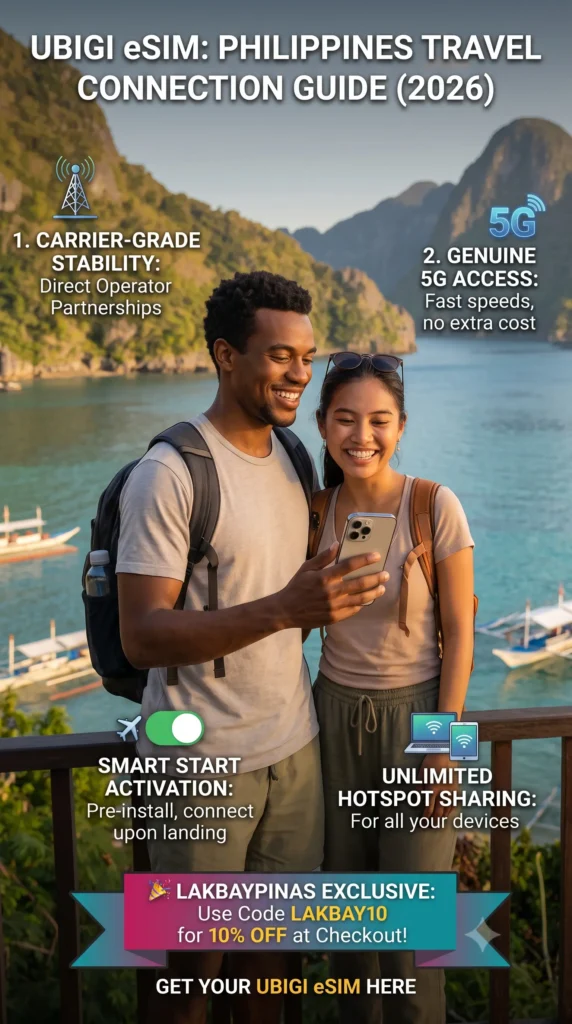
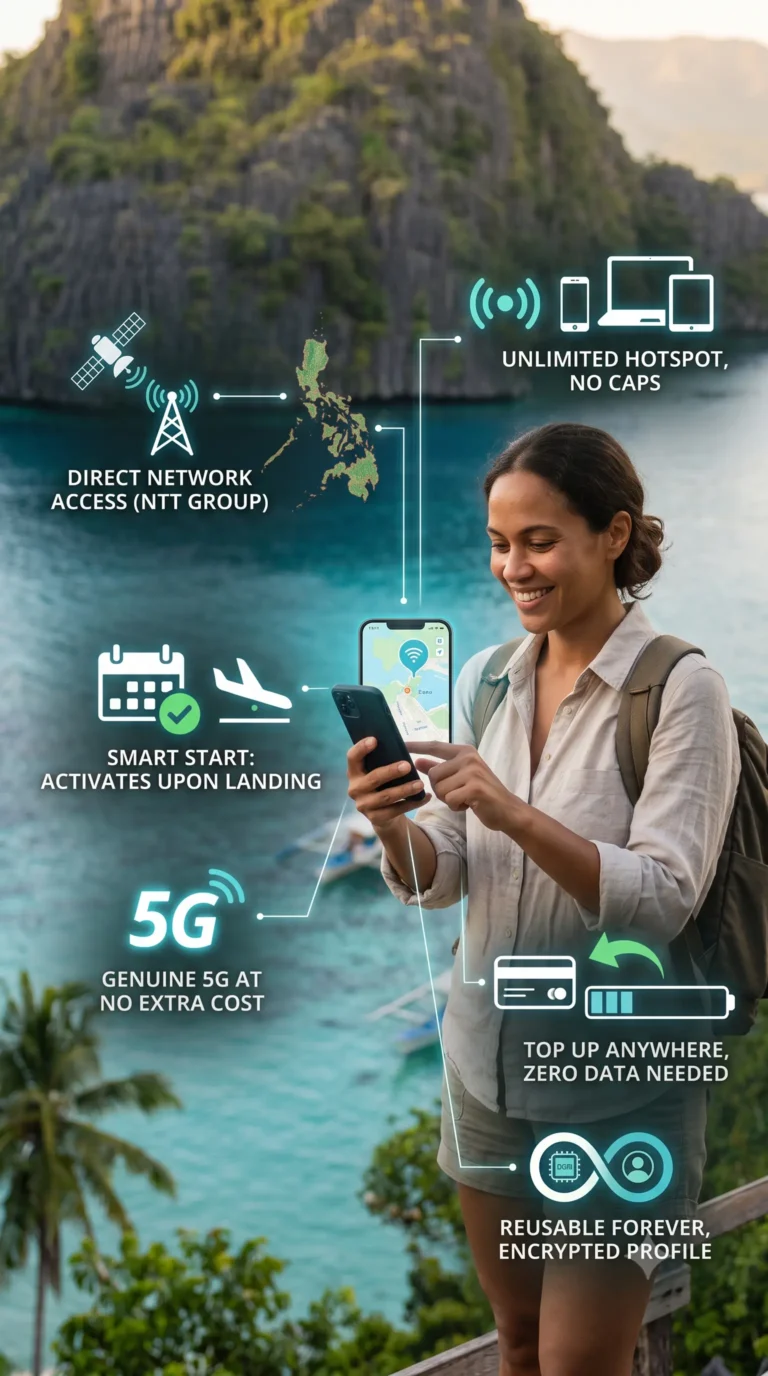
For most travelers, yes. Ubigi is the top eSIM pick for the Philippines in 2026 because it runs on its own carrier-grade network infrastructure (through parent company Transatel, part of Japan’s NTT Group), partnering directly with local operators rather than reselling someone else’s roaming deals. That translates to more stable coverage, genuine 5G at no extra cost where available, Smart Start activation that only counts down when you land, and unrestricted hotspot sharing. Plans start at around $4, and you can install everything before you even leave home.
If you just needed the verdict, there it is. But let me show you the why, because the reasons Ubigi stands out are exactly the reasons a cheap random eSIM can leave you stranded in Palawan with a dead connection.
LakbayPinas Exclusive: Use code LAKBAY10 at checkout for 10% off your first Ubigi purchase. → Get your Ubigi eSIM here
Table of Contents
First, What Actually Is an eSIM (and Why You Want One Here)?
An eSIM (embedded SIM) is a digital SIM card already built into your phone. Instead of hunting for a kiosk at the airport, queuing to register a physical SIM under the SIM Registration Act, and swapping tiny plastic cards with a paperclip, you simply download a data plan straight to your device.
For a country like the Philippines, spread across 7,000+ islands with travel that bounces between Manila, Cebu, Bohol, Siargao, and Palawan, the appeal is obvious. You keep your home number active for calls and OTPs, you avoid brutal roaming fees, and you land already connected. The best part is that most phones from the last five years, iPhone XR and newer, recent Samsung Galaxy, and Google Pixel models, already support it.
Quick compatibility check: dial *#06# on your phone. If an EID number appears, your device is eSIM-ready.
Why Ubigi Is the Best eSIM for the Philippines
Here’s where the near-identical eSIM apps separate from the ones worth your money. Most travel eSIM brands are essentially middlemen. They buy wholesale roaming access and resell it to you through a nice app. Ubigi is different, and that difference is its single strongest selling point.
1. It OwnsInfrastructure (This Is the Big One)
Ubigi is operated by Transatel, a French telecom company that is itself a full Mobile Virtual Network Operator, and Transatel is owned by the NTT Group, one of the largest telecom companies on the planet and a Fortune Global 500 heavyweight.
Why should you care about corporate ownership on your beach trip? Because it means Ubigi runs much of the underlying infrastructure and holds direct relationships with local carriers rather than buying access third-hand. In practice, reviewers consistently find this shows up as more consistent, more stable performance and fewer dead zones than the reseller crowd. When you’re relying on Google Maps to find a jump-off point for a hike or navigating unfamiliar provincial roads, that reliability isn’t a luxury, it’s the whole point.
In the Philippines, Ubigi connects you to the major local networks, so you’re riding real domestic infrastructure, not a watered-down roaming signal.
2. Smart Start: Buy Now, Activate When You Land
This is one of my favorite features and something surprisingly few competitors get right. With Ubigi’s Smart Start, your plan’s validity period doesn’t begin the moment you buy it. It starts counting down only when you arrive in the Philippines and your phone first connects to a local network.
That means you can install and set up your eSIM a week (or up to six months) before you fly, on your comfortable home Wi-Fi, and not lose a single day or megabyte of your allowance. Land, flip on your Ubigi line, and you’re online before you reach the baggage carousel. No scrambling for airport Wi-Fi, no QR-code panic in the arrivals hall.
3. Genuine 5G at No Extra Cost
Ubigi includes 5G access in 60+ destinations at no additional charge wherever the local network supports it. In Metro Manila, Cebu City, and other urban centers with solid 5G rollout, that means fast enough speeds for uploading reels, video calls home, streaming, and working online without lag. You’re not paying a premium tier for it; if 5G is available, you get it.
4. Unlimited Hotspot Tethering (No Sneaky Caps)
If you travel with a laptop, a partner, or a group, this one matters a lot. Ubigi lets you share your data via hotspot with no daily cap. Compare that to some big-name competitors that throttle or cut off tethering after a set amount per day. For a digital nomad working from a café in Siargao or a couple sharing one plan across two phones, uncapped hotspotting is a genuine money-saver.
5. Top Up Anywhere, Even With Zero Data Left
Run out of data mid-trip on a remote island like Palawan? Ubigi gives you free access to its app specifically so you can recharge without needing an existing connection or Wi-Fi first. You buy more data and you’re instantly back online. It’s a small touch that solves a very real “stranded with no signal” problem.
6. Reusable Forever, Encrypted, and Secure
Install the Ubigi eSIM profile once and it’s yours for life. Next time you travel, to the Philippines again or anywhere among 200+ destinations, you just open the app and buy a new plan. No reinstalling, no new QR codes. On top of that, your data connection is encrypted, which makes it far safer than logging into public airport, mall, or hotel Wi-Fi.
Ubigi Philippines Plans & Pricing (2026)
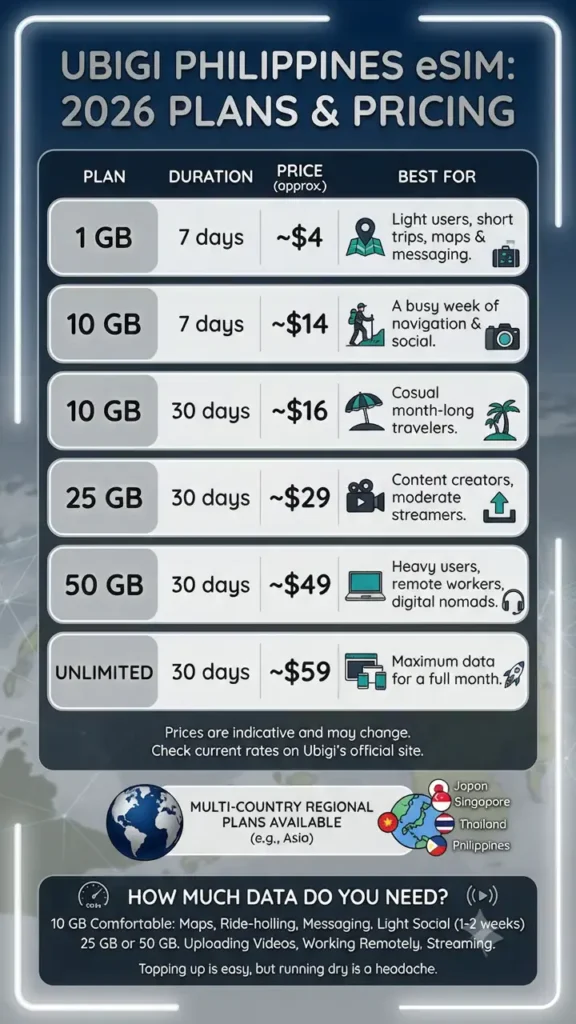
Ubigi offers flexible, prepaid, one-off data plans sized for everything from a weekend getaway to a month of island-hopping. Here’s a representative snapshot of the Philippines lineup:
| Plan | Duration | Price (approx.) | Best for |
|---|---|---|---|
| 1 GB | 7 days | ~$4 | Light users, short trips, maps & messaging |
| 10 GB | 7 days | ~$14 | A busy week of navigation and social |
| 10 GB | 30 days | ~$16 | Casual month-long travelers |
| 25 GB | 30 days | ~$29 | Content creators, moderate streamers |
| 50 GB | 30 days | ~$49 | Heavy users, remote workers, digital nomads |
| Unlimited | 30 days | ~$59 | Maximum data for a full month |
Prices are indicative and may change. Always check current rates on Ubigi’s official site before purchasing. Ubigi also offers multi-country regional plans that include the Philippines, ideal if your trip includes stops in Japan, Singapore, Thailand, or elsewhere in Asia.
Â
How much data do you actually need? For a one to two week trip that’s mostly maps, ride-hailing, messaging, and light social media, 10 GB is comfortable. If you’re uploading a lot of photos and videos, working remotely, or streaming, step up to 25 GB or 50 GB. When in doubt, size up. Topping up is easy, but running dry on a travel day is a headache.
What to Keep in Mind (An Honest Look)
No product is perfect; otherwise, it isn’t worth reading. Here’s the straight talk:
- Data-only, no local number. Like nearly all travel eSIMs, Ubigi doesn’t give you a Philippine phone number or SMS. You make calls and send messages through WhatsApp, Viber, Messenger, FaceTime, and iMessage over data, which is how most travelers communicate anyway. Your home SIM stays active for any critical calls or bank OTPs.
- Rural and remote coverage depends on local towers. This is true of every eSIM, not just Ubigi. Your speed is only as good as the network coverage in that spot. In cities and major tourist hubs, expect excellent performance. On far-flung islands or deep in the mountains, coverage can thin out, that’s the physical reality of infrastructure, not a flaw in the app.
- The app is functional, not flashy. An old log-out bug has since been fixed, biometric login is now available, and the 5G/4G display is handled by your phone’s native network icon rather than the app itself — which keeps things transparent. It does everything you need; it’s just a touch utilitarian.
For the overwhelming majority of Philippines trips, none of these are dealbreakers.
How to Set Up Your Ubigi eSIM for the Philippines
Getting started takes about three minutes, and you should do it before you fly:
- Check compatibility. Dial
*#06#. If an EID appears, you’re good to go. - Choose your plan. Head to Ubigi’s website, select the Philippines, and pick the data plan that fits your trip length. At checkout, enter code LAKBAY10 for 10% off your first purchase.
- Download the Ubigi app and create a free account.
- Install the eSIM. Scan the QR code you receive by email, or install directly in-app, all over your home Wi-Fi.
- Land and switch on. When you arrive in the Philippines, turn on your Ubigi line in your phone’s settings. Smart Start activates it automatically, and you’re online.
That’s it. No kiosks, no queues, no paperclips.
Ubigi vs. Other Options for the Philippines
Ubigi vs. airport SIM cards: Physical SIMs mean queuing, registering under the SIM Registration Act, and swapping out your home SIM. Ubigi skips all of that and keeps your home number active.
Ubigi vs. international roaming: Roaming from your home carrier can cost eye-watering per-day fees. Ubigi charges local-style prepaid rates, often a fraction of the cost.
Ubigi vs. reseller eSIMs: This is the real comparison. Many budget eSIM apps resell roaming access, which can mean less stable connections and more dead zones. Ubigi’s carrier-grade infrastructure through Transatel and NTT is the differentiator, you’re on real network relationships, not a third-hand signal.
For a long-term stay of several months in one place, a local physical SIM might eventually edge out any eSIM on raw price. But for the classic Philippines trip, one to four weeks of island-hopping, Ubigi is the “land, connect instantly, and don’t stress” choice.
Frequently Asked Questions
Is Ubigi the best eSIM for the Philippines? For most travelers, yes. Ubigi stands out because it runs on carrier-grade infrastructure through Transatel (NTT Group) rather than reselling roaming, giving it more stable coverage, Smart Start activation, free 5G where available, and uncapped hotspot sharing.
Does Ubigi work in the Philippines? Yes. Ubigi connects to major local mobile networks across the Philippines, with 4G/LTE widely available and 5G in urban centers like Metro Manila and Cebu at no extra cost.
How much does a Ubigi eSIM for the Philippines cost? Plans start at around $4 for 1 GB over 7 days and scale up to roughly $59 for unlimited data over 30 days. Multi-country Asia plans that include the Philippines are also available.
Can I use Ubigi as a hotspot in the Philippines? Yes, and unlike some competitors, Ubigi places no daily cap on hotspot tethering, so you can share your connection with a laptop or travel companion freely.
Will I keep my phone number with a Ubigi eSIM? Yes. Ubigi is data-only and sits alongside your existing SIM, so your home number stays active for calls, texts, and bank OTPs while you use Ubigi for internet.
When does my Ubigi plan start? Thanks to Smart Start, your plan only begins counting down when you land in the Philippines and first connect to a local network, so you can install it days or weeks in advance without wasting any allowance.
The Bottom Line
After weighing the options, the standout eSIM for a Philippines trip in 2026 is Ubigi, and it comes down to substance over marketing. Anyone can build a slick app and resell roaming data. Ubigi actually owns the pipes, and that carrier-grade backbone is what you feel when your maps load instantly stepping out of the airport, when your hotspot doesn’t cut out mid-workday, and when your connection holds steady as you move between islands.
Set it up on your couch before you fly, land already connected, and spend your trip exploring these islands instead of hunting for a signal. That’s exactly what a travel eSIM should do, and Ubigi does it better than the crowd.
Ready to stay connected on your next Philippine adventure? Get your Ubigi eSIM here →
Use code LAKBAY10 at checkout for 10% off your first purchase — exclusive for LakbayPinas readers. Set it up at home, land already online, and spend every minute in these islands doing what you came here for.