Cebu Ocean Park is the largest oceanarium in the Philippines and the undisputed “anchor tenant” of the South Road Properties (SRP) district. Unlike the grueling 4-hour trek to Oslob for whale sharks, this facility offers a high-impact marine experience in a climate-controlled, urban setting just minutes from the city center. It serves as the perfect “soft introduction” to the Visayas’ biodiversity, functioning as a strategic staging ground before you explore the adjacent SM Seaside City complex or the Il Corso waterfront dining strip.
For travelers, this is your all-weather insurance policy. When monsoon rains cancel island-hopping tours in Mactan, Cebu Ocean Park remains fully operational, providing a dry, comfortable, and visually stunning alternative for families and photographers alike.
⚡ Quick-Facts: The “TL;DR” Summary
| Category | Key Details |
| 📍 Location | South Road Properties (SRP), Cebu City (Behind SM Seaside) |
| ⏰ Operating Hours | 10:00 AM – 6:00 PM Daily (Last Entry strictly at 5:00 PM) |
| 🎟️ Ticket Price (2025) | ₱600 (Weekday Locals) / ₱800 (Regular/Weekends) |
| 🚗 Parking Cost | ₱30 for the first 3 hours (+₱10/succeeding hour) |
| 🦈 Best Time to Visit | 10:45 AM (Before the 11 AM Feeding Frenzy) |
| ⏳ Duration | Allow 3–4 hours for the full walkthrough |
Pro Tip: Don’t let the 6:00 PM closing time fool you. The park aligns its closure with the sunset to push visitors toward the Il Corso boardwalk next door. Plan to exit right at closing to catch the golden hour by the sea before grabbing dinner at the waterfront restaurants.
Table of Contents
Essential Logistics: How to Get to Cebu Ocean Park
Located at South Road Properties (SRP), the park is accessible via the MyBus system from SM City Cebu or Mactan Airport. For groups, a Grab/Taxi is recommended (approx. ₱150-200 from the city center) to bypass transfer hassles. Parking is available for ₱30.
The MyBus Matrix: Cheap but High Friction
For solo travelers or those on a strict budget, the MyBus system is the primary transit artery. These are European-style, high-capacity buses that connect the major SM hubs. However, if you are coming from Mactan-Cebu International Airport (MCIA) with heavy luggage, be warned: this route requires two transfers.
Leg 1 (Airport to Hub): Take the MyBus from MCIA Terminal 1 or 2 to SM City Cebu (North Reclamation). Buses depart every 20 minutes. Fare: ₱50.
Leg 2 (The Connector): Transfer to the route heading to SM Seaside City. This bus utilizes the CSCR Tunnel, bypassing the notorious traffic of downtown Colon. Fare: ₱25.
Leg 3 (The Last Mile): Upon arrival at the massive SM Seaside terminal, look for the designated Ocean Park Shuttle loop. While the 1-kilometer distance is technically walkable (10 minutes), the SRP heat index can be brutal, and the pathway is entirely exposed to the sun. Fare: ~₱25 (or often free with specific ticket bundles).
The Private Vehicle & Grab Advantage
If you are traveling as a “barkada” of three or more, the math favors a GrabCar or Taxi. The combined MyBus fares for three people (~₱225 total) often exceed the cost of a direct Grab from SM City to the park (₱150–₱200). You pay a small premium for speed, skipping the queue at the terminals and the wait times between transfers.
For locals driving their own vehicles, Cebu Ocean Park offers one of the cheapest parking rates in the metro.
Base Rate: ₱30 for the first 3 hours.
Extension: ₱10 per succeeding hour.
The Lot: It is a surface-level, open-air lot. On weekends, this fills up rapidly by 11:00 AM, forcing latecomers to park further away at the SM Seaside complex.
Pro Tip: If you are driving from Mandaue or the Airport, use Waze to specifically target the CSCR Tunnel. It costs nothing to use, but it cuts travel time by 30 minutes by going under the city rather than through the congested Plaza Independencia area.

Entrance Fees & Ticket Strategy (2025 Rates)
For the best value, book online via Klook for ~₱656 to skip the queue. If you are a Cebu resident visiting on a weekday, the local rate is ₱600, but you must present a valid ID. On weekends and holidays, the standard rate is ₱800 for everyone.
The Price Breakdown
Avoid the confusion at the ticket booth by knowing your tier before you arrive.
| Ticket Category | Price (PHP) | Who is it for? |
| Local Resident | ₱600 | Cebu residents with valid ID (Weekdays Only). |
| Regular / Walk-in | ₱800 | Non-residents & Weekend/Holiday visitors. |
| Online (Klook) | ~₱656 – ₱700 | Smart travelers who want to skip the line. |
| Infant Access | Free | Children strictly below 2 feet in height. |
The “Local” Loophole
The ₱600 local rate is a fantastic deal, but it is strictly enforced. It applies only on weekdays (Monday–Friday) and requires physical proof of residency. A company ID with a Cebu address or a government-issued ID (Driver’s License/Postal ID) is mandatory.
Warning: If you visit on a Saturday or Sunday, being a “local” does not matter—you will pay the full ₱800.
The “Klook” Advantage
The real value of booking online isn’t just the small discount (~₱100 savings); it is the utility. On weekends, the walk-in ticket queue can snake out into the humid, unshaded forecourt. Online voucher holders often get a dedicated redemption lane or can scan directly at the turnstiles, saving you 20–30 minutes of standing in the heat.
The “Freemium” Reality Check
Be aware that your entrance fee is essentially a “viewing-only” pass. It grants access to the exhibits (Oceanarium, Jungle Trek, Bird Show), but interactive experiences are aggressive upsells.
Bird Feeding (Lory Loft): ₱100 for a cup of nectar.
Sea Trek (Helmet Dive): ₱1,200 (requires swimsuit).
Croc Cage: ₱2,000 for a 15-minute adrenaline dip.
Stingray Interaction: ₱1,000.
Pro Tip: Measure your kids before you leave the house. Cebu Ocean Park uses a height-based system (2 feet cutoff), not age. If your toddler is tall for their age (2ft 1in), they pay the full adult rate. Bring a copy of their birth certificate just in case, but usually, the “height stick” at the entrance is the final judge.
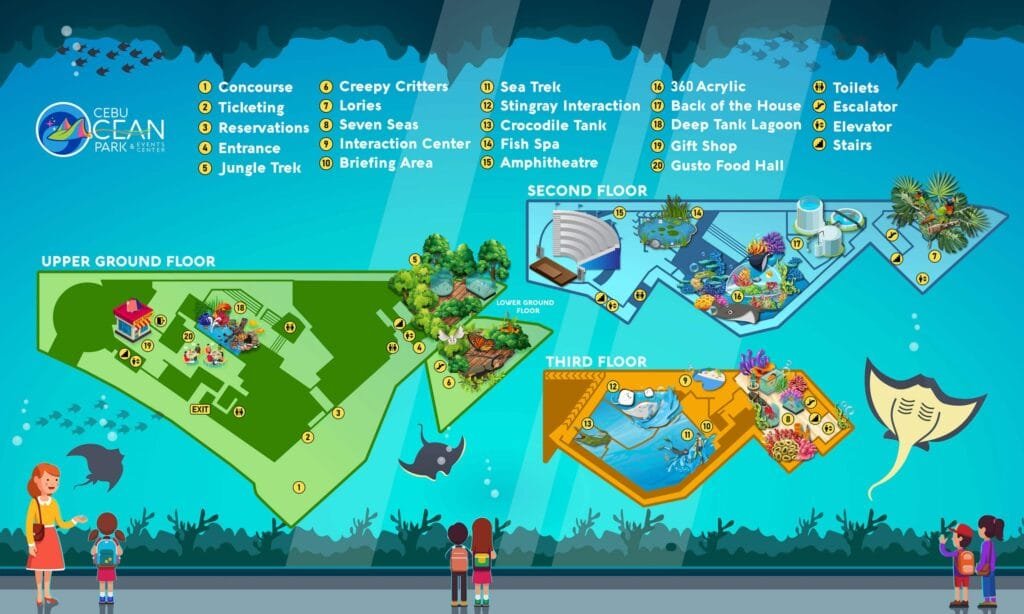
Inside the Zones: A Walkthrough of the Exhibits
Cebu Ocean Park features a linear, one-way layout that guides you through distinct ecosystems, starting from freshwater rivers and ending in the deep ocean. The three must-see zones are the open-air Jungle Trek, the interactive Lory Loft, and the massive 360-degree Oceanarium tunnel.
Zone 1: Jungle Trek (Freshwater Ecology)
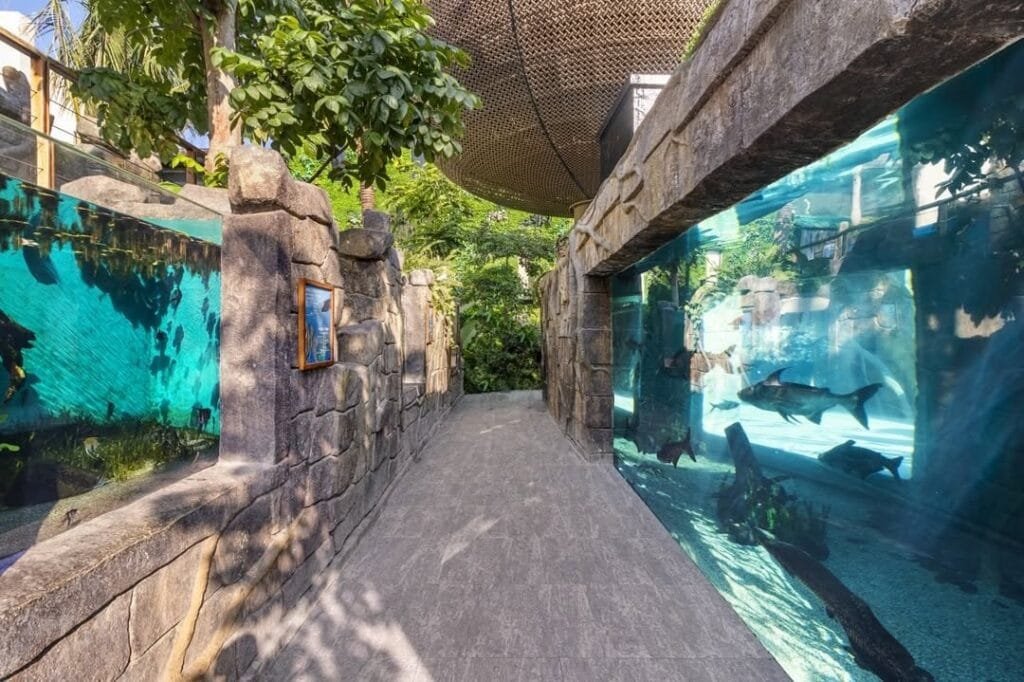
Your journey begins outdoors in the Jungle Trek. This zone recreates riverine environments, showcasing Amazonian giants like the Arapaima and local freshwater species. It is designed to teach the hydrological cycle, connecting the rivers to the sea.
However, be prepared for the elements. Since this section is open-air, it is directly exposed to the Cebu sun.
Heat Warning: The humidity here can be stifling between 11:00 AM and 2:00 PM.
Strategy: Visit this zone immediately upon opening (10:00 AM) or late in the afternoon (5:00 PM) to avoid the peak heat index.
Zone 2: Lory Loft (Avian Interaction)
Next, you enter a giant, walk-in flight aviary designed like a bird’s nest. This is the most chaotic and high-energy part of the park. Dozens of colorful Lories and Lorikeets fly freely and will land on your head or shoulders if you have food.
The Cost: You can purchase a cup of nectar for ₱100. Be warned: once the birds see the cup, they swarm. It is fun for adults but can be terrifying for small children.
Accessibility Alert: While most of Cebu Ocean Park is ramp-accessible, the suspended bridge structure in the Lory Loft is not wheelchair friendly. If you are traveling with seniors or PWDs, they may need to skip the elevated bridge portion or stay on the lower viewing deck.
Zone 3: The Oceanarium (Main Tank)
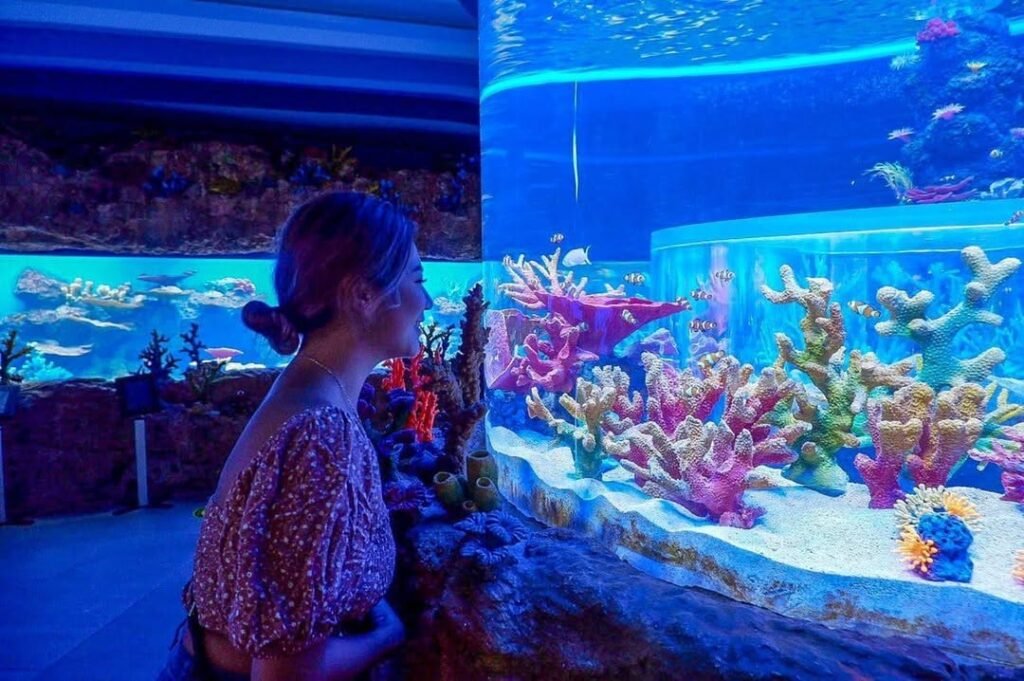
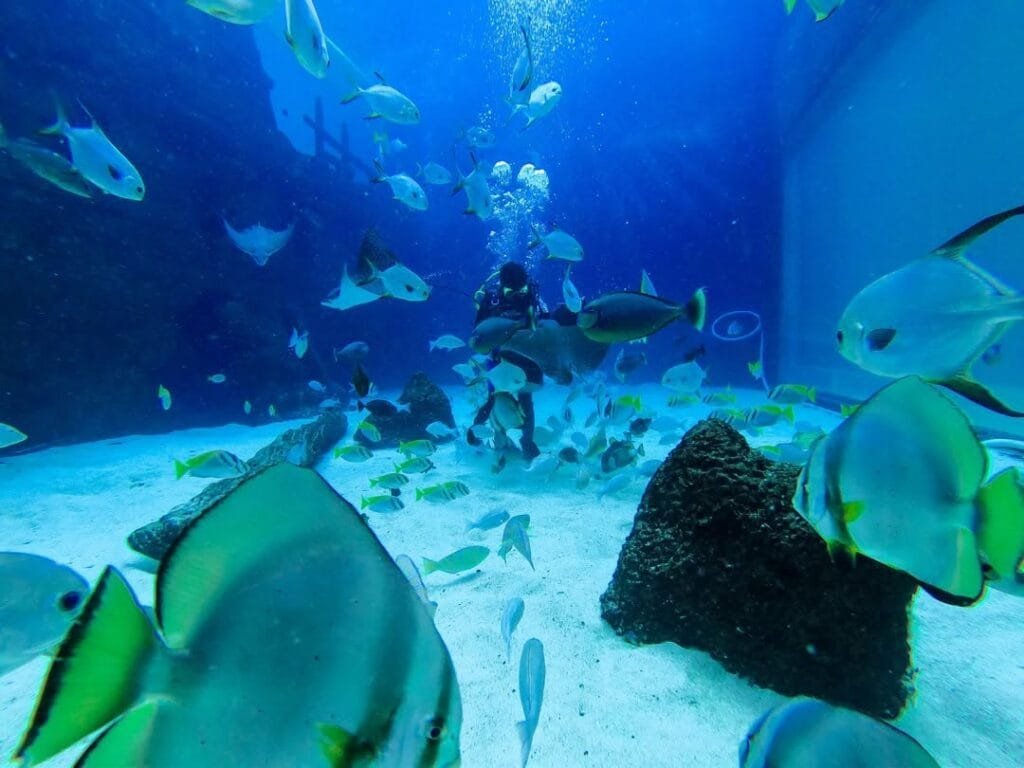
The climax of the tour is the deep-water Oceanarium. This massive tank holds millions of liters of saltwater and features a stunning 360-degree viewing tunnel.
The Aesthetic: Unlike standard blue tanks, this one features a dramatic “shipwreck” design, providing jagged structures for groupers and sharks to patrol.
The Experience: This is the cool-down zone. The air-conditioning is strong, and the lighting is dim. It’s the perfect place to rest your legs after the hot walk through the Jungle Trek.
Pro Tip: Don’t rush through the tunnel. Most visitors power-walk to the end, but the best photos are actually taken from the semi-tunnel section just before the main arch, where the light refraction is less severe on camera lenses.
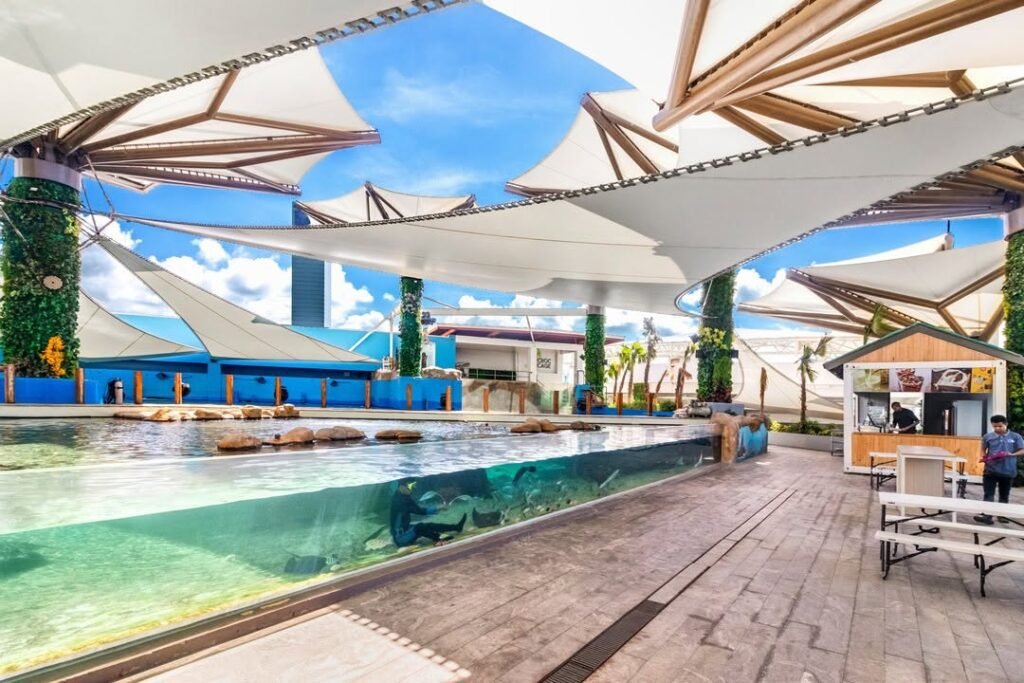
Premium Interactions: Are They Worth It?
For travelers seeking adrenaline beyond the glass, Cebu Ocean Park offers three premium upgrades: the Sea Trek helmet dive (₱1,200), the Croc Cage (₱2,000), and the Stingray Interaction (₱1,000). While thrilling, these activities come with strict height and medical restrictions that can derail your plans if you aren’t prepared.
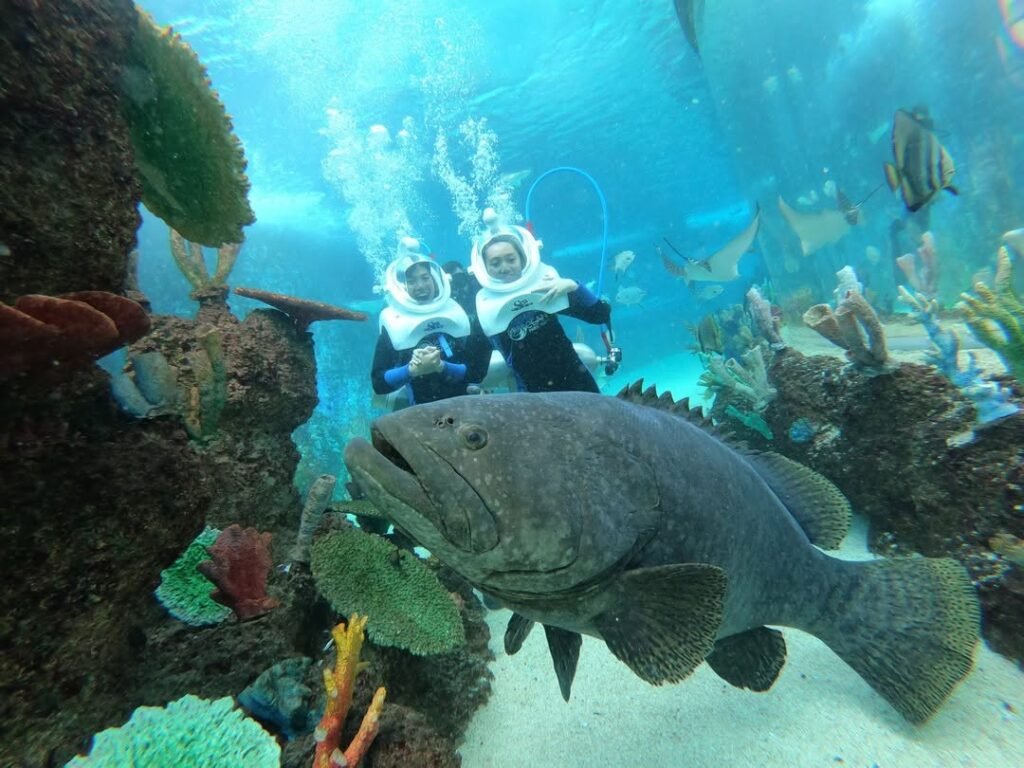
Sea Trek (Helmet Diving): The “Truth Bomb”
This activity allows you to walk along the floor of the Main Tank surrounded by sharks and groupers, wearing a specialized helmet supplied with surface air. However, before you promise this to your children, grab a measuring tape.
-
The Height Barrier: The strict minimum height is 140cm (4 feet 7 inches). This is significantly higher than most theme park rides (usually 120cm). Many 8 or 9-year-olds will not make the cut, leading to tears at the registration desk.
-
The No-Fly Zone: This is a critical safety constraint. Because you are breathing compressed air underwater, your body absorbs nitrogen. To prevent decompression sickness (“the bends”), you are strictly prohibited from flying for 12 hours after the dive. If you have a flight out of Mactan that same evening, you cannot book this activity.
Croc Cage: Fear vs. Physics
For ₱2,000, you are lowered into the enclosure of a 14-foot Saltwater Crocodile inside a reinforced clear acrylic cylinder.
-
The Reality: Physically, you are perfectly safe; the glass is thick, and the cylinder is robust.
-
The Thrill: Psychologically, it is terrifying. The distortion of the curved glass makes the crocodile appear even larger, and seeing a predator that size inches from your face triggers a primal fear response that no amount of logic can suppress.
Stingray Interaction: The Wet Factor
Unlike the “touch pools” in other aquariums where you just dip a finger, this is a full-body wading experience.
-
Prepare to Soak: You will be standing in the water with rays gliding against your legs. Depending on your height, the water level can reach your waist or chest.
-
Logistics: You absolutely need a full change of clothes and a towel. Do not attempt this expecting to just “roll up your jeans.”
Pro Tip: If you plan to do the Sea Trek, book the earliest slot (around 11:00 AM or 12:00 PM). This maximizes your surface interval before any potential flights the next day and ensures the water visibility is at its peak before the afternoon feeding sediments cloud the tank.
Dining Guide: Gusto Food Hall vs. Aqua Dining
Dining inside Cebu Ocean Park is mandatory as there is a strictly enforced “No Outside Food and Beverage” policy. Your choice comes down to two distinct venues: the volume-driven Gusto Food Hall for families or the atmospheric Aqua Dining for couples.
Gusto Food Hall: The Safe Bet
Located along the main visitor flow, Gusto operates as a high-capacity food court with a “live cooking” theater concept. The menu leans heavily into Asian Fusion, specifically Singaporean and Hong Kong street food.
The Vibe: It is loud, bustling, and fast—perfect for hungry kids who can’t wait.
What to Order: The Chicken Parilla is widely cited as a best-seller for its smoky char. For a comforting option, the Singaporean Laksa offers a decent coconut-curry kick that rivals standard hawker stalls.
Value: It offers the best price-to-volume ratio in the park, making it the default choice for 90% of visitors.
Aqua Dining: The “Vibe Check”
Marketed as “The First Underwater Dining Experience in Cebu,” this venue transforms the main Oceanarium tunnel into a fine-dining restaurant, usually available for lunch slots or after-dark dinners.
The Proposition: You are paying for the ambiance, not a Michelin-star meal. The novelty of eating a multi-course meal while sharks and rays glide overhead is unbeatable for proposals or anniversaries.
The Reality Check: Managing expectations is key. Recent guest reviews (2024–2025) have been mixed regarding culinary execution, with specific complaints about dishes like the Seafood Risotto being “salty as seawater.” If you are a gourmet critic, you might be disappointed. If you are there for the photos and the romantic novelty, it is worth the ₱1,500+ per head splurge.
Pro Tip: If you choose Aqua Dining, skip the complex seafood dishes where seasoning can be inconsistent. Stick to the safer proteins like steaks or grilled meats, and focus on the visual spectacle of the tank—that’s the real main course.
The Strategic Itinerary (Barkada vs. Family)
To maximize your visit and avoid “museum fatigue,” do not wander aimlessly. You must anchor your schedule around the specific animal feeding times, which are the most dynamic visual events of the day.
The Perfect “Event-Anchor” Flow
Follow this optimized timeline to beat the crowd and the heat:
10:00 AM: Arrival & Entry (Scan online ticket immediately).
10:15 AM: Jungle Trek. Tackle this open-air zone first while the morning air is still cool.
11:00 AM: Main Tank Feeding. This is non-negotiable. Be at the viewing tunnel 15 minutes early to secure a front-row spot for the shark frenzy.
12:30 PM: Lunch at Gusto Food Hall.
02:00 PM: Bird Show at the Amphitheater.
06:00 PM: Exit.
The “Event Anchor” Strategy
The park’s energy peaks during the 11:00 AM and 3:00 PM feeding slots. If you miss the morning feed, you must catch the afternoon one. These are the only times the massive groupers and sharks become truly active, creating the photo opportunities you see on Instagram.
The Sunset Exit
Plan your exit strictly at 6:00 PM. This aligns with the sunset and allows you to transition seamlessly to the Il Corso waterfront strip next door. It’s the logical “after-party” where you can enjoy dinner by the sea, turning a half-day trip into a full-day SRP experience.
Pro Tip: Most visitors leave after the 3:00 PM feeding. If you stay until 5:00 PM, return to the Main Tank Tunnel. The crowds usually vanish during this “Golden Hour,” giving you unobstructed, reflection-free shots of the sharks without strangers’ heads in your frame.
Is Cebu Ocean Park Worth the Hype?
Cebu Ocean Park has successfully transitioned from a mere “rainy day backup plan” to a cornerstone of the modern Cebu itinerary. It bridges a critical gap in the region’s tourism portfolio: providing an accessible, high-quality marine interaction experience without the logistical exhaustion of a 4-hour drive to Oslob.
While the ₱800 weekend price point puts it on the premium end for locals, the operational quality—specifically the massive Oceanarium tunnel and the well-maintained Jungle Trek—justifies the cost. It acts not just as an attraction, but as the perfect “staging ground” for the South Road Properties (SRP), allowing you to seamlessly transition from marine education to a sunset dinner at Il Corso or retail therapy at SM Seaside.
If you are a family with young kids, a couple looking for a unique date spot, or a traveler needing a “chill” day between island hopping, this park is a non-negotiable stop.
Explore More of Cebu: Your Next Stop
Cebu Ocean Park is just the starting point. Depending on whether you want more adrenaline, historic culture, or mountain breezes, here is how to structure the rest of your trip using our Ultimate Cebu Guides:
1. The “Southbound” Thrill & Pilgrimage Loop Since you are already at the SRP (South Road Properties), you are perfectly positioned to head further south.
-
Next Stop for Thrills: Just a few towns over in Minglanilla is the premier amusement complex of the Visayas. Check our guide on Anjo World Theme Park Ticket Prices & Rides to see if Snow World is worth the add-on.
-
The Spiritual Detour: Continue south to Sibonga to visit the castle-like monastery. Read our Ultimate Guide to Simala Shrine (2025) for dress codes and mass schedules.
-
Chasing Waterfalls: If you are heading deep south for nature, the multi-level turquoise waters described in our Inambakan Falls Travel Guide are a must-visit.
2. The “Upland” Mountain Escape Had enough of the ocean? Swap the humidity for the cool mountain air of Busay and Balamban.
-
Flower Power: Visit the “Little Amsterdam” of Cebu. See the best photo spots in our Ultimate Guide to Sirao Flower Garden (2025).
-
The Crown Jewel: For hikers, the highest point in the province offers stunning jagged views. Plan your hike with our Osmeña Peak Ultimate Guide.
3. The “Historic City” Contrast Balance the modern SRP district with the deep history of downtown Cebu.
-
The Icons: No trip is complete without visiting the birthplace of Philippine Christianity. Read our Guide to Magellan’s Cross.
-
The Chinese Heritage: Visit the serene and colorful Cebu Taoist Temple in Beverly Hills for a quiet architectural contrast.
Still planning your itinerary? Don’t miss a beat. Browse our curated list of the Top 10 Tourist Destinations in Cebu (2025 Guide) to ensure you hit every major landmark.
Frequently Asked Questions (FAQs)
Here are the quick answers to the most common logistical questions travelers ask before visiting Cebu Ocean Park.
1. Can I bring outside food or drinks inside?
No. The park enforces a strict “No Outside Food and Beverage” policy. Security personnel conduct bag checks at the entrance, and any snacks or water bottles will be confiscated. The only standard exceptions are for infant formula or specific medical dietary requirements. You are expected to purchase all meals and hydration from the internal outlets like Gusto Food Hall.
2. Is there luggage storage available?
Yes, but it is limited. There are rental lockers available near the entrance, but they are designed for backpacks and small items, not large check-in suitcases. If you are transiting directly from Mactan Airport, it is strongly recommended to drop your bags at your hotel first. Dragging luggage through the MyBus transfers and into the park lobby is a major friction point.
3. How long does the tour take?
Plan for 3 to 4 hours. Because the park utilizes a linear, one-way layout, you cannot easily backtrack once you pass certain turnstiles. This duration allows enough time to walk the Jungle Trek, engage with the Lory Loft, and watch the Main Tank feeding without feeling rushed.
Pro Tip: Re-entry is generally prohibited. Once you exit the turnstiles to go to SM Seaside or Il Corso, you cannot re-enter the park on the same ticket. Ensure you have seen everything (and used the restroom) before you make your final exit.