I. Introduction: The “Use It or Lose It” Trap
Picture this: You land in Caticlan for a 5-day vacation in Boracay. You buy a 10GB travel SIM because you want to be safe, and you pay $15 for it.
You have a great trip, posting stories and checking emails. But when you fly home, you check your data usage and realize you only used 3GB. The remaining 7GB—which you paid good money for—vanishes into thin air the moment your 30-day validity expires.
This is the “Use It or Lose It” Trap.
For years, travelers have been forced to rent their internet connectivity. Whether you buy a local Globe SIM or a standard travel eSIM like Airalo, you are always racing against a ticking clock. If life gets busy and you don’t travel for a few months, your data investment is wiped out.
But in 2026, a new category of travel data has emerged to solve this exact problem: the Non-Expiring eSIM.
What is a Non-Expiring eSIM?
(The Short Answer for Travelers)
Definition: A Non-Expiring eSIM (also known as a “Lifetime” or “No Expiry” plan) is a prepaid data package with no validity limit.
Unlike traditional plans that expire after 7 or 30 days, the gigabytes you purchase sit in your account indefinitely. They remain active on your phone for months or even years until you actually consume them.
| |
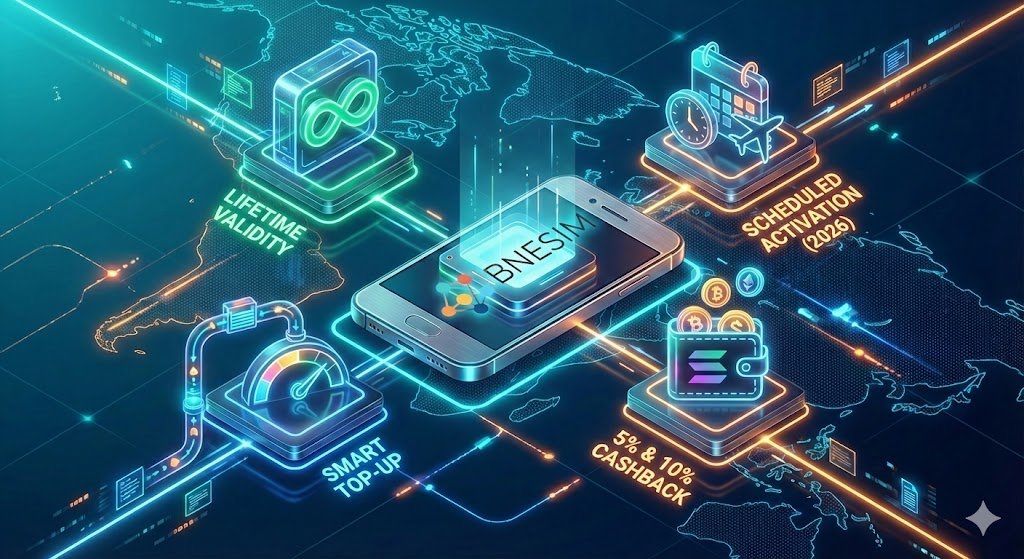
Why? | The industry pioneer in “One-Time” non-expiring eSIM. Features Scheduled Activation and Smart Top-Ups on the Globe 5G network. |
Why This Matters for Philippine Travel
The Philippines is rarely a “one-and-done” destination. Between “Piso Fare” seat sales and the pull of 7,000+ islands, many travelers return multiple times a year.
A non-expiring plan allows you to buy a bulk data package (e.g., 20GB) in January, use a few gigabytes for a weekend in Cebu, pause your usage, and then use the remaining data for your Christmas trip to Manila—without paying a single peso extra.
LakbayPinas “Sayang” Tip: In Filipino culture, we have a word for wasted value: “Sayang.” Buying a 30-day SIM card for a 4-day trip is the definition of sayang. If you visit the Philippines frequently, stop buying disposable SIMs. A non-expiring profile acts like a permanent utility bill that you only pay when you use it.
LakbayPinas Exclusive Offer We’ve partnered with BNESIM to get you connected for less. Use code LAKBAY20 at checkout for 20% OFF your first purchase (capped at €10).
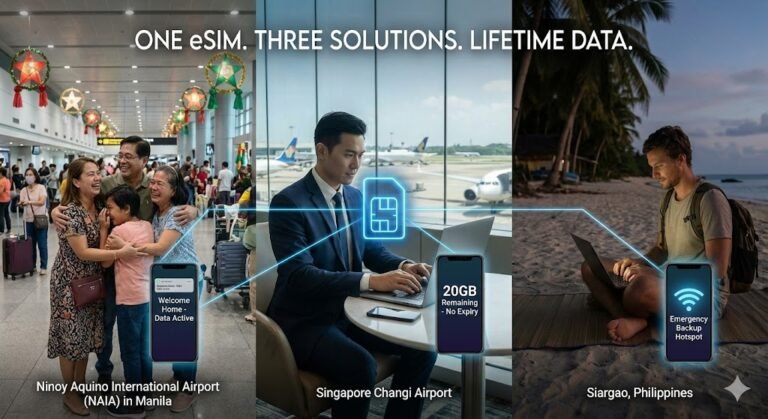
Table of Contents
II. Who Needs a Non-Expiring eSIM?
Not every traveler needs a lifetime plan. If you are visiting the Philippines once for a “bucket list” vacation and never plan to return, a standard 30-day card is perfectly fine.
However, for specific types of travelers, a disposable SIM card is a logistical nightmare and a financial waste. If you fit into one of the following three profiles, a non-expiring eSIM isn’t just a luxury—it is the most practical tool in your travel kit.
1. The “Balikbayan” (Returning Filipino)
- The Routine: You visit home once or twice a year—usually for Christmas (December) or Holy Week (March/April).
- The Old Way: Every time you land at NAIA, you buy a new tourist SIM, queue up for registration, and get a new temporary number that expires a few months after you leave.
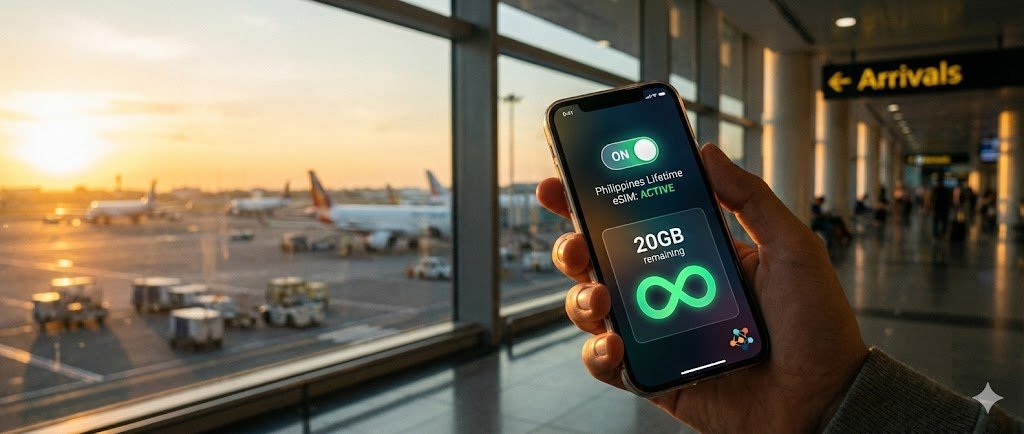
- The BNESIM Advantage: You install the profile once. It lives on your phone permanently. When you land in Manila for Christmas, you just toggle it “ON” and you are instantly connected. When you return to the US, Canada, or Dubai, you toggle it “OFF.” Your data waits for you until your next homecoming.
2. The Regional Business Traveler
- The Routine: You are based in Singapore or Hong Kong and fly to Manila or Cebu for quick 48-hour meetings or weekend layovers.
- The Problem: Buying a standard 7-Day / 1GB travel plan costs roughly $4–$5. If you visit once a month, that adds up to $60/year, and you are constantly installing and deleting new eSIMs.
- The BNESIM Advantage: You buy a 20GB Lifetime Plan for ~$45 one time. This single purchase could last you for an entire year of business trips, costing you significantly less in the long run and removing the hassle of buying a plan before every flight.
3. The Digital Nomad (The “Backup Tank”)
- The Routine: You are working remotely from islands like Siargao, El Nido, or La Union.
- The Reality: “Island WiFi” is notoriously unreliable. Brownouts (power outages) are common, and hotel fiber lines frequently go down during storms.
- The BNESIM Advantage: Think of this as your “Emergency Internet Spare Tire.” You might primarily use the hotel WiFi or a cheap local Smart SIM, but when those fail (and they will), you instantly switch your data source to your non-expiring eSIM to finish that Zoom call or send that file. Since the data never expires, it costs you nothing to keep it in reserve for emergencies.
LakbayPinas “Real Talk” Tip: The Problem with “Regular Load” Local prepaid SIMs (Globe/Smart) technically have “load” that lasts for a year, but the actual high-speed data promos (like Go50 or PowerAll) usually expire in 3 to 7 days. This means you are constantly reloading and registering for promos every few days. A non-expiring eSIM removes this “admin work.” You just have data. Simple.
III. Deep Dive: BNESIM’s Features
Most travelers are used to the “Subscription Model” (paying rent for access). BNESIM operates on a “Consumption Model” (owning the resource), but they have added powerful tech features for 2026 that competitors lack.
1. The “Lifetime” Concept
When you select a “One-Time” plan, you purchase data credits that belong to you indefinitely. There is no “Valid Until” date.
2. Scheduled Activation (New for 2026)
One of the biggest anxieties for travelers is timing their SIM activation.
- The Feature: You can purchase a data plan weeks in advance and schedule its activation for the exact day and hour you land in the Philippines.
- The Benefit: Perfect for Type-A planners. You get the admin work done early, and the data automatically goes live the moment your plane touches down.
3. Smart Top-Up
- The Feature: When enabled, the app monitors your balance. If you drop below 100MB, it automatically tops up your data.
- The Benefit: You never experience a sudden “offline blackout” in the middle of a Grab booking or Zoom call.
4. The Ecosystem: Crypto Wallet & Cashback
BNESIM isn’t just a SIM; it’s a travel wallet.
- In-App Crypto Wallet: Built on Solana, the wallet allows you to top up using BNE Coins or major cryptocurrencies.
- Cashback Rewards:
- 5% Cashback: On every purchase made via the in-app wallet.
- 10% Cashback: Received on every renewal if you subscribe to a monthly plan (which also includes a Free VPN).
IV. The Math: Non-Expiring eSIM vs. Monthly Plans
Let’s look at the hard numbers. As travel editors, we constantly analyze “Price per GB,” and this is where the non-expiring eSIM creates a massive gap between BNESIM and traditional competitors like Airalo or Holafly.
The Scenario:
You are a traveler who visits the Philippines 3 times a year (e.g., January, May, December).
On each trip, you use roughly 3GB of data for Maps, Grab, and messaging.
- Total Annual Need: 9GB.
The Cost Comparison
Strategy | Plan Purchased | Total Cost | Result |
Option A (Traditional 30-Day eSIM) | Buy 3 separate 3GB plans (Avg. price ~$8.50 each) | **~$25.50** | You pay more, and if you only use 2GB on one trip, you lose the leftover data. |
Option B (BNESIM Lifetime) | Buy one 10GB Lifetime plan (Current price ~$10–$12) | ~$11.00 | You SAVE ~$14.50 (over 50%). Plus, you get 1GB extra that stays in your account forever. |
The Verdict: By switching to a non-expiring plan, you cut your yearly data bill in half. Even better? You eliminate the “admin time” of searching for, buying, and installing a new eSIM three times a year. You just land and turn it on.
Why the “Price Per GB” is Misleading on Standard Plans
When you look at a standard travel eSIM, you might see a cheap sticker price like $4.50 for 1GB. It looks affordable.
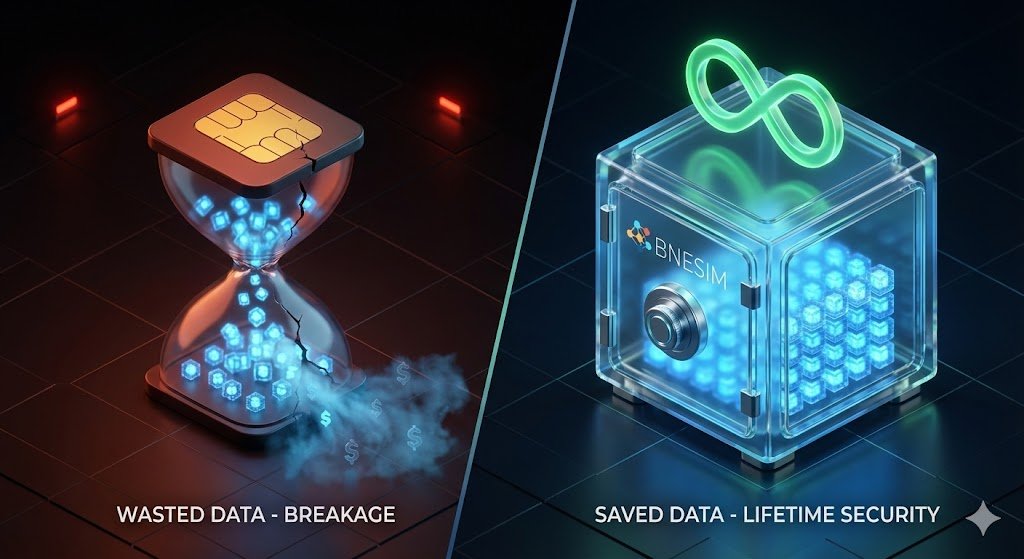
But the hidden cost is the breakage—the data you pay for but never use.
- If you buy a 5GB / 30-Day plan for $12 but only use 3.5GB, your actual cost per GB skyrockets because you threw 1.5GB in the trash.
- With BNESIM’s One-Time plans, your “efficiency rate” is 100%. Every cent you spend goes toward data you eventually consume, whether it takes you 3 days or 3 years to use it.
LakbayPinas Budget Tip: The “Pasaload” Alternative? Local networks like Globe and Smart allow you to share “load” (credits) or register for promos, but these promos (like Go50 or PowerAll) expire strictly in 3 to 7 days. Unless you live in the Philippines full-time, managing these short-term local promos is a headache. A non-expiring eSIM is the digital equivalent of having “Magic Data” (a popular Smart promo) that works instantly for international travelers without the need to maintain a physical SIM card.
V. Performance in the Philippines (Local Context)
A non-expiring eSIM is only useful if it actually connects when you need it. There is no point in having “Lifetime Data” if you can’t get a signal during a sudden brownout in Manila or a hotel WiFi failure in Cebu.
Here is how BNESIM performs on the ground.
Network Check: The Globe Telecom Backbone
BNESIM’s primary roaming partner in the Philippines is Globe Telecom, one of the country’s two major network giants.
- Why this matters: Globe has historically held a stronghold in urban business districts and major tourist hubs. If you are transiting through NAIA (Manila Airport), attending meetings in Makati/BGC, or staying in Cebu IT Park, Globe’s infrastructure is incredibly dense and reliable.
- 5G Speed: In these key metro areas, BNESIM taps into Globe’s 5G network, delivering speeds that are often faster than hotel WiFi (which can be congested). This makes it an ideal “backup pipe” for heavy tasks like uploading video files or hosting Zoom calls.
The “Safety Net” Factor
For the frequent traveler or Digital Nomad, the Philippines can be unpredictable.
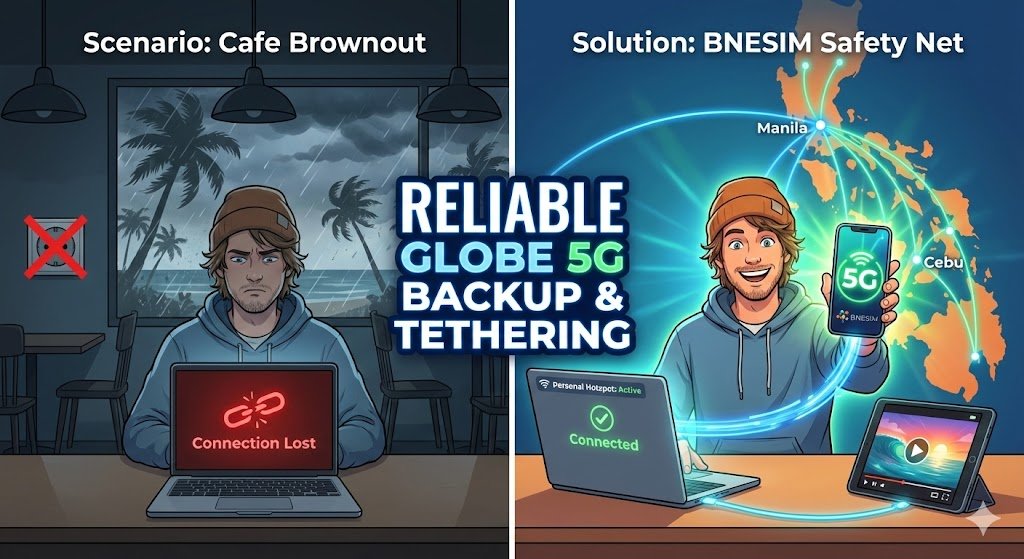
- Scenario: You are working from a cafe in La Union and the power goes out (a common occurrence). The cafe’s fiber internet dies instantly.
- The Fix: Because your BNESIM data never expires, it is always sitting dormant on your phone. You simply toggle your data source from “WiFi” to “BNESIM,” and within seconds, you are back online via Globe 5G. You didn’t need to scramble to buy a promo or load credits; the data was already there, waiting for this exact emergency.
Tethering: Yes, You Can Share It
One common fear with “travel data” is that it is locked to your phone.
We confirmed that BNESIM allows full tethering (Personal Hotspot).
This is critical for business travelers. You can turn your iPhone or Android into a portable router and share your non-expiring data with your:
- Laptop (for sending emails at the airport gate).
- iPad (for watching Netflix on the bus).
- Travel Companion (if their local SIM runs out of load).
Unlike “Unlimited” plans from competitors like Holafly which often block hotspotting to prevent abuse, BNESIM’s consumption model means you own the data—so you are free to share it however you like.
LakbayPinas “Backup” Tip: The Dual-Network Strategy If you are a serious remote worker, the ultimate setup is to buy a cheap local Smart physical SIM for your primary island data (since Smart is often better in remote areas like Siargao) and keep a BNESIM (Globe) profile active as your non-expiring backup. This gives you access to both major networks, ensuring you are never offline, no matter which island you are on.
VI. Are There Any Alternatives? (Honest Review)
We believe in giving you the full picture. While BNESIM is our top pick for the Philippines, it is not the only player in the “non-expiring” game.
Here is how the landscape looks in 2026 and why we still recommend BNESIM for most travelers.
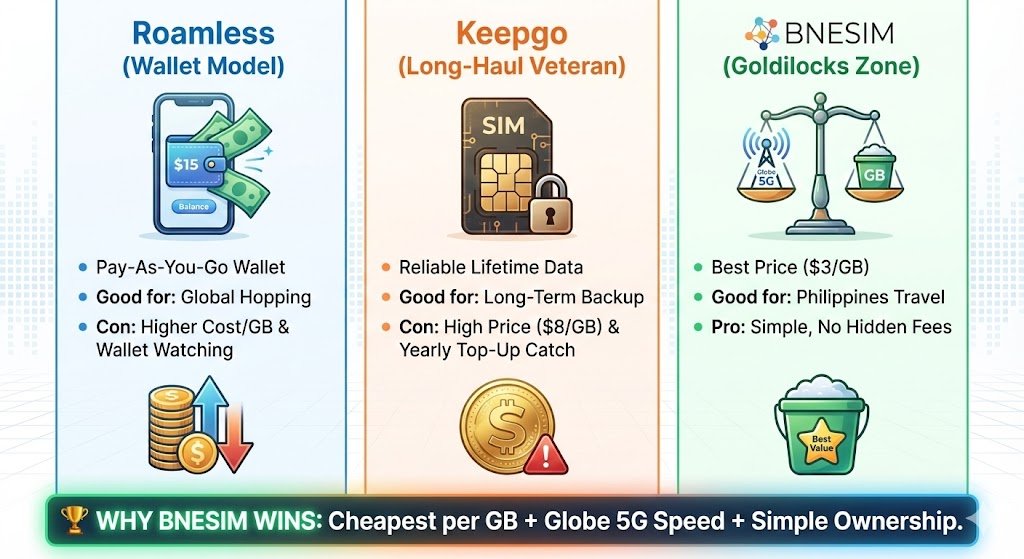
1. Roamless (The “Wallet” Model)
- How it works: Instead of buying a “Data Plan” (e.g., 5GB), you load cash credits into a digital wallet (e.g., $20.00). You then “Pay-As-You-Go” for every megabyte you use.
- The Good: Your wallet balance never expires. It uses a single global eSIM, so you never have to reinstall profiles.
- The Bad: The “Pay-As-You-Go” rate for the Philippines can fluctuate. While convenient, it often works out to be slightly more expensive per GB than buying a bulk BNESIM data pack upfront. It requires you to constantly watch your wallet balance to ensure it doesn’t hit $0.00 mid-trip.
- Verdict: Great for global travelers visiting 5+ countries in a month; less efficient for a focused Philippine trip.
2. Keepgo (The “Long-Haul” Veteran)
- How it works: One of the oldest providers of “Lifetime Data.” They offer robust connectivity and a similar non-expiring promise.
- The Good: Extremely reliable and works in dozens of countries.
- The Bad: Price Shock. Keepgo’s 1GB lifetime plan often starts around $8.00–$9.00 USD. Compared to BNESIM (which starts closer to $3.00), you are paying a massive premium for the same service.
- The Catch: To keep some Keepgo lines active, you may need to perform a minimal “top-up” (e.g., $3) once a year to prevent the SIM itself from being deactivated due to inactivity.
- Verdict: Solid technology, but the price-per-GB makes it hard to recommend for budget-conscious travelers.
Why BNESIM Wins the Comparison
When you stack them side-by-side, BNESIM sits in the “Goldilocks Zone” for Philippine travel:
- Better Pricing: It is significantly cheaper than Keepgo (approx. $3/GB vs. $8/GB).
- Better Network: It locks onto Globe 5G, which we’ve found to be faster in urban hubs than the roaming partners used by some generalist providers.
- Simplicity: You buy a bucket of data. You use it. You keep the rest. No “wallet anxiety” and no yearly maintenance fees.
LakbayPinas Tips: if you are a digital nomad hopping between Vietnam, Thailand, and the Philippines, Roamless is a strong contender because of its single global wallet. But if your main focus is returning to the Philippines to visit family or explore islands, BNESIM offers the best raw value for your peso.
VII. Step-by-Step: How to Maintain Your Non-Expiring Esim
The beauty of a non-expiring eSIM is that you only have to do the hard work (installation) once. After that, it becomes a permanent utility on your phone, just like your flashlight or calculator.
Here is how to set up your “Forever Data” ecosystem for the Philippines.
Step 1: The “One-Time” Install
- Action: Purchase your “One-Time” (Non-Expiring) data plan on the BNESIM website or app.
- The Process: Scan the QR code provided to install the eSIM profile.
- Crucial Tip: DO NOT DELETE THIS PROFILE.
- Once the trip is over, your instinct might be to “clean up” your phone settings and remove the “Travel” SIM. Stop. If you delete the eSIM profile from your phone settings, you disconnect your device from your “lifetime” data balance. To “turn it off,” simply toggle the line to Disabled/Off in your settings. It will sit dormant until you need it again.
Step 2: The “Arrival” Toggle
- Scenario: You have just landed at NAIA Terminal 3 or Mactan-Cebu International Airport.
- Action:
- Go to Settings > Cellular/Mobile Data.
- Find your BNESIM line (which you hopefully labeled “Philippines”).
- Toggle “Turn On This Line.”
- Ensure “Data Roaming” is set to ON.
- Result: Since the profile was already installed on your phone from your last trip, you will connect to the Globe network instantly. No QR codes to scan, no emails to search for.
Step 3: The “Top-Up” (Refilling the Tank)
- Scenario: It’s been 2 years and you finally used up your 20GB balance.
- Action: You do not need to install a new eSIM.
- Open the BNESIM App.
- Go to the “My eSIMs” tab.
- Select your active Philippines profile and tap “Top-Up” (or “Boost” for a quick refill).
- Buy a new 10GB or 20GB One-Time plan.
- Result: The new data is instantly added to your existing eSIM profile. You are back online in seconds without ever leaving the app.
LakbayPinas “Organization” Tip: Label It Clearly. In your phone settings, do not leave the label as “Secondary” or “Business.” Rename it to “BNESIM – Global” or “Travel Data.” Why? If you visit Japan or Thailand next month, you can use this exact same eSIM profile (by topping it up with a regional plan), making it your universal travel key for Asia.
VIII. Conclusion: Stop Renting Your Internet
For the last decade, travel connectivity has been built on a flawed model: Rent a SIM, use it for a week, and throw the rest away.
It is a model designed to make money for telecom companies, not to save money for travelers.
If you are a “one-and-done” tourist visiting the Philippines for a single bucket-list vacation, a standard 30-day card is fine. But for the thousands of Balikbayans, digital nomads, and repeat travelers who fly in and out of NAIA every year, the old model is broken.
The verdict is simple: Stop renting your internet. Start owning it.
Our Final Recommendation
If you plan to step foot in the Philippines more than once a year, a non-expiring eSIM is the only financially sensible choice.
By choosing a “Lifetime” plan, you turn your data into a permanent digital asset. You eliminate the stress of expiration dates, you avoid the “admin work” of buying new SIMs for every trip, and you ensure that you always have a Globe 5G safety net in your pocket for emergencies.
BNESIM is currently the clear market leader in this category, offering the best balance of network reliability, app experience, and price-per-GB.
LakbayPinas Final Word:The best travel hack isn’t finding the cheapest deal; it’s finding the tool that makes your life easier.We keep a BNESIM profile active on our own phones permanently. Whether we are landing in Manila for a meeting or hopping a ferry to Bohol, we know we are connected the second the boat docks—without ever worrying if our load has expired.
Ready to switch to Lifetime Data?
Don’t let your next gigabyte go to waste.
IX. FAQ (Frequently Asked Questions)
Here are the most common questions travelers ask us about switching to a non-expiring eSIM.
Does the eSIM profile itself expire if I don’t use it?
No, as long as it has a data balance.
Unlike a traditional prepaid SIM that gets deactivated if you don’t load it for 120 days, a BNESIM profile remains active on your phone effectively forever, provided you have a valid “One-Time” plan attached to it.
- The Golden Rule: Never delete the eSIM profile from your phone settings, even if you run out of data. As long as the profile is installed, you can simply “top up” new data in the app, and it will work instantly. If you delete it, you cannot reinstall the same QR code.
Can I transfer my non-expiring eSIM to a new phone?
Yes, but it requires a specific step.
eSIMs are digital, but they are securely locked to one device for safety. You cannot simply scan the old QR code on a new iPhone 17.
- The Process: If you upgrade your phone, you must contact BNESIM support (or use the automated “Replace eSIM” feature in the app). They will issue you a new QR code for the new device and move your remaining data balance over to it.
- Note: There is typically a small flat fee (approx. €1.00) for issuing a replacement eSIM profile, which is still much cheaper than losing your data.
Is non-expiring eSIM slower than a regular monthly plan?
No.
There is a common myth that “lifetime” data is deprioritized. In our testing, BNESIM’s One-Time plans connect to the exact same Globe Telecom 5G/4G towers as their monthly plans. You get the same speed, the same coverage, and the same low latency for Zoom calls or gaming. The only difference is how the billing works.
LakbayPinas Device Tip: Lost your phone in the Philippines? If your phone is lost or stolen during your trip, your data is safe. Because your balance is tied to your BNESIM Account (email) and not just the physical device, you can log in on a backup phone, request a replacement eSIM, and instantly recover your remaining gigabytes. This is a huge advantage over losing a physical SIM card, where your load is gone forever.