Visited: August 2026 — Published: September 2026
The Jovellar Underground River in Barangay Quitinday, Albay, is a subterranean river experience that includes a bamboo raft ride through a lit limestone cave, a deep gorge swimming pool, cliff jumping, and a downstream waterfall — all accessible from Legazpi City in under an hour by private vehicle. The LGU sets the entrance fee at PHP 50 for Filipino tourists and the mandatory bamboo raft ride at PHP 400 per raft (up to 10 people). A short 10–15 minute trek through rice paddies gets you to the cave mouth.
Key Takeaways:
- Entrance fee is PHP 50 (Filipino adult); bamboo raft ride costs PHP 400 per raft, shared across up to 10 people
- Best season is November to May — the water runs its signature teal color; wet-season visits turn it murky brown
- Access is easy: a flat-to-moderate 10–15 minute walk from the registration area to the cave entrance
- The standout feature is the shift from pitch-dark raft ride to an open cliff-jumping gorge all in one continuous tour
Table of Contents
Where Is Jovellar Underground River Located?
The Jovellar Underground River sits inside Barangay Quitinday in the municipality of Jovellar, Albay, roughly 24.5 kilometers west of Legazpi City. It runs through the Quipia River system, a network of limestone gorges and cave tunnels that eventually drains toward the coast near Donsol, Sorsogon.
One thing worth knowing before you go: the site goes by three names. The official government designation is “Jovellar Underground River,” used by the Municipal Tourism Office and the Provincial Tourism, Culture, and Arts Office of Albay (PTCAO). Travel blogs and Google Maps sometimes label it “Quitinday Underground River” — that’s the same place. “Naglaus Underground River” is its original local name, still used by older residents. The confusion matters because “Quitinday” can send some travelers toward the Quitinday Green Hills in Camalig — a completely different attraction, 25 minutes away in a different municipality. Double-check your driver has the right destination before you leave Legazpi.
The site sits in a part of Albay that was historically isolated from tourism development. Decades of difficult terrain and regional instability kept this area largely unvisited, which is the direct reason the cave system and surrounding forest are in such good ecological shape today.
How to Get to Jovellar Underground River from Legazpi
The fastest route from Legazpi to Jovellar Underground River is a direct private vehicle charter taking 32–45 minutes.
By Private Vehicle or Charter (Recommended)
Rent or charter a vehicle from Legazpi City. The total distance is approximately 24.5 kilometers via newly paved provincial roads that cut directly into Jovellar’s interior — no need to stop in another town. A one-way commercial taxi charter quotes between PHP 410 and PHP 490. Negotiate a flat whole-day wait-and-return rate before you depart; there are no taxis circulating in rural Jovellar to pick you up for the return. Car rental operators like Blueline Legazpi Car Rental (dispatch: +63-953-671-2454) handle chartered day trips from city hotels.
This is the route I used. My driver quoted PHP 900 for a round trip with waiting time, which worked out cheaper than two one-way fares once I factored in the wait.
By Public Jeepney (Budget Route)
This is a three-leg trip, and the last jeepney back from Jovellar leaves early — plan around it.
- Leg 1 — Legazpi Grand Central Terminal to Guinobatan: Board a westbound jeepney or passenger van toward Guinobatan. This covers 20 kilometers in 30–45 minutes, costing PHP 30–50. The terminal sits adjacent to Pacific Mall or Gaisano in Legazpi.
- Leg 2 — Guinobatan to Jovellar Town Proper: Transfer to a Jovellar-bound jeepney at the Guinobatan town center. This 16-kilometer leg takes 45–60 minutes and costs PHP 50–100. These jeepneys depart only when full. The first trip leaves Guinobatan as early as 5:00 AM; the last return trip from Jovellar departs between 3:00 PM and 5:00 PM. Miss it, and you are hiring a private motorcycle back.
- Leg 3 — Jovellar Town to Barangay Quitinday: From the town proper, hire a habal-habal (motorcycle taxi) or tricycle to Quipa Village. This 5-kilometer final leg takes 15–20 minutes and costs PHP 40–120 depending on whether you negotiate a round-trip rate. Arrange a return pickup time with your driver before heading down to the river.
Upon arriving at Quipa Village, you register at the Municipal Tourism Office — walk there from the public market — before your driver takes you the remaining distance to the tourist center.
For more rivers, lakes, and falls worth adding to your Bicol itinerary, see our guide to river, lake, and falls destinations across the Philippines.
Entrance Fees, Permits, and Guide Requirements at Jovellar Underground River
The LGU sets all fees at a fixed rate; there is no bargaining, and every visitor must register and pay before entering the trail.
Full Fee Breakdown
| Fee Category | Classification | Cost (PHP) |
|---|---|---|
| Entrance Fee | Filipino Tourist | PHP 50 |
| Entrance Fee | Foreign Tourist | PHP 200 |
| Entrance Fee | Children (10 and below) | PHP 30 |
| Entrance Fee | Senior Citizen | PHP 40 |
| Entrance Fee | Jovellar Local Resident | PHP 10 |
| Bamboo Raft Ride (Balsa) | Per raft, up to 10 persons | PHP 400 |
| Bamboo Raft Ride | Local Resident rate | PHP 200 |
| Dry Caving | Per person | PHP 300 |
| Guide Fee | Per group (mandatory) | PHP 200 |
| Kubo (Small Hut) | Daytime rental | PHP 450 |
| Large Cottage | Group rental | PHP 1,000 |
| Parking — Motorcycle | PHP 10 | |
| Parking — Tricycle | PHP 15 | |
| Parking — 4-Wheel Vehicle | PHP 30 |
The Mandatory Guide Policy
A PHP 200 per-group guide fee is non-negotiable. This rule replaced the previous free-roam access model, and it’s one of the better decisions the LGU has made here. The guide poles your raft through the cave, controls light inside the cavern, enforces the no-touch rule on stalactites, and monitors water levels. In a cave where the water level can shift quickly after rain, having someone who reads those conditions daily is worth more than the fee.
The guides are young — teenagers and early-twenties locals who were trained by the municipality in environmental conservation. Mine spoke good English, pointed out specific stalactite formations I would have floated past in the dark, and warned me exactly where the current picked up at the rear of the cave. That’s not information you get from a pamphlet.
Cash Only — No ATM in Jovellar
There is no ATM in Jovellar municipality. The nearest cash machines are in Guinobatan town center, which you pass through on the public transit route. If you are coming by private charter directly from Legazpi, withdraw cash before you leave the city. Bring enough for entrance fees, the raft ride, guide fee, food, and your transport back. Arriving at the registration desk without cash means turning around.
Getting to the Water: The Trail at Jovellar Underground River
The walk from the Quipa Village registration area to the cave entrance takes 10–15 minutes and is manageable for most fitness levels.
Stage 1: Registration Area to the Rice Paddy Path
The trail starts on level ground at the tourist center, where you pay fees and meet your guide. The first section winds through rice paddies and vegetable plots on a packed-earth path about a meter wide. This part is flat and easy. In August, the paddies were bright green and the path was firm underfoot, not muddy — though I was visiting on a sunny morning. After rain, this section gets slippery.
Stage 2: Transition to Rocky Terrain
After the farmland, the path becomes rockier as it approaches the gorge rim. There are no formal trail markers, but the route is obvious — your guide walks ahead. The rocks are irregular limestone, and some are loose. Watch your footing here, especially if you are carrying a bag.
Stage 3: The Wooden Staircase and Bamboo Bridge
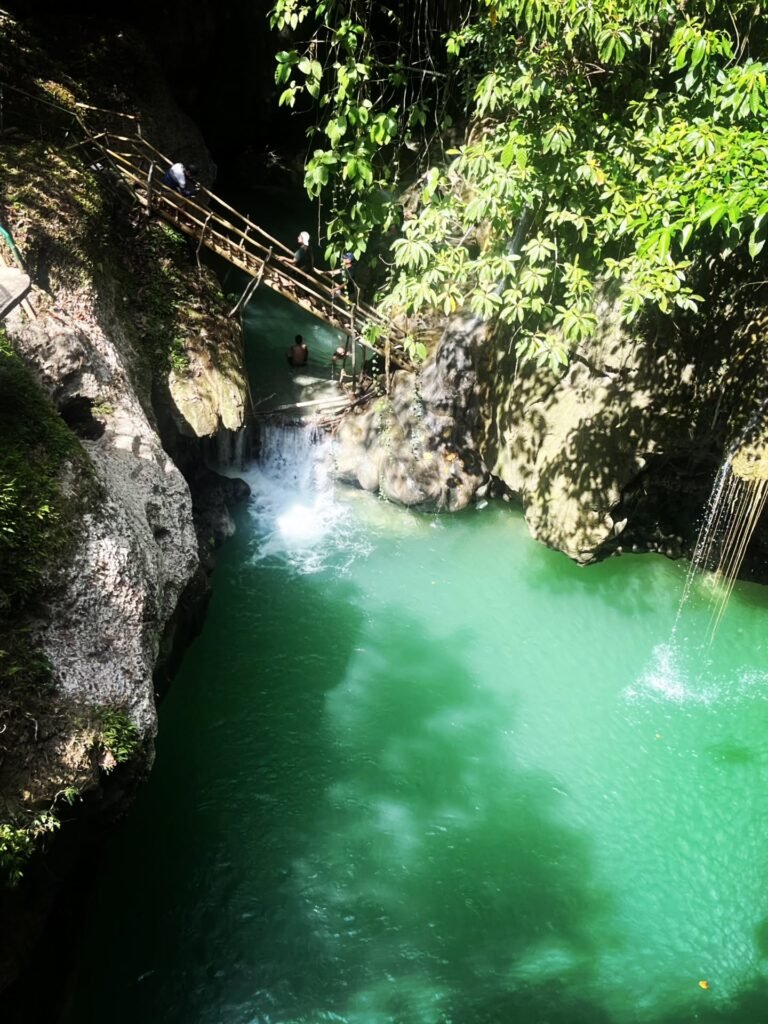
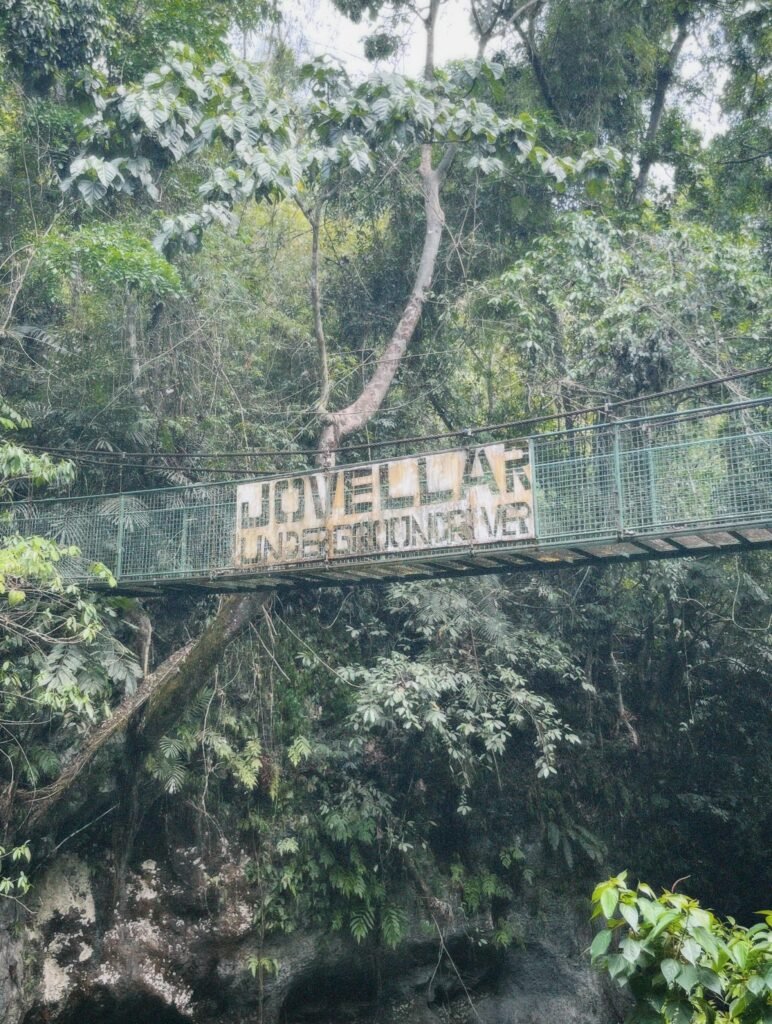
The final descent to the cave mouth is via a man-made wooden stairway and bamboo bridge built and maintained by the local community. This section is steep. The wood can be wet and slick from cave spray, so grip the handrail. This is the only section I would call genuinely careful footing — it is not dangerous, but it rewards attention.
Footwear Recommendation
Wear aqua shoes or waterproof trekking sandals with grip. The trail and cave entry both involve wet, smooth limestone. Flip-flops are a real hazard on the staircase descent. Barefoot works for local guides who have done it hundreds of times; for a first-time visitor, closed-toe water shoes are the right call. You will be wet from the moment you board the raft, so there is no point trying to keep your footwear dry.
Trek Summary
- Distance: Short (under 500 meters from registration to cave mouth)
- Time: 10–15 minutes at a normal walking pace
- Terrain: Flat farmland → rocky path → steep wooden staircase
- Difficulty: Easy to moderate; the staircase is the only technical section
- Accessibility: Not suitable for wheelchairs or for visitors with significant mobility limitations
Swimming and Activities at Jovellar Underground River
Swimming is allowed in the open gorge pool and at Sigpit Falls, and it is genuinely one of the better natural swimming spots in Albay.
The Bamboo Raft Ride Through Naglaus Cave
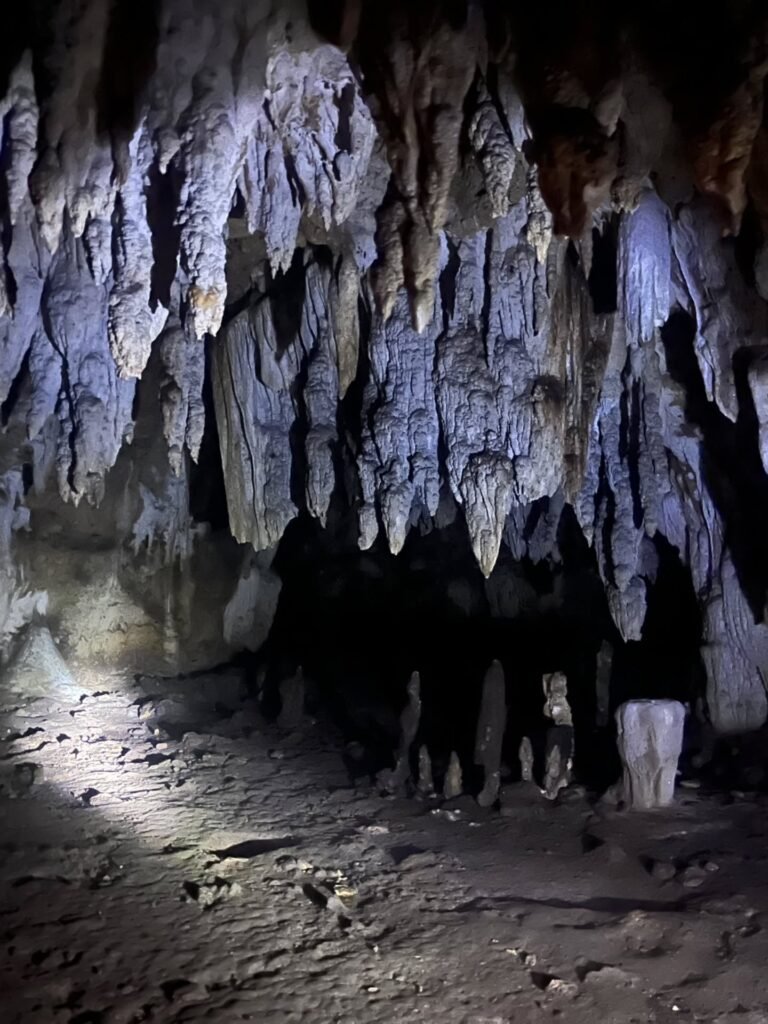
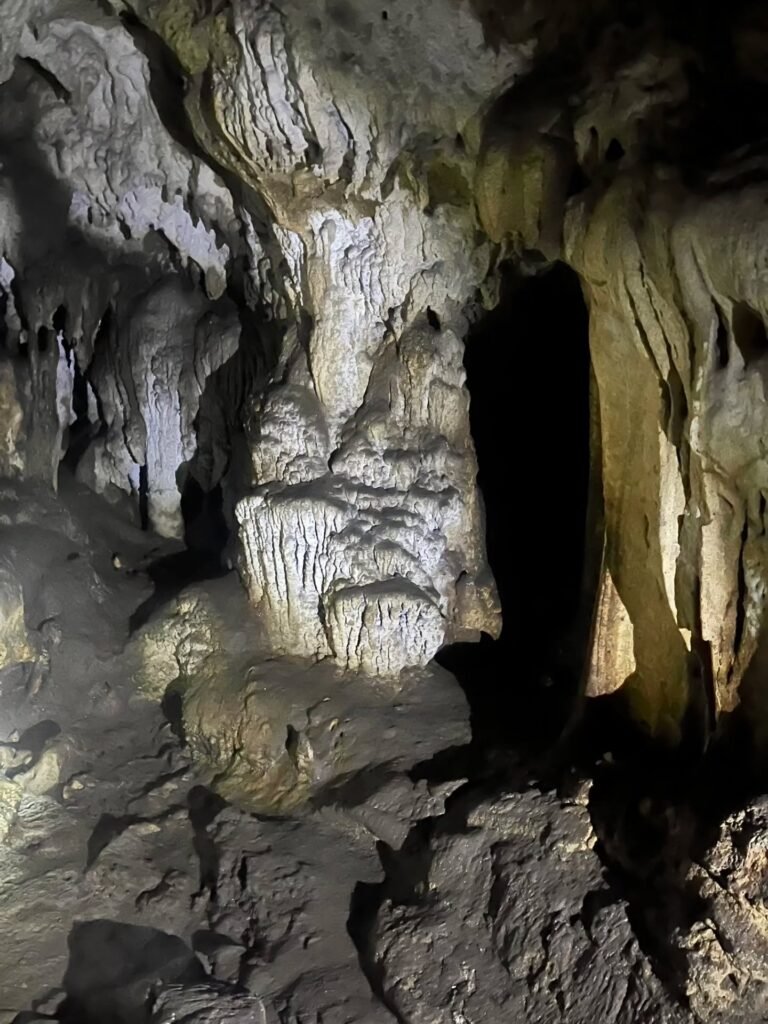
This is what most visitors come for. The 150–180 meter subterranean tunnel is navigated on a traditional bamboo raft — locally called a balsa — poled by your guide. Each raft fits up to 10 people, so the per-person cost drops significantly in a group. The cave entrance delivers a natural freshwater shower from ceiling drips, which is a sharp, cold introduction before you go dark. Inside, the guide’s flashlight picks out stalactites, stalagmites, and mineral columns from the limestone ceiling and submerged floor. The silence inside is complete — just water moving against bamboo and the occasional flap of bats overhead.
When I went through in August, the water level was moderately high from recent rain, and the guide controlled the raft speed carefully near the rear of the cave where the current accelerates around large boulders. The whole transit takes roughly 10–15 minutes one way.
The Gorge and Cliff Jumping
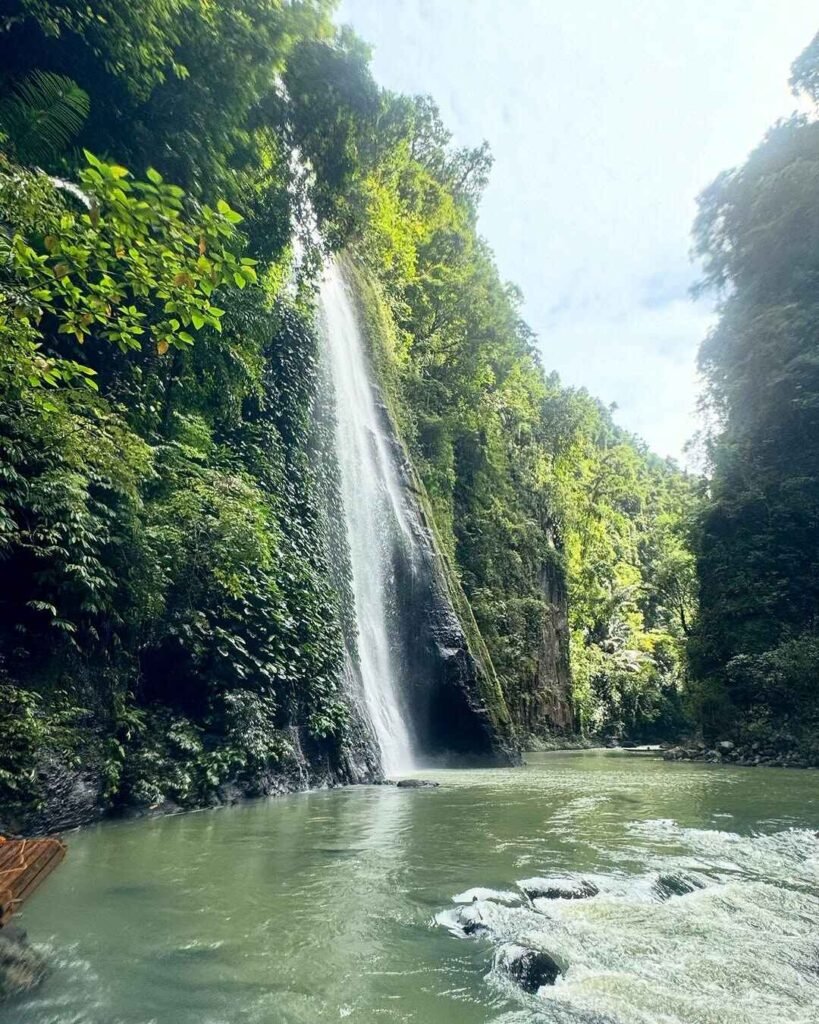
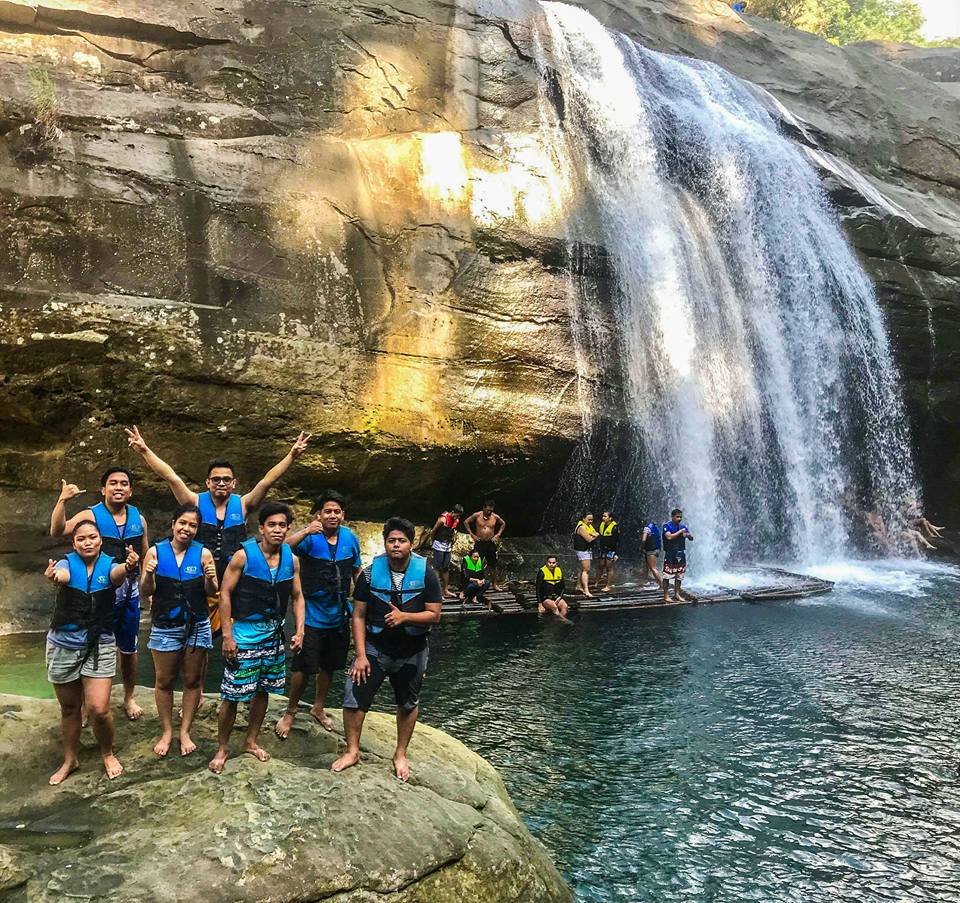
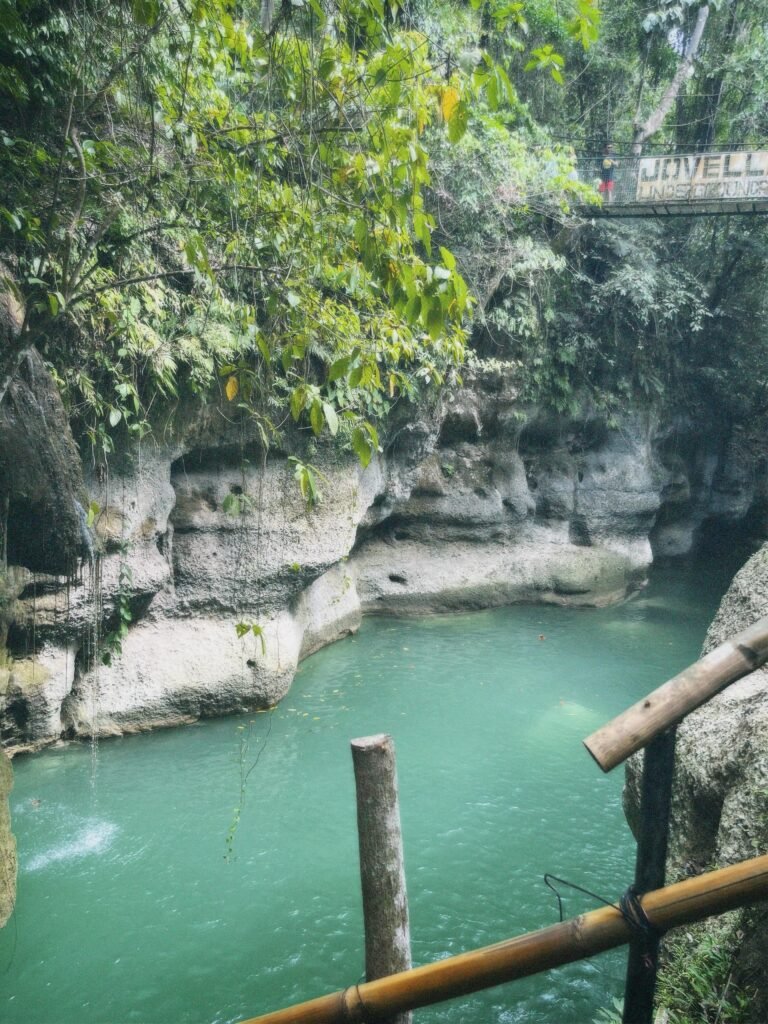
After the raft exits the back of the cave, the river opens into a deep, walled gorge. This was my favorite section. The water in the gorge pool is noticeably deeper — reaching an estimated 10 feet or more in the center. Cliff jumping happens off the limestone walls and from a rope swing suspended from an overhanging tree. The jumps are not extreme in height, but the water is deep enough to be safe for straight entries. For the Jovellar Underground River cliff jumping and waterfalls section of the tour, this is the energy shift that makes the whole trip feel complete — quiet cave, then open sky and a cold plunge.
Life vests are mandatory in the gorge for all swimmers, including strong swimmers. The guide enforces this.
Sigpit Falls (Quitinday Falls)
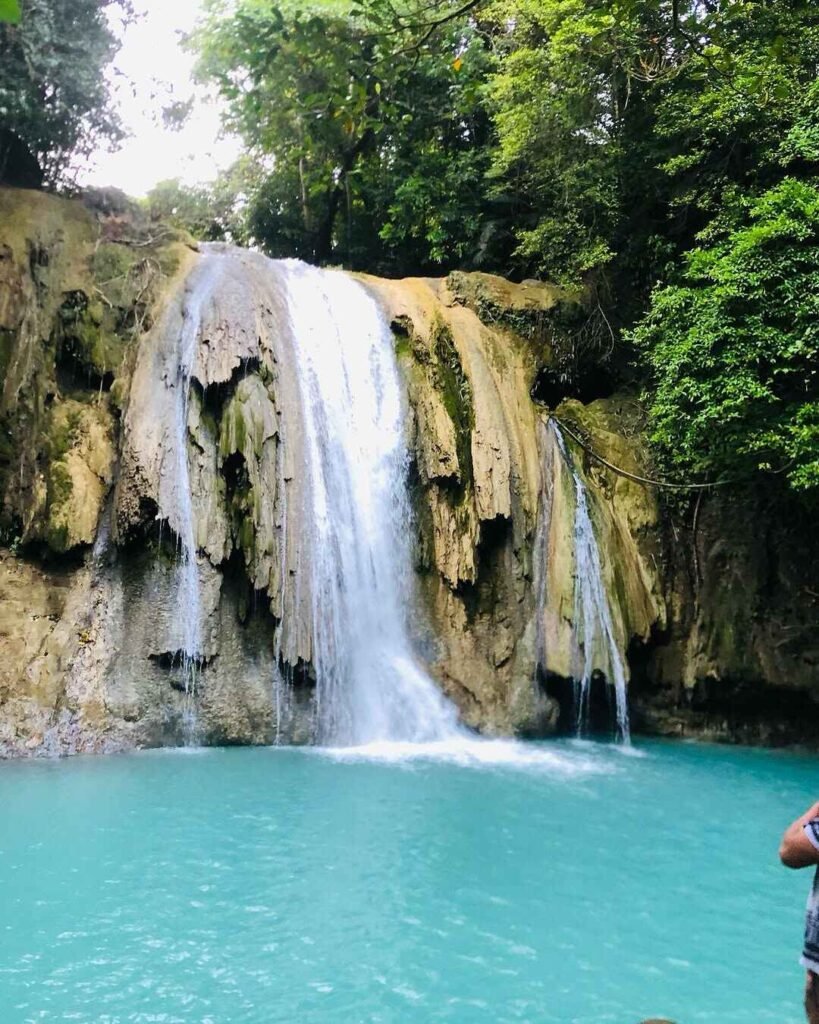
Approximately 300–350 meters downstream from the cave exit, the Quipia River drops over a rocky ledge into the two-tiered Sigpit Falls, also called Quitinday Falls, which measures roughly 40–50 feet in total height. The first pool at the base is 3–4 feet deep — good for wading and relaxing. The second pool, directly under the main cascade, drops to about 10 feet and is suitable for swimming and diving. Access from the gorge is by a riverside trail and a pedestrian bridge. Sigpit Falls is included in the standard entrance fee — no extra charge.
Dry Caving
The upper, non-submerged limestone chambers above the main tunnel are accessible as a separate dry caving activity at PHP 300 per person. This involves scrambling over sharp rocks through unlit passages. It requires a baseline fitness level and closed-toe shoes with ankle support. If you have done the raft ride and want something more physically demanding, this is a natural add-on.
River Tubing and Wading
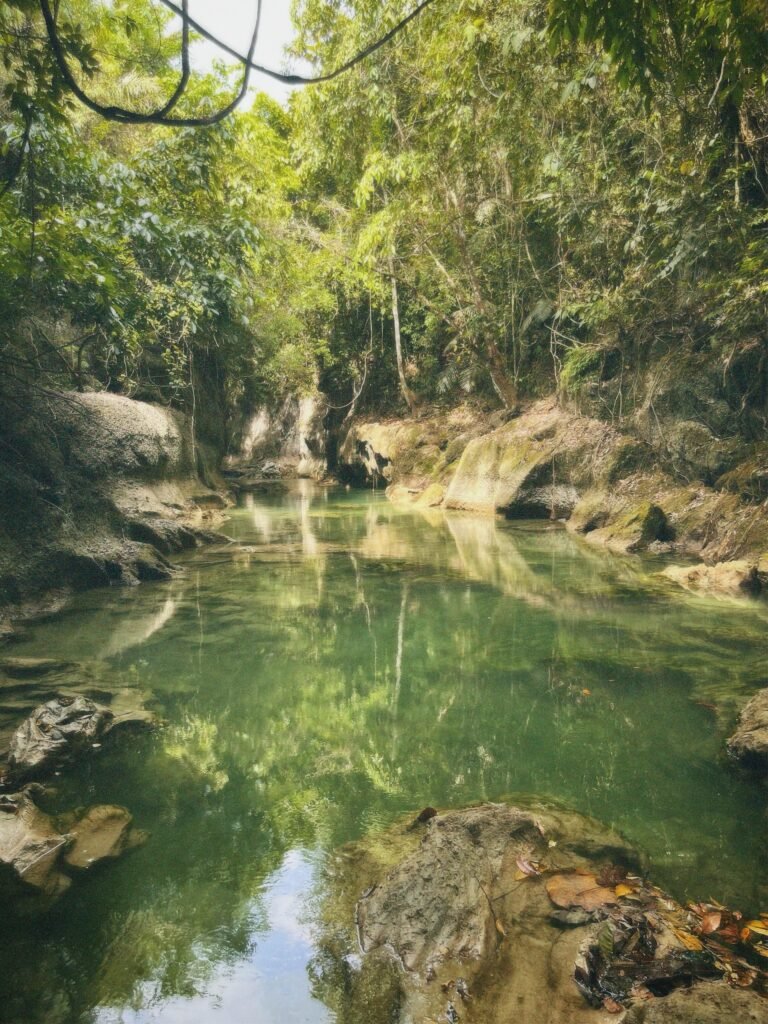
The calmer, shallower sections of the Quipia River downstream from the gorge are used for river tubing and wading. This is the most relaxed activity in the complex — a good option for families with children or anyone who wants to stay in the water without the intensity of cliff jumping.
You can also find nearby Sumlang Lake in Camalig for a completely different water experience — flat bamboo raft dining with a straight view of Mayon Volcano, about an hour from Jovellar.
Best Time to Visit Jovellar Underground River
The dry season from November through May delivers the teal-colored water the site is known for; the wet season turns the river murky and raises flood risk.
During dry season, the Quipia River runs with its signature teal water color — a product of low sediment load and the mineral composition of the spring-fed source. Morning light between 6:00 AM and 9:00 AM hits the gorge walls at an angle that makes the water color most vivid. Arrive early if photography matters to you.
From June through October, monsoon and typhoon rains push topsoil and sediment into the Quipia system. The water turns brown. Levels rise sharply, the current inside the cave accelerates, and the site closes when conditions become hazardous. Guides make the call on the day — there is no booking system to check remotely before you arrive.
I visited in August — technically wet season — but got lucky with a dry, sunny morning. The water was cleaner than I expected, closer to a light olive than full brown, but still nothing like the teal you see in dry-season photos. If you want the Jovellar Underground River teal water color at its best, come between December and April.
The site opens at 6:00 AM and closes at 6:00 PM under standard municipal schedules, with some sources listing 7:00 AM to 5:00 PM as an alternate window. Either way, plan to arrive by 8:00 AM at the latest to beat group tours and leave time for the falls.
Budget Breakdown for Visiting Jovellar Underground River
A solo Filipino traveler on public transport spending a full day at the site can expect to pay around PHP 700–900 all-in, excluding accommodation.
| Expense | Cost (PHP) |
|---|---|
| Entrance Fee (Filipino adult) | PHP 50 |
| Bamboo Raft Ride (shared, per person in group of 4) | ~PHP 100 |
| Mandatory Guide Fee (per group of 4, split) | ~PHP 50 |
| Habal-Habal from Jovellar Town to Quitinday (round trip) | PHP 80–120 |
| Jeepney: Legazpi to Guinobatan | PHP 30–50 |
| Jeepney: Guinobatan to Jovellar | PHP 50–100 |
| Food (packed lunch or village stall) | PHP 100–200 |
| Dry Caving (optional) | PHP 300 |
| Kubo rental (optional, split among group) | PHP 100–225 |
| Estimated Total (without optional extras) | ~PHP 460–570 |
| Estimated Total (with dry caving + hut) | ~PHP 900–1,100 |
Private charter from Legazpi adds PHP 410–490 one-way or roughly PHP 800–1,000 for a round trip with waiting, which remains competitive once you add up jeepney fares and eliminate the missed-last-jeepney risk.
What to Pack for Jovellar Underground River
| Item | Essential? |
|---|---|
| Aqua shoes or waterproof trekking sandals with grip | Yes — non-negotiable |
| Swimwear worn under clothes | Yes |
| Dry bag or waterproof phone case | Yes — total submersion is likely |
| Headlamp or waterproof flashlight | Recommended |
| Cash (PHP) — no ATM in Jovellar | Yes |
| Change of dry clothes for the ride home | Yes |
| Sunscreen (reef-safe) | Yes |
| Packed lunch or snacks | Recommended — no restaurant at the site |
| Insect repellent | Recommended |
| Small towel | Yes |
| GoPro or waterproof camera | Optional but worthwhile |
Leave single-use plastics behind. The site enforces a strict pack-in, pack-out waste policy — there are no bins in the gorge. Everything you bring in comes back out with you.
Safety Tips for Visiting Jovellar Underground River
The site is safe for most visitors when conditions are dry and LGU rules are followed; the main risks are flash flooding, slippery rock surfaces, and unsupervised non-swimmers near deep water.
Life Vests Are Mandatory
The Municipal Tourism Office requires all raft passengers and gorge swimmers to wear a life vest (PFD) at all times on the water. This applies regardless of swimming ability. Helmets are also provided for the raft ride. The equipment is supplied by the site — you do not need to bring your own.
Flash Flooding and Cave Closure
The most serious risk at Jovellar Underground River is a rapid rise in water level inside the cave. The Quipia River responds quickly to rain upstream, even when the weather at the site appears clear. The guides monitor conditions and close the cave when the water level reaches a safety threshold. Do not attempt to enter the cave tunnel independently. If the guide says the cave is closed, it is closed — there are no exceptions. Operations are fully suspended during typhoons and active flooding events.
Slippery Rock Surfaces
The wooden staircase to the cave mouth, the cave entry points, and the limestone rocks throughout the gorge are wet and smooth. Grip soles matter. Falls on wet limestone hurt. Take the staircase one step at a time on the descent.
Depth Changes in the Gorge
The gorge pool has abrupt depth changes with no visual warning from the surface. The central section drops to 10 feet or more; the edges near the cliff walls are shallower but uneven. Non-swimmers should stay in the shallow downstream sections or the upper Sigpit Falls pool (3–4 feet deep) and must keep their life vest on at all times in open water.
Currents Inside the Cave
The current accelerates near the rear exit of the cave, where large boulders narrow the channel. On the raft, the guide manages this. If you are in the water — which you should not be inside the cave — this section creates a genuine pull. Stay on the raft inside the tunnel.
Cell Signal and Emergency Communication
There is no mobile phone signal inside the cave or in the gorge. Signal in the Barangay Quitinday area is limited or absent depending on your network provider. Arrange your driver’s return pickup before you descend. If you have a medical condition or travel with non-swimmers, tell your guide before the tour starts — the guides are trained to manage the group but need to know who needs closer supervision.
Supervision for Non-Swimmers and Children
Children and non-swimmers are welcome at the site. The bamboo raft is fully accessible for non-swimmers and is the safest way to experience the cave. Keep children in their life vests throughout the gorge section. The shallow 3–4 foot pool at Sigpit Falls is the best area for young children to wade.
For general water activity safety standards and , check the broader Albay tourist spot guide for context on how sites like this are regulated provincially.
What I Would Do Differently Next Time
I visited in August and got a clear morning, which was fortunate — but wet-season timing is still a gamble. Next time, I would go between December and February specifically to see the teal water color rather than the muted olive I experienced. I would also arrive at 7:00 AM instead of 9:00 AM; by the time I reached the gorge, two tour groups from Legazpi had arrived, and the cliff jumping spot got crowded fast.
I skipped dry caving on this visit to save time, and I regret it. The PHP 300 is reasonable for what sounds like a genuinely different physical experience. I’d add that to the itinerary next time and plan for a full 5–6 hours at the site rather than the 3.5 hours I spent.
One practical thing I missed: I didn’t negotiate a cottage rental in advance. By mid-morning, both large huts were taken by a group that had booked early. If you are visiting with four or more people and want a shaded base between activities, ask about cottage availability at the registration desk the moment you arrive.
Frequently Asked Questions About Jovellar Underground River
Can you swim inside the Jovellar Underground River?
Swimming inside the cave tunnel is not permitted — the only way to navigate the subterranean section is by bamboo raft, which is guided and mandatory. Swimming is allowed in the open gorge immediately after the cave exit and in the pools at Sigpit Falls downstream. Life vests are required for all water activities in the gorge, and the deepest section reaches approximately 10 feet. Non-swimmers can participate in the full raft ride without any swimming requirement.
How do you get to Jovellar Underground River from Legazpi City?
The fastest route is a direct private vehicle charter from Legazpi City, covering 24.5 kilometers in 32–45 minutes for approximately PHP 410–490 one-way. Negotiate a whole-day wait-and-return rate with your driver before departing. By public transport, take a jeepney from Legazpi Grand Central Terminal to Guinobatan (PHP 30–50, 30–45 min), transfer to a Jovellar-bound jeepney (PHP 50–100, 45–60 min), then hire a habal-habal from Jovellar town to Barangay Quitinday (PHP 40–120). Note that the last jeepney back from Jovellar departs between 3:00 PM and 5:00 PM.
What is the entrance fee for Jovellar Underground River?
The LGU sets the entrance fee at PHP 50 for Filipino tourists, PHP 200 for foreign tourists, PHP 30 for children aged 10 and below, and PHP 40 for senior citizens. The bamboo raft ride costs PHP 400 per raft shared by up to 10 people. A mandatory guide fee of PHP 200 per group is charged separately. All fees are paid at the Quipa Village registration center, and the site is cash only — there is no ATM in Jovellar municipality.
What activities are included in the Jovellar Underground River tour?
The standard tour covers the bamboo raft ride through the 150–180 meter Naglaus Cave, swimming and cliff jumping in the open gorge pool, and access to Sigpit Falls (also called Quitinday Falls) approximately 350 meters downstream — all within the base entrance fee and raft charge. Optional add-ons include dry caving (PHP 300 per person) through the upper limestone chambers and river tubing in the calmer downstream sections. Rope swinging into the gorge pool is also available at no extra charge as part of the gorge activity area.
What is the best time of year to visit Jovellar Underground River in Albay?
The best time to visit is during the dry season from November through May, when the Quipia River runs its well-known teal water color due to low sediment levels and stable water volume. The months of December through April offer the most reliable weather and the best visual conditions for photography. The wet season from June through October brings heavy sediment that turns the water brown, raises flood risk, and can result in cave closure on short notice. Mornings between 6:00 AM and 9:00 AM offer the best light in the gorge regardless of season.
Final Verdict: Is Jovellar Underground River Worth Visiting?
The Jovellar Underground River delivers something genuinely rare in Philippine ecotourism: a single site where you transition from a dark, silent limestone cave to an open cliff-jumping gorge and a tiered waterfall, all within a short trek from a road-accessible village. 5 out of 5 for adventure travelers and day-trippers from Legazpi; slightly lower for visitors expecting polished facilities, since changing rooms, ATMs, and mobile signal are all absent by design.
If you are planning a multi-day Albay trip, add the Cagsawa Ruins in the afternoon and the Mayon Skyline View Deck for a second day — the underground river anchors the best inland half-day in the province, and the Jovellar Underground River Albay day trip from Legazpi is well worth the drive. For more on what Albay offers beyond the volcano, the Ibalong Festival and cultural highlights add useful context to the region’s character before you travel.