

Burias Island is one of three major islands that make up Masbate province in the Bicol Region, and for travelers who want dramatic rock formations, shifting sandbars, and an island-hopping route that still feels raw and unpolished, it delivers. The classic circuit from San Pascual covers Animasola Island, Tinalisayan Island, and Sombrero Island in a single day, and every one of those stops is genuinely different from the last.
That said, this trip has a hard ceiling on flexibility. When I was there in September 2026 — covering Masbate as part of 69 provinces since 2015 — the logistics were the whole game: which ferry you catch, how much cash you carry in small bills, and whether you leave the port early enough to avoid the Ragay Gulf chop by mid-afternoon. Get those right and Burias earns its reputation. Get them wrong and you are spending an unplanned night on the island.
This guide gives you the 2026 numbers and the practical order for using them.
Key Takeaways
- A standard boat charter from San Pascual covering Animasola, Tinalisayan, and Sombrero costs ₱3,000 to ₱4,000 for up to 5-6 passengers. Adding Dapa Island costs ₱500 more.
- The last public outrigger from San Pascual back to Pasacao leaves at 2:30 PM. The last Starhorse RORO departs at 5:00 PM. Missing both means an unplanned overnight.
- There are zero ATMs on Burias Island. Withdraw everything in Naga City, Pasacao, or San Andres before you cross.
- The best travel window is March to late May. A secondary window exists in November to December with fewer crowds but residual typhoon risk.
- Generator power on Sombrero Island runs 6:00 PM to 6:00 AM only. Charging costs ₱50 per device. A high-capacity power bank is not optional.
- Burias Island is not suited for travelers expecting reliable mobile data, card payments, air-conditioned facilities, or flexible departure times.
Table of Contents
Is Burias Island Worth Visiting?
Burias Island is worth the trip if you want a rugged, regulated island-hopping experience in an area that still feels like it hasn’t been over-marketed. The three main stops on the San Pascual circuit cover genuinely distinct terrain: sedimentary rock formations at Animasola, a tidal sandbar at Tinalisayan, and beach camping on Sombrero. No two feel alike, which is harder to find than it sounds.
It is not worth the trip if you need luxury resorts, 24-hour power, strong mobile signal, or the ability to book things as you go. San Pascual is a cash-only, limited-signal, generator-dependent town. The outer islands are more so. The beauty of the place is real, but it comes attached to genuine inconvenience, and the travelers who end up frustrated are almost always the ones who expected otherwise.
A 2D1N trip works if you are budget-conscious and do not mind a packed first day. A 3D2N trip is better if you want a weather buffer, a more relaxed pace, or time to see the mainland heritage sites alongside the island circuit.
Where Burias Island Is Located
Burias Island is located in the island province of Masbate, Bicol Region (Region V), in the central Philippines. It sits between the Ragay Gulf to the north and the Ticao and Burias Passes to the south and east. Administratively, the island is split between two municipalities: San Pascual in the north and Claveria in the south.
For most travelers, San Pascual is the relevant entry point. It is the main tourism hub for the island-hopping circuit and the terminus for ferries from Pasacao in Camarines Sur. Burias Island is one of three principal islands in Masbate province, alongside Masbate Island and Ticao Island.
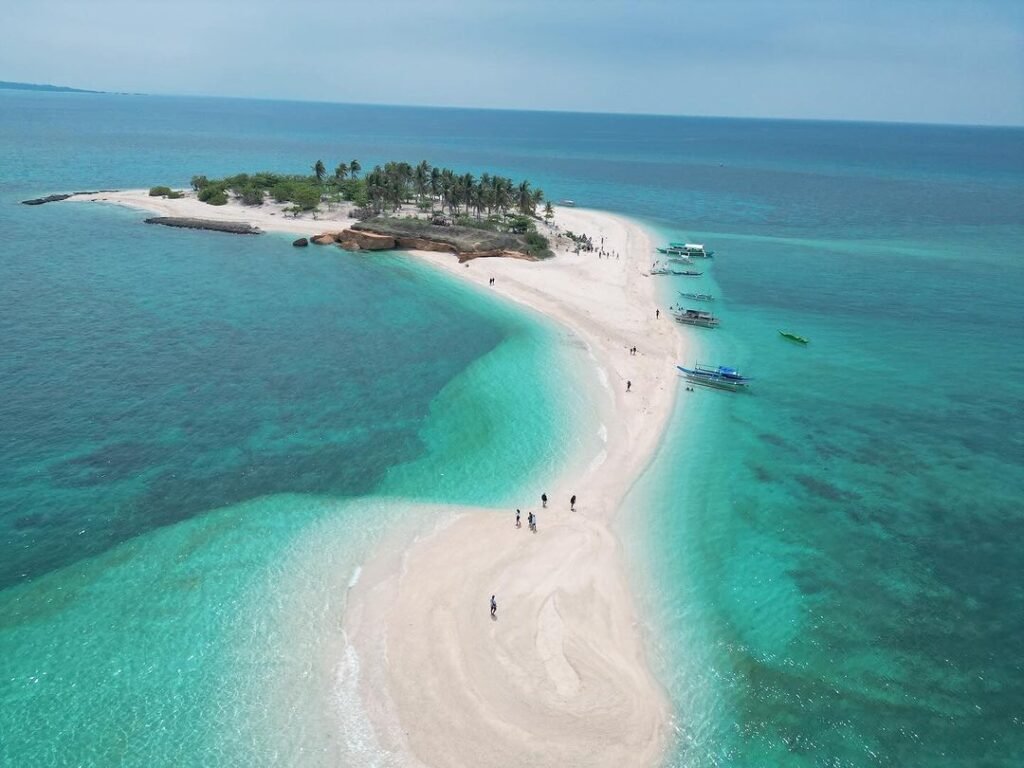
The Burias group of islands — meaning Burias and its surrounding islets including Animasola, Tinalisayan, Sombrero, and Dapa — falls under San Pascual’s jurisdiction on the northern end of the main island.
| Access Point | Route |
|---|---|
| Naga / Camarines Sur | Naga → Pasacao Port → San Pascual (ferry) |
| Manila via Bicol | Manila (overnight bus) → Naga → Pasacao → San Pascual |
| Manila via Quezon | Manila → San Andres → charter boat to Burias |
| Albay / Legazpi | Pio Duran → Claveria (RORO) → overland to San Pascual |
| Masbate City | Masbate → Mobo → Claveria (RORO) → overland to San Pascual |
How to Get to Burias Island from Manila
There are three distinct corridors into Burias Island. Which one you use depends on where you are starting and whether you want to include other islands in the route.
Route 1: Via Pasacao Port (Camarines Sur) — Recommended
This is the most structured and reliable way to reach San Pascual. From Manila, board an overnight bus to Naga City. Peñafrancia Tours, DLTB, and Isarog Lines all serve this route. Travel time is 8 to 9 hours and fares range from ₱700 to ₱1,600 depending on whether you take a regular, deluxe, or premium sleeper seat.
From Naga’s central transport terminal, take a van or jeepney to Pasacao Port. The ride takes about 45 minutes and costs ₱70 to ₱150 per person.
At Pasacao, you have two vessel options across the Ragay Gulf to San Pascual:
| Route | Operator | Departure Times | Fare | Travel Time |
|---|---|---|---|---|
| Pasacao → San Pascual | Starhorse Shipping (RORO) | 5:00 AM, 10:00 AM | ₱300-₱360 | 2.5-3 hours |
| San Pascual → Pasacao | Starhorse Shipping (RORO) | 5:30 AM, 5:00 PM | ₱300-₱360 | 2.5-3 hours |
| Pasacao → San Pascual | Public commuter outriggers | 7:00 AM, 10:00 AM, 2:00 PM | ₱130-₱200 | 2-3 hours |
| San Pascual → Pasacao | Public commuter outriggers | 5:30 AM, 9:30 AM, 2:30 PM | ₱130-₱200 | 2-3 hours |
The 2:30 PM outrigger and 5:00 PM RORO from San Pascual are the day’s final return options. Missing both of them means you stay overnight on Burias whether you planned to or not.
The Starhorse RORO vessels are the island’s primary supply chain link. Their cargo tariffs set the cost of goods in San Pascual: ₱540 for bicycles, ₱1,920 for motorcycles, ₱4,980 for private SUVs, and ₱12,900 for 10-wheel trucks. That freight cost is why everything on the island costs more than it does in Naga.
Route 2: Via San Andres, Quezon
Buses from Alabang Starmall or Cubao go directly to San Andres in Quezon Province, an 8-hour journey with fares of ₱420 to ₱500 via Barney Bus or Superlines. From San Andres port, travelers charter private outrigger boats that typically stop at Alibijaban Island before crossing into Masbate waters for the Burias circuit.
This is the better route if you want to combine Alibijaban’s sandbar and mangrove forests with Burias in one trip. The open-water crossing is longer and more weather-sensitive than the Pasacao route, and private boat charters for the combined itinerary run ₱8,000 to ₱9,000 for up to 10 passengers.
Route 3: Via Claveria (from Albay or Masbate City)
Travelers coming from Albay or already in Masbate use RORO vessels into Claveria, the southern municipality of Burias Island.
| Route | Operator | Departure | Fare | Travel Time |
|---|---|---|---|---|
| Pio Duran (Albay) → Claveria | Santa Clara / Kho Shipping | Typically twice daily | ₱350-₱440 | 3 hours |
| Claveria → Mobo (Masbate) | Kho Shipping Lines | 6:00 PM | ₱450-₱550 | 4 hours |
| Mobo → Claveria | Kho Shipping Lines | 12:01 AM | ₱450-₱550 | 4 hours |
Kho Shipping’s vehicle rates: ₱4,800 for sedans, ₱6,000 for SUVs, and up to ₱21,600 for 40-foot trucks.
After landing in Claveria, the overland trip to San Pascual covers 124 kilometers of poorly maintained provincial roads by jeepney, tricycle, or habal-habal. Expect 3.75 to 4 hours on the road. This route only makes sense if you are already in Albay and want to build a Claveria-side itinerary, or if you are connecting from Masbate City. It is a grueling way to reach the tourist circuit on the northern end of the island compared to just taking the Pasacao ferry directly to San Pascual.
When to Visit Burias Island
The best months to visit Burias Island are March through late May, when the Ragay Gulf and Burias Pass settle into their most reliable calm window. This aligns with the dry season and the tail end of the Amihan (northeast monsoon), giving you the highest probability of boat travel without coast guard suspensions or dangerous chop.
A secondary window opens in November and December after the worst of the wet season clears. Temperatures are lower and crowds are thinner, but late-season tropical depressions are still possible, so check PAGASA forecasts before you commit.
June through October is when the Habagat (southwest monsoon) and Pacific typhoon season dominate the Ragay Gulf. The Philippine Coast Guard issues no-sail orders frequently during this window, and those orders apply to tourist charters with no exceptions. Being stranded on Burias during a weather delay is not a minor inconvenience: there are no ATMs, restaurants, or reliable power on the outer islands.
Beyond the seasonal window, there is also a daily timing rule. Thermal winds build over the Masbate landmass as the sun rises and push the Ragay Gulf choppier by early afternoon. All island-hopping boats should depart San Pascual between 5:30 AM and 8:00 AM at the latest. The later you leave the port, the rougher the crossing gets, and the less buffer you have before the 2:30 PM return cut-off.
If you visit in the second week of May, the Isla Rancho Festival runs from around May 12 to 17, culminating near the feast day of St. Paschal Baylon. Masbate is often called the Rodeo Capital of the Philippines, and this festival is where that identity is most visible: barn dance competitions, beef cooking showcases, and cattle demonstrations that draw the year’s highest tourist numbers to San Pascual.
Fees, Boat Charters, and What You Will Actually Spend
The full cost of a Burias Island island-hopping day is not a single line item. Fees are collected in cash at each individual stop by different barangay caretakers or environmental officers. Bring small bills. The rate board at the San Pascual Tourism Office beside the port is where all registrations begin, and nothing moves until you clear it.
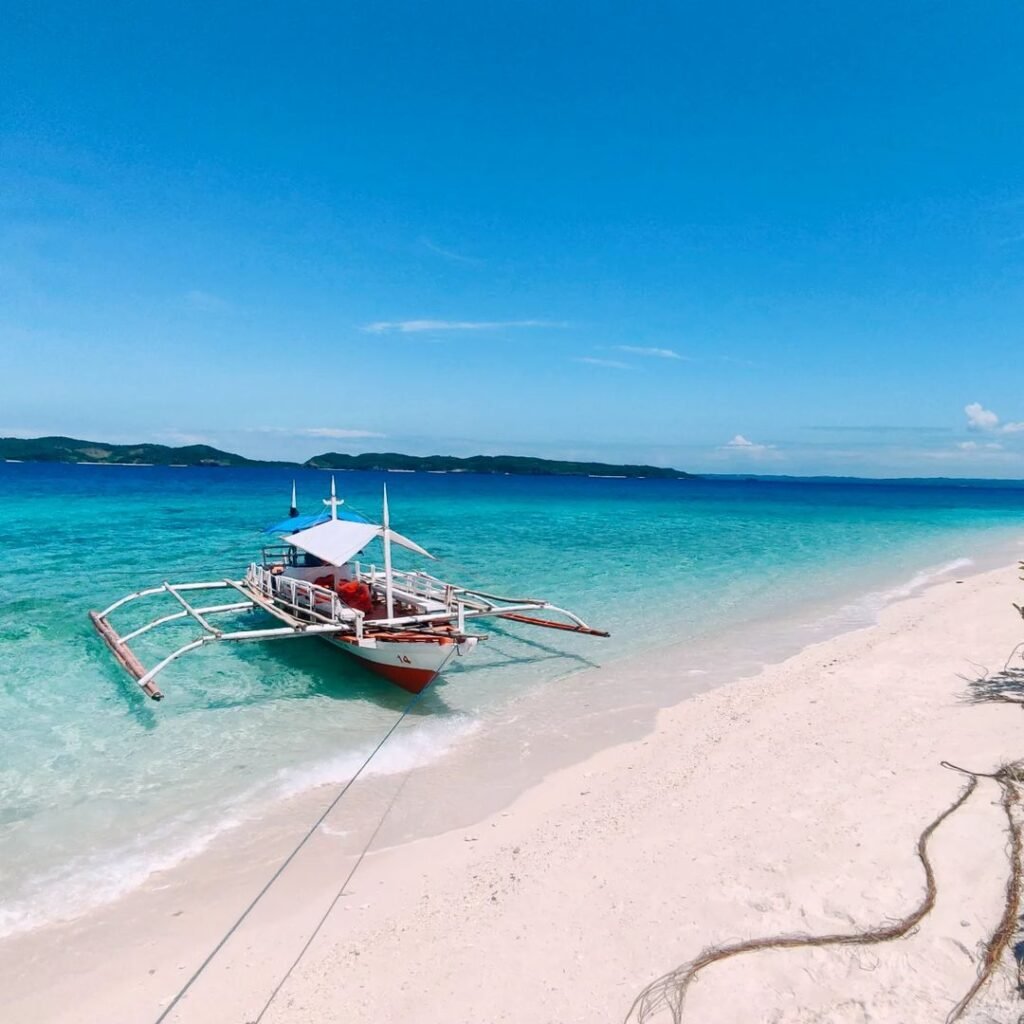
Boat charter rates from San Pascual: ₱3,000 to ₱4,000 for a standard outrigger covering Animasola, Tinalisayan, and Sombrero for up to 5 to 6 passengers. Each additional island stop (Dapa, Templo) costs ₱500 more per island.
| Fee | Amount |
|---|---|
| Environmental / LGU registration, San Pascual port | ₱50-₱100 per person |
| Municipal terminal fee, San Pascual | ₱30-₱50 |
| Entrance fee, Animasola Island | ₱20-₱50 per person |
| Docking fee, Animasola Island | ₱100 per boat |
| Entrance fee, Tinalisayan Island | ₱50-₱100 per person |
| Docking fee, Tinalisayan Island | ₱300 per boat |
| Entrance fee, Sombrero Island | ₱50-₱100 per person |
| Overnight tent pitching, Sombrero Island | ₱100-₱200 per tent |
| Freshwater for bathing (banlaw), Sombrero Island | ₱150-₱200 per drum |
| Entrance fee, Dapa (Snake) Island | Free |
On my September 2026 visit, the total per-person spend for a day trip with a shared charter split six ways — including registration, all island fees, and food bought at the Pasacao market before crossing — came to around ₱1,200 to ₱1,500 per head, not counting the ferry fare from the mainland. For an overnight trip on Sombrero, add your accommodation tier: tent pitching at ₱150-₱200, open cottages at ₱700-₱1,500, or closed air-conditioned cottages at ₱2,500-₱3,500 (generator power from 6:00 PM to 6:00 AM only, with a ₱50 per device charging fee).
There are zero ATMs on Burias Island. GCash and Maya do not work reliably outside the immediate vicinity of the San Pascual municipal hall. Withdraw everything you need in Naga City, Pasacao, or San Andres before you board any boat.
The Four Island-Hopping Stops
Animasola Island (“Anima Sola” — Lonely Soul)
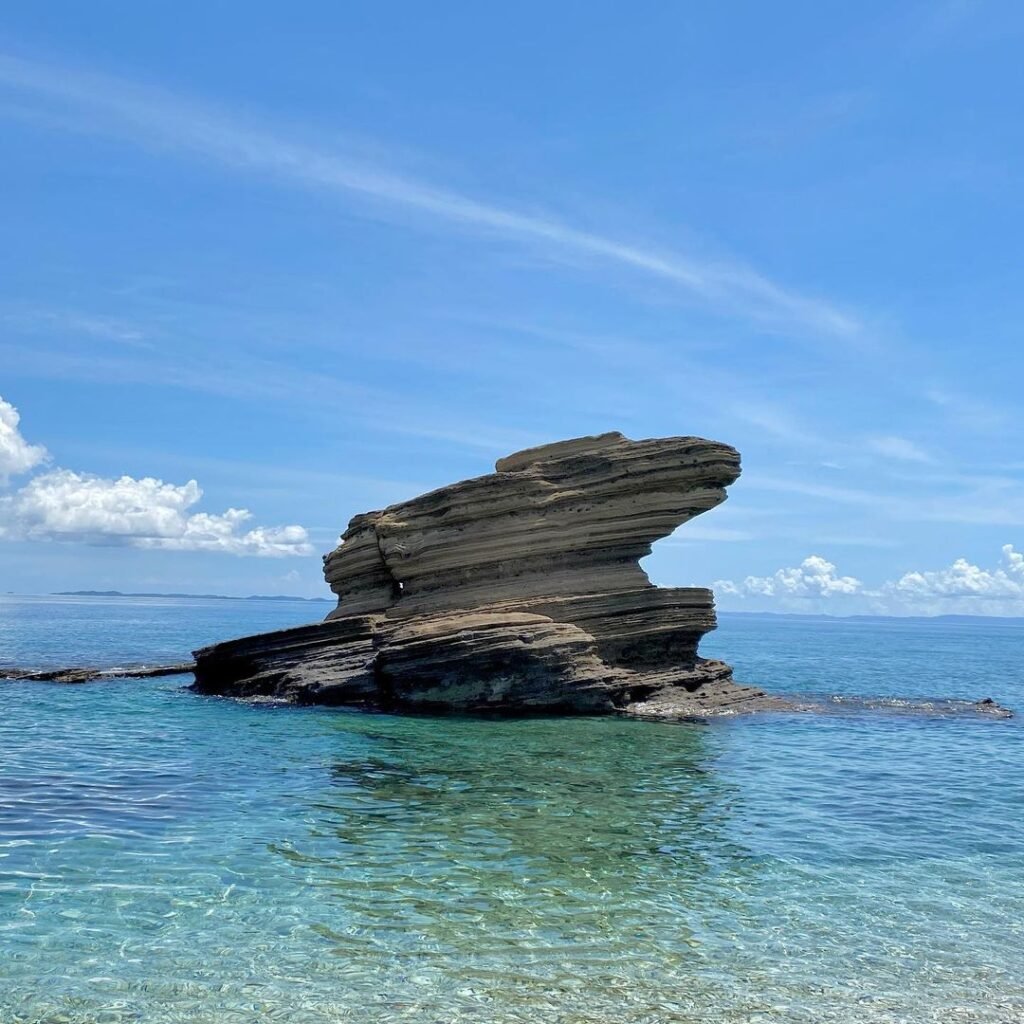
Animasola Island is the geological anchor of the Burias circuit and the stop most photographers come for. Unlike the limestone karst formations you see in Palawan or Bohol, Animasola is sedimentary sandstone: thick horizontal strata of ocher, brown, and copper-colored rock built up over millions of years and then carved by wind and wave into formations that look from certain angles like torn pages of an enormous petrified book, and from others like the head of a reptile emerging from the sea.
At the base of the cliffs, wave action has carved natural tide pools — locals call them the natural Jacuzzis — that are accessible for bathing only at low tide. The terrain is sharp and unforgiving. Barnacle-encrusted rock will cut your feet through thin sandals. Aqua shoes with reinforced soles are mandatory, not optional. The island has no shade at all, so pack high-SPF sunscreen and wear a hat you can secure in open-sea wind.
Tinalisayan Island and Its Sandbar
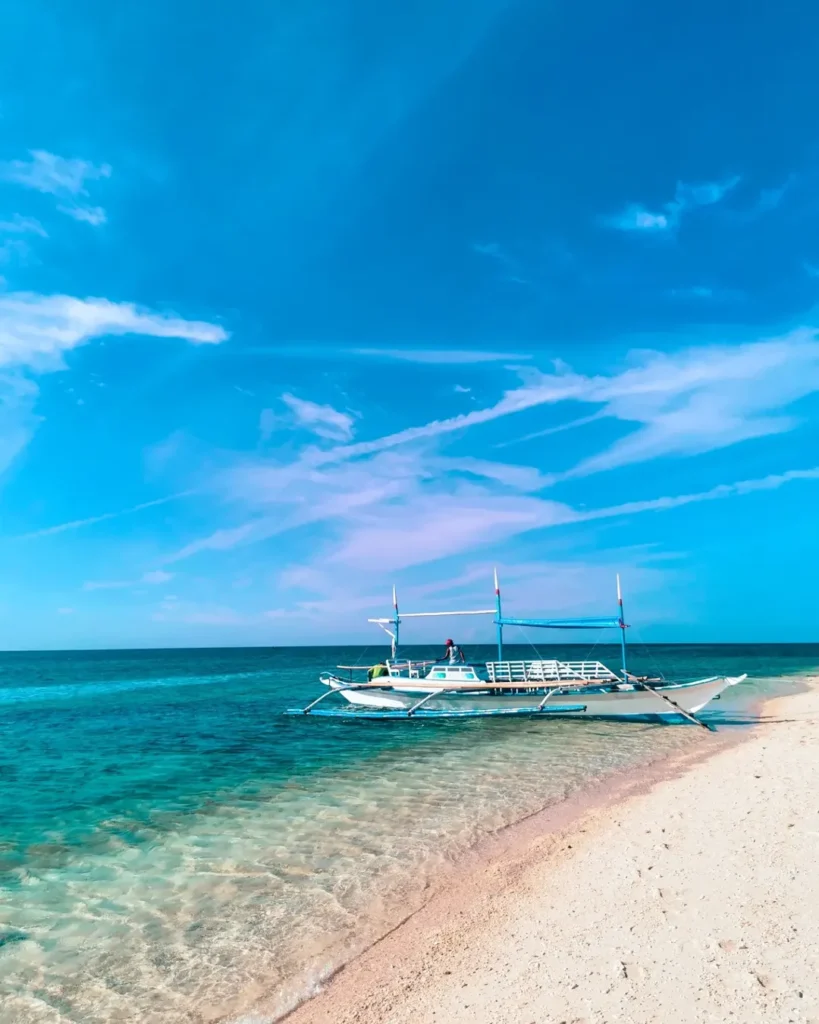
Tinalisayan is the visual counterpoint to Animasola: flat, white, and surrounded by shallow clear water. The sandbar is fully exposed only at low tide, and the boat captain times the arrival to the tidal ebb. Come at high tide and the sandbar is mostly underwater, which changes the photograph entirely. If your tour departs early enough from San Pascual, hitting Tinalisayan around mid-morning usually puts you at or near low tide during the dry season months.
There is no shade on the sandbar either. The sun exposure here is more aggressive than it looks in the photos because the white sand reflects upward as much as the sky pushes down.
Sombrero Island
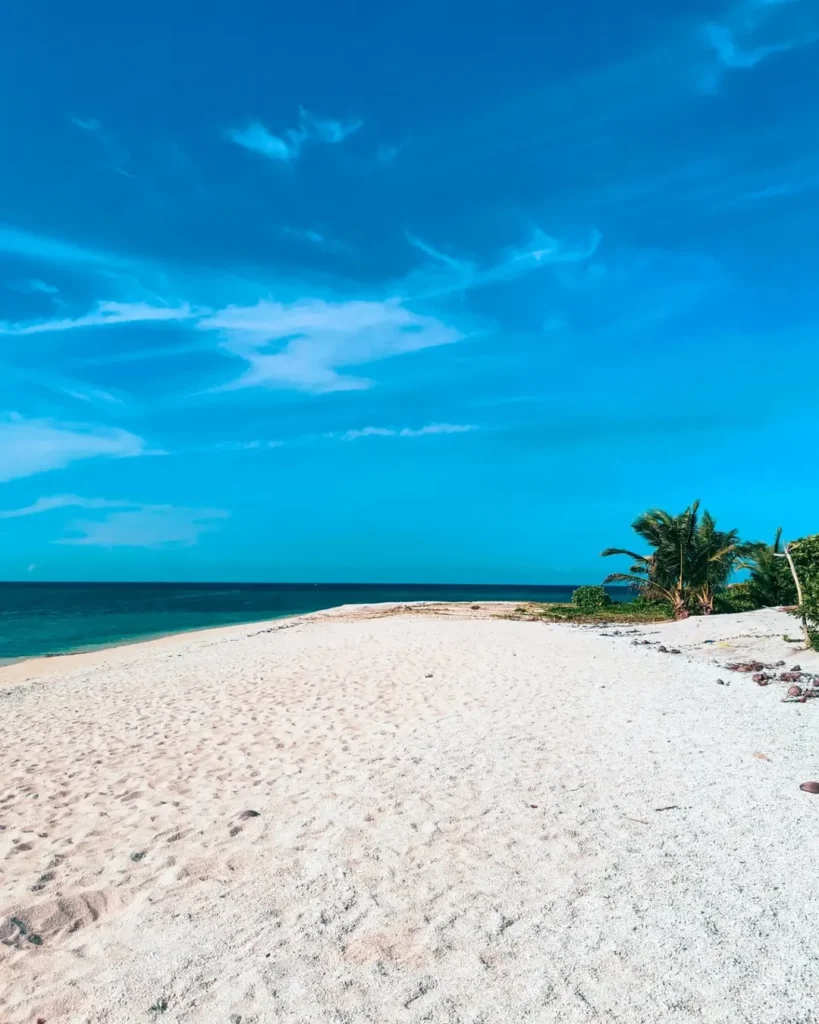
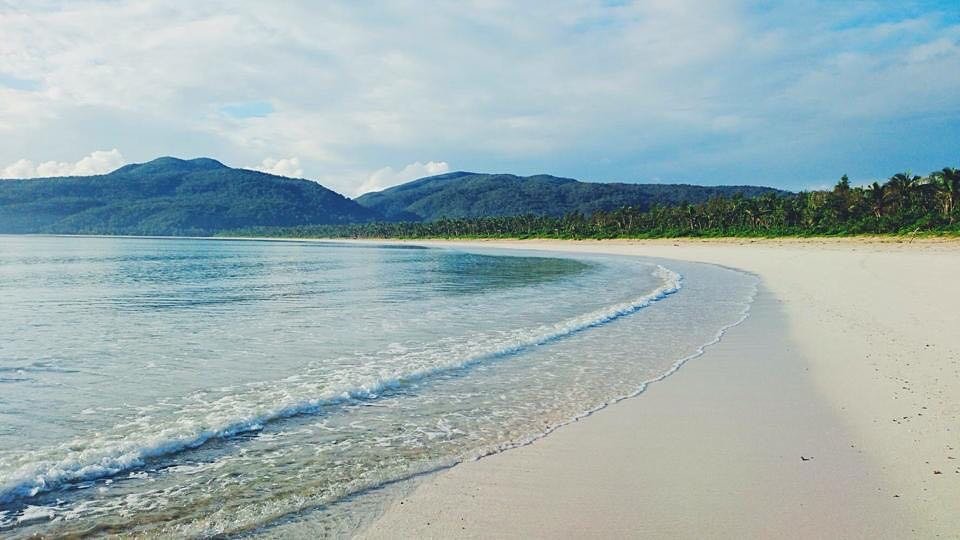
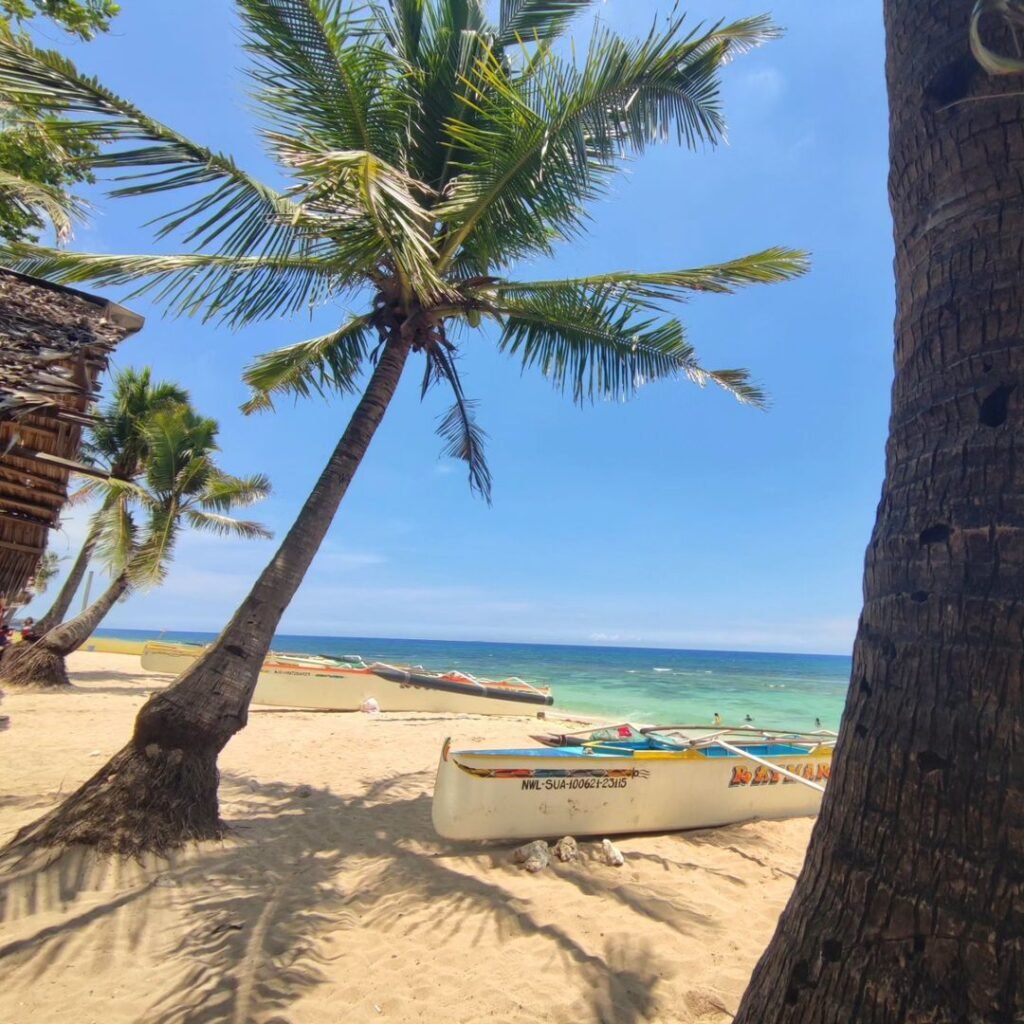
Sombrero Island gets its name from a rock formation at the island’s center that, viewed from the right angle at sea, looks exactly like a cowboy hat. It is the overnight base for the Burias circuit: white-sand beach, zoned camping areas, basic sari-sari stores, and a western exposure that produces an unobstructed sunset view over the Sibuyan Sea.
Open fires directly on the beach are prohibited under LGU environmental rules designed to protect the silica sand from carbon scoring. Fires are only permitted in designated halved metal drums or pre-dug fire pits. Accommodation ranges from tent pitching (₱150-₱200 per tent) to open wooden cottages (₱700-₱1,500) to closed air-conditioned bahay kubo structures (₱2,500-₱3,500). Generator power runs 6:00 PM to 6:00 AM only. Charging any device costs ₱50. Plan your power bank accordingly.
Freshwater for bathing is transported to Sombrero from the San Pascual mainland in large plastic drums. Island caretakers sell it at ₱150 to ₱200 per drum. There is no natural aquifer on the island.
Dapa Island (Snake Island)
Dapa Island has sheer cliffs, a small secluded cove, and a strong current underneath it that makes cliff jumping the main activity. The “Snake Island” name comes from the Yellow-lipped sea krait (Laticaudinae subfamily) that breeds in the island’s deep rock crevices. These snakes are genuinely venomous but are not aggressive toward humans unless disturbed. Do not reach into blind crevices in the rock, and do not try to handle or provoke them. Entrance to Dapa is free — no fee collected here.

Where to Stay Near Burias Island
San Pascual’s accommodation sector is deliberately small and rustic. There are no resort chains here. Power grid stability is the main variable across every option in town: only 9 of 22 barangays in San Pascual have electricity, and even in the town proper, grid power typically runs from 5:00 PM to 5:00 AM, or in more restricted zones from 5:00 PM to 10:30 PM. The Department of Energy’s MEDP 2025-2029 plans hybrid solar plants for the area, but as of my visit in September 2026, travelers should assume limited grid access and plan accordingly.
| Property | Location | Rate Range | Notes |
|---|---|---|---|
| Sunset View Tourist Inn | San Pascual town center | ₱680-₱3,200 | Air-con available, near the port, subject to power outages |
| Atlaza Resort | Brgy. Laurente, San Pascual | Varies | Beachfront access, slightly outside town |
| Virjen Island Resort | Virgin Island, San Pascual | ₱750+ | Very basic island accommodation |
| Sombrero Island Resort | Sombrero Island | ₱150-₱3,500 | Tent pitching, open cottages, closed A/C cottages; generator 6 PM-6 AM |
| MSS Fuentes Lodging | San Pascual town center | ₱200-₱500 | Fan-only, very basic, near the port |
| Treasure Island Hotel | Masbate City (mainland) | ₱1,068+ | Modern amenities, useful pre-trip base before Claveria/Burias |
| GV Hotel Masbate | Masbate City (mainland) | ₱791+ | Budget city option near Masbate transport terminals |

Health, Safety, and Emergency Contacts
Medical infrastructure on Burias Island is limited to the San Pascual Rural Health Unit (RHU), which handles basic outpatient consultations, minor trauma, and has pharmaceutical cold-chain storage for vaccines. Serious injuries, diving incidents, or complex medical emergencies require maritime medical evacuation to Naga City or the Eastern Bicol Medical Center. Carry a complete personal first-aid kit, motion sickness medication, and any prescriptions you depend on.
The Philippine Coast Guard Sub-Station San Pascual monitors the Ragay Gulf and Burias Pass and enforces life-vest regulations. When the PCG grounds vessels due to weather, no tourist charter sails. This is non-negotiable and applies regardless of how much of your itinerary you have left.
For emergencies on the island, the San Pascual DRRMO maintains these hotlines: 0949-737-3547 / 0966-130-6906.
Mobile signal from Globe and Smart is available only near the San Pascual municipal hall and town plaza. On the outer islands, expect a complete communication blackout.
Practical Rules: Signal, Power, and What to Bring
Cash: Withdraw everything in Naga City, Pasacao, or San Andres. No ATMs on the island. No card terminals. No reliable mobile wallet transfers. Bring enough small bills for every island fee, docking fee, and food purchase separately because the fees are collected by different people at each stop.
Power: On Sombrero Island, generators run 6:00 PM to 6:00 AM. Charging costs ₱50 per device. In San Pascual town, the grid runs 5:00 PM to 5:00 AM in the best-served barangays, shorter in others. Bring a high-capacity power bank as primary power and treat the generator as backup.
Signal: LTE from Globe and Smart works only in the immediate area around the San Pascual municipal hall and town plaza. Assume zero signal on the outer islands for the entire duration of island hopping and overnight camping.
What to bring: Thick-soled aqua shoes (mandatory at Animasola), high-SPF sunscreen, a hat with a strap, a dry bag for electronics, your own drinking water and food from the mainland market, motion sickness medication, a personal first-aid kit, all medications you depend on, and a power bank large enough to last two days.
Who should not go: Travelers who need reliable mobile data for work or emergencies, anyone with significant mobility limitations on uneven and sharp terrain, pregnant travelers, and infants. The boat crossings can be rough, the terrain at Animasola requires careful footing, and medical evacuation takes hours.
Frequently Asked Questions About Burias Island
How long does the ferry from Pasacao to San Pascual take?
The Pasacao to San Pascual crossing takes 2.5 to 3 hours depending on sea conditions. Starhorse Shipping’s RORO departs Pasacao at 5:00 AM and 10:00 AM. Public commuter outriggers depart at 7:00 AM, 10:00 AM, and 2:00 PM. The RORO is more stable in rough weather.
What is the last ferry from San Pascual back to Pasacao?
The last public outrigger from San Pascual departs at 2:30 PM. The last Starhorse RORO departs at 5:00 PM. Missing both guarantees an unplanned overnight on Burias Island, which then disrupts any bus or flight connection on the mainland.
Is there an ATM on Burias Island?
There are zero ATMs anywhere on Burias Island. No card terminals, no reliable GCash or Maya signal outside the municipal hall area. Withdraw all your cash in Naga City, Pasacao, or San Andres before crossing.
How much does a boat charter cost for island hopping in San Pascual?
A private outrigger charter from San Pascual covering Animasola, Tinalisayan, and Sombrero costs ₱3,000 to ₱4,000 for up to 5 to 6 passengers. Each additional island (Dapa, Templo) adds ₱500. All charters must be registered at the San Pascual Tourism Office beside the port before departure.
Can you camp on Sombrero Island?
Yes. Sombrero Island is LGU-zoned for overnight camping. Tent pitching costs ₱100 to ₱200 per tent. Open wooden cottages run ₱700 to ₱1,500 and closed air-conditioned cottages run ₱2,500 to ₱3,500. Open fires on the beach are prohibited. Generator power runs from 6:00 PM to 6:00 AM. Device charging costs ₱50 per item. Freshwater for bathing costs ₱150 to ₱200 per drum and must be ordered from the caretaker.
When does the Ragay Gulf become too rough to cross?
The Ragay Gulf becomes consistently rough during June through October, when Habagat and typhoon season dominate. Within any given day, thermal winds build from late morning onward, making afternoon crossings choppier than morning ones. The Philippine Coast Guard Sub-Station San Pascual grounds all tourist boats during gale warnings and tropical cyclone signals, with no exceptions.
Is Burias Island accessible from Quezon Province?
Yes. From San Andres in Quezon, you can charter a private outrigger to Burias Island, typically routed through Alibijaban Island first. The crossing is longer and more weather-sensitive than the Pasacao route. Charter rates for the combined Alibijaban-Burias circuit run ₱8,000 to ₱9,000 for up to 10 passengers.
Are there restaurants on the outer islands?
There are no restaurants on any of the outer islands. Sombrero Island has sari-sari stores with snacks and drinks. For proper meals, use the paluto system: buy raw ingredients at the Pasacao or San Andres market before crossing, and arrange for your boat crew or the island caretaker to cook them for a small fee.
Is Burias Island the same as Burias in Quezon Province?
No. Burias Island is in Masbate province, Bicol Region. It should not be confused with place names in Quezon Province. The island of Burias is one of three principal islands of Masbate, divided between the municipalities of San Pascual (north) and Claveria (south).
Final Verdict: Who Should Go and Who Should Skip It
Burias Island is one of the few island-hopping destinations in the Philippines where the logistics are genuinely part of the experience rather than just obstacles to it. The circuit from San Pascual covers three stops that feel nothing alike — and that variety, within a single day’s boat ride, is the actual reason to go.
The trip suits barkadas willing to organize logistics in advance, photographers who want sedimentary rock formations and tidal sandbars rather than the usual limestone and dive resort scenery, and travelers who are comfortable with ferry timing, cash-only systems, and basic facilities as facts of the destination rather than failures of planning.
It does not suit travelers who expect to wing it. The 2:30 PM last boat is not a suggestion. The cash requirement is absolute. The generator on Sombrero Island does not negotiate hours. When I weigh this against other rugged island-hopping destinations I have covered over the years, Burias punches well above its name recognition — but only for the traveler who shows up prepared. Come with your cash counted, your food bought, your boat pre-registered, and your alarm set early enough to leave the port before the gulf decides to remind you who is actually in charge.
For broader Bicol-side context before planning the rest of your trip around Burias, the top Bicol tourist spots guide covers what is worth building into the mainland portion of your itinerary whether you enter through Naga or Legazpi.

How to get to Burias Island if I hail from Davao City, Mindanao? How much would the transpo cost me? Thank you.
you need fly from Davao to NAGA airport, then travel by land to Pasacao Port then a boat ride to Burias island.