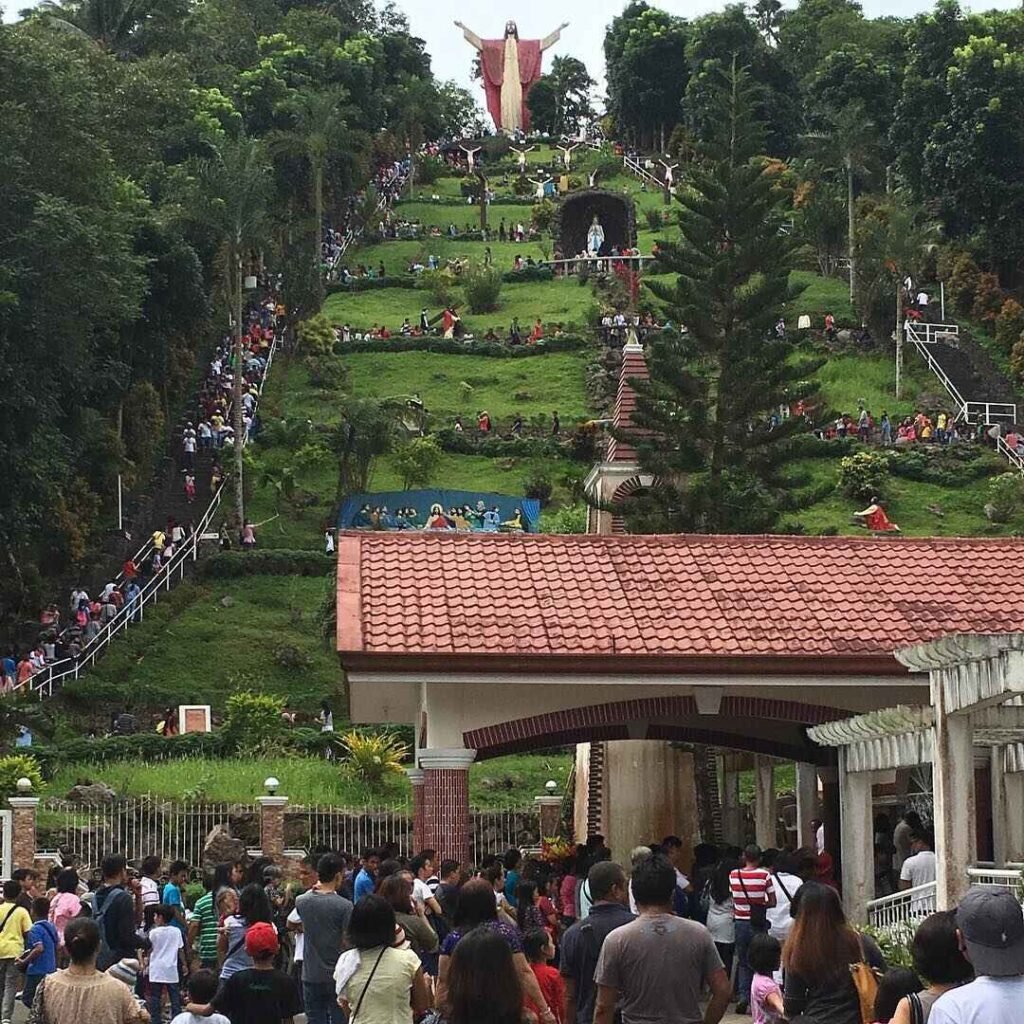
Regina Rica, formally known as the Regina Rosarii Institute for Contemplation in Asia, is a 13.5-hectare pilgrimage sanctuary in Sitio Aguho, Barangay Sampaloc, Tanay, Rizal. The sanctuary is managed by the Dominican Sisters of Regina Rosarii and centers on a 71-foot statue of Our Lady that is visible from the highway.
When I visited in September 2026, having covered 69 of the country’s 82 provinces since 2015, Regina Rica stood out as a deliberately designed sacred space, unlike any I have walked through in Luzon. This guide covers the mass schedule, entrance fees, dress code, directions, and everything a first-time pilgrim needs to plan the trip.
Key Takeaways
- The sanctuary is open Wednesday through Sunday, 8:00 AM to 5:00 PM. It is closed Monday and Tuesday, except during Holy Week.
- Sunday masses run at 9:00 AM, 11:00 AM, 1:30 PM, and 3:30 PM. Saturday has masses at 11:00 AM and 3:30 PM. Weekdays (Wednesday to Friday) have one mass at 11:00 AM.
- The entrance fee situation is unsettled. The sanctuary has historically operated on a no-fee basis, but fee notices have appeared at the gate. Check the official Facebook page at facebook.com/ReginaRICAOfficial before your trip (as of September 2026).
- Parking costs ₱50 for cars and SUVs, ₱100 for vans and buses (as of September 27, 2026).
- The dress code is strict: no shorts, no sleeveless tops, no slippers. Cover-ups are available to borrow at the entrance if you forget.
- The Feast of Our Lady of the Rosary in October and Holy Week are the two peak pilgrimage periods. Arrive before 9:00 AM on those dates.
- Driving from Quezon City takes roughly 2 to 2.5 hours via Marcos Highway through Antipolo and Teresa.
Table of Contents
What is Regina Rica and why do pilgrims go there?
Regina Rica is one of the few pilgrimage destinations in the Philippines built entirely around the Dominican contemplative tradition rather than a historic parish or a civil-war-era miracle. The site was founded by the Dominican Sisters of Regina Rosarii, a congregation established on May 13, 2005, under the leadership of Sister Mary Epifania “Eppie” F. Brasil, OP.
That date, May 13, carries three layers of meaning for the congregation. It is the Feast of Our Lady of Fatima. It is the official founding day of the order.
And it anchors the sisters to Matthew 5:13, the verse that calls believers to be the “salt of the earth.” The founding sisters broke from their former congregation, OP Molo, after nineteen months of discernment, driven by a calling to serve what they describe as the poor and broken.
The congregation’s first base was a rented center at 70 Scout Fernandez Street in Barangay Laging Handa, Quezon City. Their Marian devotion was real enough then that they kept a 20-foot statue of Our Lady on the roof deck. The hymn they sang described the Lady waiting on top of a hill, which made the roof deck feel like a placeholder.
In 2009, a fundraising campaign called “Our Lady’s Club 513” asked 513 benefactors to pledge ₱513 monthly for five years. Through it, the congregation acquired the Tanay land. They began building what pilgrims now call the Land of a Million Miracles.
What distinguishes Regina Rica from other Philippine Marian shrines is its emphasis on silence, structured contemplation, and a physical journey. The 71-foot statue of Our Lady, sculpted by Bikolano artist Jose “Jojo” Barcena Jr., shows Mary actively cradling the infant Jesus while her mantle appears to shelter the hills below. Inside the statue is SULOD, an adoration chapel whose name is both an acronym (Sanctuary of Universal Love and Devotion) and the Ilonggo word for “enter.”
Shoes come off at the threshold. Cameras stay in bags. That level of control over the visitor experience is rare among publicly accessible shrines in the country, and it is why people return.
The congregation’s logo, a Dominican shield containing a white teardrop with Our Lady at its center, signals the theology of the place: sorrow acknowledged, but held inside maternal presence. Pilgrims who arrive carrying specific anxieties tend to find that framing useful.

Regina Rica mass schedule. Saturday, Sunday, and weekdays
The Regina Rica mass schedule for 2026 is organized by day of week. Sunday carries the heaviest load. It serves working pilgrims from Metro Manila and nearby provinces.
Here is the complete schedule:
| Day | Mass Times |
|---|---|
| Monday | Closed (except Holy Week) |
| Tuesday | Closed (except Holy Week) |
| Wednesday | 11:00 AM |
| Thursday | 11:00 AM |
| Friday | 11:00 AM |
| Saturday | 11:00 AM, 3:30 PM |
| Sunday | 9:00 AM, 11:00 AM, 1:30 PM, 3:30 PM |
For Saturday, the two scheduled masses are at 11:00 AM and 3:30 PM. If you want to attend the Saturday mass and still have time to walk the grounds, the 11:00 AM mass gives you the afternoon.
For Sunday, the four masses cover the full day from morning through late afternoon. The 9:00 AM Sunday mass is the most practical for visitors coming from Manila by private car, since it rewards an early departure. The 3:30 PM mass on Sunday is the last mass of the week and draws pilgrims who prefer to avoid peak midday crowds on the S-Trail.
On weekdays Wednesday through Friday, there is a single mass at 11:00 AM. No afternoon mass is scheduled on those days.
During Holy Week, the sanctuary opens on Holy Monday and Holy Tuesday (ordinarily closed days) from 8:00 AM to 6:00 PM, and additional masses are added to the schedule. The sisters post updated Holy Week schedules on their official Facebook page in the weeks before Lent. For the feast of Our Lady of the Rosary in October, outdoor masses and evening processions are added.
The mass at Regina Rica is not a standard parish liturgy. The sequence begins with a contemplative prayer orientation before the formal liturgy. It ends with the congregation facing the hill and the statue for the Regina Rica prayer.
This is followed by anointing with the sanctuary’s signature blessed oil. First-time visitors often arrive expecting a regular Mass and leave having experienced something considerably more structured and participatory.
If you need to confirm today’s or tomorrow’s schedule, the most reliable place is the official Facebook page at facebook.com/ReginaRICAOfficial. No public contact number has been consistently verified for the gate office, so the Facebook page is the practical fallback.
The mass is celebrated in Filipino (Tagalog). The prayers and responses are in the vernacular, with occasional Latin segments during special liturgical seasons.
How do you get to Regina Rica in Tanay Rizal?
Regina Rica sits in Barangay Sampaloc, Tanay, Rizal, roughly 60 kilometers east of Quezon City. The drive via Marcos Highway takes 2 to 2.5 hours depending on traffic out of Metro Manila.
By private car, the standard route is Marcos Highway eastward through Cogeo, Antipolo, and Teresa, continuing toward Tanay. Once you reach Barangay Sampaloc, the signs for Regina Rica are visible from the road. Waze and Google Maps both recognize “Regina Rica Tanay” as a destination and navigate reliably to the gate.
If you come via the Marilaque Highway (the scenic Marikina-Rizal-Laguna-Quezon route favored by motorcyclists), note that speed limits on that road are strictly enforced at 50 kph, with certain winding sections reduced to 40 kph. LTO and PNP-HPG run active checkpoints on weekends. The Marilaque is beautiful, but if you are not familiar with it, Marcos Highway is the safer and more predictable choice.
By public transit, the commute from Metro Manila requires multiple legs. Fares as of September 27, 2026 are as follows:
| Leg | 1 | 2 | 3 |
|---|---|---|---|
| Route | Cubao or Shaw Blvd to Tanay Public Market | Tanay Market to Brgy. Sampaloc Junction | Brgy. Sampaloc to Regina Rica gate |
| Mode | UV Express or Jeepney | Jeepney or Tricycle | Local Tricycle |
| Duration | ~2 hrs | 30–40 mins | 10–15 mins |
| Fare | ₱45–₱75 | ₱25–₱50 | ₱50–₱80 shared / ₱120–₱150 special |
Jeepney and tricycle fares follow fuel prices, so when pump prices move the rate at the terminal tends to move with them.
Alternatively, from the LRT-2 Santolan station, take a jeepney to Cogeo Gate 2, then transfer to a Tanay-bound jeepney via Sampaloc. This route works but adds a transfer and roughly 30 minutes compared to boarding at Cubao or Shaw.
From San Jose del Monte in Bulacan, the trip requires an additional leg: bus to EDSA-Shaw (roughly ₱100 to ₱160, about 2.5 hours), then the route above. Total transit time from SJDM averages 4.5 to 5.5 hours. If you are coming from Bulacan, plan a pre-dawn departure to arrive before the midday crowds.
Parking at the sanctuary costs ₱50 for cars and SUVs, and ₱100 for vans and buses. On busy Sundays and during Holy Week, the parking area fills early.
Arriving by 8:00 AM secures a spot closer to the gate. If you plan to combine the visit with other Tanay destinations, the trailhead for Mt. Kulis is a short drive away and gives the trip a full-day structure.

What are the visiting hours and what can you see inside?
Regina Rica is open Wednesday through Sunday, 8:00 AM to 5:00 PM. The gate closes at 5:00 PM and the grounds are not accessible outside those hours. The sanctuary is closed Monday and Tuesday every week without exception, except during Holy Week when it opens on those two days from 8:00 AM to 6:00 PM.
That Monday and Tuesday closure catches many first-time visitors off guard. The old version of this article stated a five-day schedule; the correct operating window is Wednesday through Sunday.
The first structure you encounter is the Pasilungan, the orientation center where staff brief arriving pilgrims on the rules and hand out any necessary cover-ups. From there, the main route is the S-Trail, a winding pathway of exactly 308 steps ascending the El Shaddai Hills to the base of the 71-foot statue.
The steps are paved with memorial tiles carrying the names of benefactors. The climb is real and takes 15 to 20 minutes at a relaxed pace.
Inside the statue is SULOD. Entry requires removing your shoes at the threshold. Photography and videography are strictly prohibited inside.
The interior holds a minimalist wooden cross without a corpus (the body of Christ is absent, intentionally), and a brief guided prayer session in front of the Blessed Sacrament. Visitors are ushered through to keep the queue moving, so expect 10 to 15 minutes inside.
Beyond the statue, the grounds include the 14 Stations of the Cross along peripheral roads that pass through:
- organic gardens
- a Koi Pond
- the Kakahuyan (forested area)
- a Sunflower Trail
The San Jose Rotonda features a 13-foot statue of St. Joseph. The Pilgrim’s Labyrinth is a unicursal walking path designed for slow, meditative movement.
The Regina Rosarii Chapel, where all scheduled masses are held, sits at the lower elevation of the property for accessibility. Its architecture deliberately resembles a tent, referencing the biblical image of God pitching a dwelling among people.
Tourists who are not attending mass can freely walk the grounds, the Stations of the Cross, and the outdoor prayer areas. The chapel is accessible during mass, and non-worshippers may observe respectfully from the back. The Candle Station, where pilgrims light color-coded candles for specific intentions, is open throughout the day.
Photography on the open grounds is generally permitted. Photography inside any chapel, including SULOD, is not.
For elderly visitors and persons with disabilities, golf carts operate a shuttle service along the paved service road. The route bypasses the 308-step S-Trail and delivers passengers directly to the upper plaza at ₱5 per passenger. Ground-level facilities including the chapel and the Dalayunan dining area have ramped access.
The sanctuary’s layout is more manageable for mobility-limited visitors than the exterior hills would suggest. For comparison, shrines like Monte Maria in Batangas present similar topographic challenges but with less formal shuttle infrastructure.
What is the dress code and how should you behave?
Regina Rica enforces a strict dress code that applies to every visitor without exception. The rule is simple: cover your shoulders, cover your knees, and wear proper footwear.
Acceptable clothing includes collared shirts, blouses with sleeves, long trousers, ankle-length skirts, and dresses that fall below the knee. Footwear must be closed-toe shoes or sandals with back straps.
The following are not allowed on the grounds:
- Sleeveless tops, sando, spaghetti straps, tank tops, or tube tops
- Shorts of any length, including board shorts
- Mini-skirts, ripped jeans, or skin-tight leggings worn as outer trousers
- Flip-flops, tsinelas, or casual beach slippers
- Caps or hats inside any chapel
If you arrive in non-compliant clothing, you are not turned away at the gate. Staff at the Pasilungan direct you to a lending area where long skirts and wrap-around shawls are available to borrow or purchase. This happens frequently enough that the system is well-organized.
Silence is the behavioral standard across prayer zones, particularly near SULOD and the chapel. Loud conversation, phone calls, and music are not appropriate inside any enclosed prayer space.
Large groups are expected to self-manage their noise level. Smoking and vaping are prohibited anywhere on the property.
During Holy Week, the grounds can receive thousands of pilgrims in a single day.
If you plan to visit during that period:
- arrive before 9:00 AM
- wear fully compliant clothing from home to avoid the queue at the lending counter
- expect the S-Trail to be significantly more crowded than on a standard Sunday

How much does a visit to Regina Rica cost?
Everything else has a fixed and consistent cost. Here is a realistic budget breakdown:
| Item | Low Spend | High Spend |
|---|---|---|
| Entrance fee | Free | Free |
| Parking (car/SUV) | ₱50 | ₱50 |
| S-Trail shuttle (per person, optional) | ₱5 | ₱5 |
| Candle offering | ₱20 | ₱35 |
| Handong Cottage rental | ₱0 (skip it) | ₱300 consumable |
| Transport from Manila (public, round trip) | ₱280 | ₱460 |
| Transport from Manila (gas, toll, private car) | ₱400 | ₱700 |
Candle offerings run ₱20 to ₱35 per candle and are color-coded by intention:
- white for general petitions and thanksgiving
- green for financial prosperity and board exams
- blue for peace of mind and career concerns
- red for family harmony
- orange for health and recovery
- gold for major physical healing
- and so on across thirteen colors
The system is thorough enough that most pilgrims end up lighting more than one.
The Handong Cottages are rented on a consumable basis at ₱300, meaning you apply the fee toward food you bring or purchase on site. The ₱300 is not refundable.
Some visitors described it as a deposit in earlier accounts, which was inaccurate. It is a consumable rental fee.
The Handumanan souvenir shop sells:
- blessed candles
- rosaries
- bottled holy water
- the sanctuary’s signature healing oils
Healing oils that have been blessed through the sisters’ prayers are one of the items most visitors take home.
By comparison, a similar full-day pilgrimage at Kamay ni Hesus in Lucban, Quezon costs roughly the same in transport. It involves a longer drive and a more physically demanding set of stations. Regina Rica is shorter on steps but more demanding on silence.

When is the best time to visit, feast day and Holy Week?
The two peak pilgrimage dates at Regina Rica are Holy Week and the Feast of Our Lady of the Rosary in October.
The Feast of Our Lady of the Rosary falls on the first Sunday of October. During the entire month of October, the sanctuary marks the Queen of the Holy Rosary with extended liturgical activities, outdoor masses, evening rosary processions, and larger-than-usual crowds. The feast day itself is the single busiest day of the year outside Holy Week.
If you want to experience the full devotional atmosphere of the site, the October feast day is the right date. If you want a quieter visit, avoid it.
Additional masses are scheduled across the week, and the Stations of the Cross route draws long, slow processions. The entire Lenten season brings higher foot traffic from Ash Wednesday through Easter Sunday, but the final three days of Holy Week are when the grounds fill to capacity.
Outside these peak periods, the quietest visits happen on Wednesday and Thursday mornings. The single 11:00 AM mass on those days draws a fraction of the Sunday crowd, the S-Trail is walkable without queuing, and the SULOD chapel has a shorter waiting line. If your goal is contemplation rather than participation in a large communal celebration, a mid-week arrival is the right call.
The gates open at 8:00 AM regardless of the day of the week.
On Sundays and feast days, arriving at or before 8:00 AM:
- secures parking
- allows time for the S-Trail before the midday heat
- positions you for the 9:00 AM mass if that is your target
The last mass on Sundays and Saturdays is at 3:30 PM, and the gates close at 5:00 PM.
What else can you do near Regina Rica in Tanay?
Tanay is worth more than half a day, and a morning mass visit pairs naturally with at least one of the municipality’s outdoor destinations.
The most practical pairing is Daranak Falls, a 14-meter waterfall with a deep swimming basin managed by the local government. It is a short drive from the Regina Rica gate.
Entrance is ₱75 for adults and ₱50 for children, with shed rentals at ₱300. Plan to leave Regina Rica by noon and arrive at Daranak before the afternoon rush.
For a more physically demanding pairing, Mt. Daraitan and Tinipak River offer marble rock formations and emerald water. The barangay requires advance registration and a guide (₱500 guide fee, ₱20 environmental fee). That combination is better suited to a full two-day itinerary rather than a same-day add-on after mass.
If you want something closer and less crowded, Nagpatong Rock Formation is a short drive from Tanay town and requires less logistical lead time than the river trails. It is a good option for a group that includes older visitors or children.
A practical one-day sequence for a Sunday trip from Manila looks like this:
- Depart Manila by 6:00 AM to arrive at Regina Rica before 8:30 AM.
- Attend the 9:00 AM Sunday mass and walk the grounds, including SULOD and the Stations of the Cross.
- Leave Regina Rica by noon.
- Lunch at a restaurant near Tanay town proper.
- Afternoon stop at Daranak Falls or Nagpatong Rock Formation.
- Return to Manila by 5:00 PM to beat the worst of the evening traffic.
Tanay’s other ecotourism sites, including Tinipak River and Masungi Georeserve, require advance booking. Masungi in particular has a conservation fee of ₱1,500 to ₱1,800 and limits group sizes strictly. Do not arrive at Masungi without a confirmed reservation.

Frequently Asked Questions
Can you visit Regina Rica without attending mass?
Yes.
The following are accessible to all visitors during operating hours, with or without attending mass:
- the grounds
- the S-Trail
- the Stations of the Cross
- the Candle Station
- the exterior of the statue
SULOD, the adoration chapel inside the statue, is accessible independent of the mass schedule but requires the same behavioral rules (shoes off, no photography, silence). Visitors who are not Catholic are welcome to walk the grounds and observe respectfully.
Is there a canteen or food option inside Regina Rica?
The Dalayunan dining area operates inside the grounds and serves basic Filipino meals. The Handumanan visitor center also retails light snacks alongside souvenirs and devotional items.
If you are coming with a large group and want to eat outside food, the Handong Cottages are available for ₱300 consumable. This allows you to use the shaded cottage areas for picnic meals.
Can you take photos inside the chapel or SULOD?
Photography on the open grounds and along the trails is generally permitted. Inside any enclosed chapel, including the Regina Rosarii Chapel during mass and especially inside SULOD, photography and videography are strictly prohibited.
This rule is enforced. Leave the camera in your bag before you enter SULOD, not after a staff member asks you to.
Is there a contact number for Regina Rica?
No consistently verified public contact number has been available for the gate office. The most reliable way to confirm today’s schedule, current fees, or special event details is through the official Facebook page at facebook.com/ReginaRICAOfficial. The sisters post updates there before major feast days and Holy Week.
Are elderly visitors and children welcome?
Yes. The golf cart shuttle bypasses the 308-step S-Trail at ₱5 per passenger, delivering elderly and mobility-limited visitors directly to the upper plaza. Ground-level facilities including the chapel have ramped access.
Children are welcome, but the silence rules inside SULOD apply to all ages. Very young children who cannot be kept quiet during the chapel session are better managed outside until the session ends.
What happens if you arrive outside the operating hours?
The gate is closed and there is no access. The sanctuary operates Wednesday through Sunday, 8:00 AM to 5:00 PM, with no exceptions outside the Holy Week adjustment. If you arrive on a Monday or Tuesday, the gate is locked.
There is no provision for late arrivals after 5:00 PM. Plan your transit accordingly, and factor in the parking and S-Trail time you need before the last mass.
What is the MOM campaign the sisters promote?
MOM stands for Mary’s One Million, a signature prayer campaign where pilgrims list their family members so the resident sisters can include them in continuous prayer. The theological intention behind it is the healing of the family tree across four generations.
It addresses the belief that present struggles can be connected to unresolved conflicts or sins from earlier generations. Participation is voluntary and handled at the Pasilungan.
Is Regina Rica worth the trip from Manila?
Regina Rica is worth the drive if you are looking for a pilgrimage destination that takes the contemplative part seriously.
Having been through most of the country’s major Marian shrines, I found the level of intentional design at Regina Rica unusual. It includes:
- the shoes-off entry into SULOD
- the structured mass sequence with the anointing of oil
- the color-coded candle system
- the organizational silence enforced on the grounds
This is not a site that lets you drift through. It asks something of you, and that is either exactly what you came for or a reason to choose somewhere else.
Who should go:
- pilgrims who want structured, guided contemplation rather than a casual prayer stop
- families making a Lenten pilgrimage and needing the Holy Week extended hours
- devotees of Our Lady of the Rosary who want to mark the October feast day in a Marian context deeper than a standard parish
- anyone who has driven the Rizal corridor before and wants a destination that combines with Daranak Falls or the trails around Treasure Mountain for a full-day itinerary
Who should skip it: visitors who want a quick photo stop and a fast exit. The site is not designed for that, and the dress code enforcement and SULOD queue will frustrate anyone who arrives without patience. The two-hour drive from Manila is also not recoverable if you arrive on a Monday or Tuesday and find the gate closed.
The practical note I would leave a first-time visitor is this: the entrance fee question is not resolved. Everything else about the site, the schedule, the parking, the shuttle, the rules, is consistent and exactly as described above.