Mt. Camisong Forest Park and Events is a privately managed eco-park in Sitio Peday, Loacan, Itogon, Benguet, about 16 kilometers from Session Road in Baguio City. The entrance fee is ₱500 for adults (as of my September 2026 visit), and the headliner is the Alapaap Glass Walkway, a bulletproof cantilevered structure elevated 19.81 meters above the pine canopy. This is not a traditional mountain climb. There is no DENR permit, no mandatory guide, and no trail quota system. It is a commercial eco-park open daily from 7:00 AM to 8:00 PM, with a free electric shuttle running from a pickup shed near the Pacdal Police Station in Baguio.
Having covered 69 of the 82 Philippine provinces since 2015, I can say with confidence that Mt. Camisong fills a gap that no other Cordillera destination currently covers: it delivers a ridge-top mountain view to grandparents, toddlers, and content creators simultaneously, without a single meter of unpaved trail. Whether that trade-off is worth ₱500 to you depends entirely on how you answer the questions in the sections below.
This guide was last updated following an on-site assessment in September 2026.
Key Takeaways
- The entrance fee is ₱500 for adults, ₱400 for students and BLISTT residents, ₱350 for seniors and PWDs, and free for children 6 and under. After 5:00 PM, the fee drops by 50%.
- The park takes 2 to 6 hours depending on whether you walk the full 4.5-kilometer Kahilom trail loop or just the 200-meter Easy Trail to the glass walkway.
- A free electric shuttle runs from a Mint Green waiting shed near the Pacdal Police Station in Baguio, departing inbound from 6:10 AM to 6:00 PM, with capacity capped at 21 to 26 passengers per trip on a first-come basis.
- The mountain ridge is engulfed in fog by 11:00 AM on most days. The last trail entry is 4:00 PM. Arrive at 7:00 AM on a weekday if clear views matter to you.
- No outside food, no outside drinks, no pets (including in the parking area), and no drones. Bags are inspected at the electronic entry gates.
- Budget travelers and hardcore mountaineers should skip this park. The mandatory in-house dining on top of a ₱500 gate fee makes the day expensive fast. Mt. Ulap is the proper alternative for anyone wanting an actual trail challenge in Itogon.
Table of Contents
Where Is Mt. Camisong Located?
Mt. Camisong Forest Park and Events sits at Sitio Peday, Barangay Loacan, Itogon, Benguet, in the Cordillera Administrative Region. It is not inside Baguio City, though most visitors treat it as a Baguio day trip. The straight-line distance from Session Road is roughly 16 kilometers, but the road through Itogon is winding and narrow, making the drive closer to 35 minutes under normal conditions.
The park occupies a 10-hectare section of the Lower Agno Watershed Forest Reserve. Mt. Camisong Property Management Inc., chaired by Ludette Y. Querubin and presided over by Oliver Samala, secured its environmental compliance certificate and Special Use Agreement in Protected Areas (SAPA) following a DENR Environmental Management Bureau assessment between October 2023 and June 2024. The park opened to the public in February 2025. As of late 2026, Phases 1 and 2 are fully operational, but the master plan extends to Phase 5, so active construction zones are still part of the reality on site.
The municipality of Itogon carries a history that the park’s design alone cannot fully convey. The Ibaloy and Kankanaey Igorots here have been mining and processing gold since at least the 10th century. The community is roughly 60 percent Ibaloi and 40 percent Kankanaey, alongside Ilocano and other groups. When you spend money at the Kalupi gift shop or buy from the artisan stalls during events like the Marahuyong Pasko Christmas market, you are putting money into a community that spent generations fighting for exactly this mountainside.
If you want a completely different kind of Benguet highland experience after your visit here, Lake Tabeo in Kabayan is worth the extra drive north.

Mt. Camisong Entrance Fee (2026)
Mt. Camisong requires no DENR permit, no local government environmental fee, and no mandatory guide. It runs its own ticketing system as a private eco-park.
| Visitor Category | Day-Use Fee | Annual Pass |
|---|---|---|
| Adult | ₱500 | ₱3,500 |
| Student (with valid ID) | ₱400 | ₱2,800 |
| BLISTT Resident | ₱400 | ₱2,800 |
| Senior Citizen / PWD | ₱350 | ₱2,450 |
| Child (6 years and below) | Free | Not applicable |
| After 5:00 PM (any category) | 50% off | Not applicable |
BLISTT covers residents of Baguio, La Trinidad, Itogon, Sablan, Tuba, and Tublay. Bring a valid government ID, a school ID, a senior or PWD card, or a Community Tax Certificate showing your address to claim the applicable discount. The park accepts cash, credit and debit cards, GCash, and InstaPay QR.
The Annual Pass launched in May 2026 in three card designs: Sibol, Malaya, and Kalinaw. Beyond removing per-visit cost friction for frequent visitors, it gives a 10% discount on park events, up to 5% off at the Kalupi gift shop, and complimentary beverages on food and beverage purchases above ₱1,500.
Trekking pole rentals are available at ₱50.
The honest assessment on value: The ₱500 fee is doing two things simultaneously. It is generating operational revenue and it is subsidizing infrastructure that most visitors never see: a 363-panel solar array generating 201 kW of clean electricity (activated July 14, 2025), an independent sewage treatment plant that processes all blackwater on-site rather than leaching nitrates into the watershed, and a 4,000-tree mapping initiative that rerouted every trail around mature pine root systems during construction.
For a visitor who walks 200 meters, takes a selfie on the glass, and leaves, the return on that ₱500 is genuinely poor. For a visitor who commits to the full 4.5-kilometer Kahilom loop and stays for lunch, the math shifts considerably.
How to Get to Mt. Camisong from Baguio
Mt. Camisong is in Itogon, not in Baguio City, which is the part most first-time visitors underestimate. The road through Loacan is narrow, fog-prone from late morning, and poorly lit after dark. Getting there is solvable, but only if you plan it before you leave.
By free electric shuttle (recommended):
The park operates point-to-point electric shuttle jeepneys manufactured by Francisco Motors Corporation, branded as the “Pinoy Transporter.” The pickup point is the Mint Green waiting shed near the Pacdal Police Station, across from Rizal Elementary School in Baguio. Inbound trips to the park depart from 6:10 AM to 6:00 PM.
Return trips from the park run until 8:00 PM. The service is complimentary, but each vehicle carries a maximum of 21 to 26 passengers and operates strictly first-come, first-served. On peak weekends, the first shuttle fills before 6:30 AM. If you want the glass walkway before the queue builds and the fog closes in, you cannot leave this to chance. Get to Pacdal early.
By public jeepney and tricycle:
From Baguio, board a PUJ bound for “Loacan” or “Kias-Loakan” from Lakandula Street (beside Orion Drug) or Harrison Road near SSS. The fare runs ₱50 to ₱80. Alight at the Loacan/Antamok crossing, then hire a tricycle for the steep final climb to the park gate. Expect to pay ₱50 to ₱150 for the tricycle depending on negotiation. This combination works, but it leaves you stranded at the gate when you want to go home. Unlike the shuttle, there is no reliable return tricycle waiting at the park entrance.
By private car or hired taxi:
The drive takes about 35 minutes from Session Road. Taxis from Baguio will make the outbound trip, but securing one back from the remote park gate is not reliable. If you hire a taxi, negotiate a round-trip waiting fare before you leave Baguio. Round-trip waiting fares typically run ₱800 to ₱1,500 depending on how long you stay.
Navigation note: Download offline maps for Benguet before leaving Baguio. Cell signal on Ambuklao Road is inconsistent, and Waze can freeze at exactly the wrong fork in Loacan.
Exit timing: Leave no later than 6:00 PM if you are driving. The Ambuklao Road back to Baguio is unlit and fog-descends fast after sunset. On my September 2026 visit, the road was navigable at 6:00 PM and a different situation entirely by 7:00 PM.

The Mt. Camisong Kahilom Trail and Glass Walk
The Kahilom Hiking Trail is the core physical experience of the park, and the name itself sets the tone. Kahilom means calmness or serenity in Cebuano, and the trail is engineered accordingly. Before a single paver was laid, the development team mapped over 4,000 mature pine trees to ensure the paths curved around root systems rather than through them. The result is 100% paved terrain, but paved does not mean flat.
| Trail | Distance | Time | Terrain | Best For |
|---|---|---|---|---|
| Easy Trail | 200 m | 15–20 min | Flat, zero elevation gain. Difficulty: 1/5 | Elderly, young children, casual visitors |
| Intermediate Trail | 800–1,000 m | 30–40 min | Rolling, steep staircase sections. Difficulty: 3/5 | First-time visitors, families, photographers |
| Full Route (Kahilom Loop) | 4.5 km | ~2 hours | Sustained rolling terrain, tight forest paths. Difficulty: 4/5 | Active walkers wanting isolation and elevation |
The Easy and Intermediate sections are heavily built-out, with steel gratings, architectural stanchions, and F&B outposts within reach. Once you push past the intermediate zone into the deep sections of the 4.5-kilometer loop, the environment changes. Paved edges give way to encroaching pine roots, the ridge wind picks up, and the views open at sharp bends with no railings and no other visitors in sight. That section is what most guides miss, because most guides write about the glass walk and stop.
Last trail entry is 4:00 PM. This is a hard operational limit. If you arrive at 2:00 PM thinking you have plenty of time, you have less than two hours before the trails close for entry. Plan accordingly.
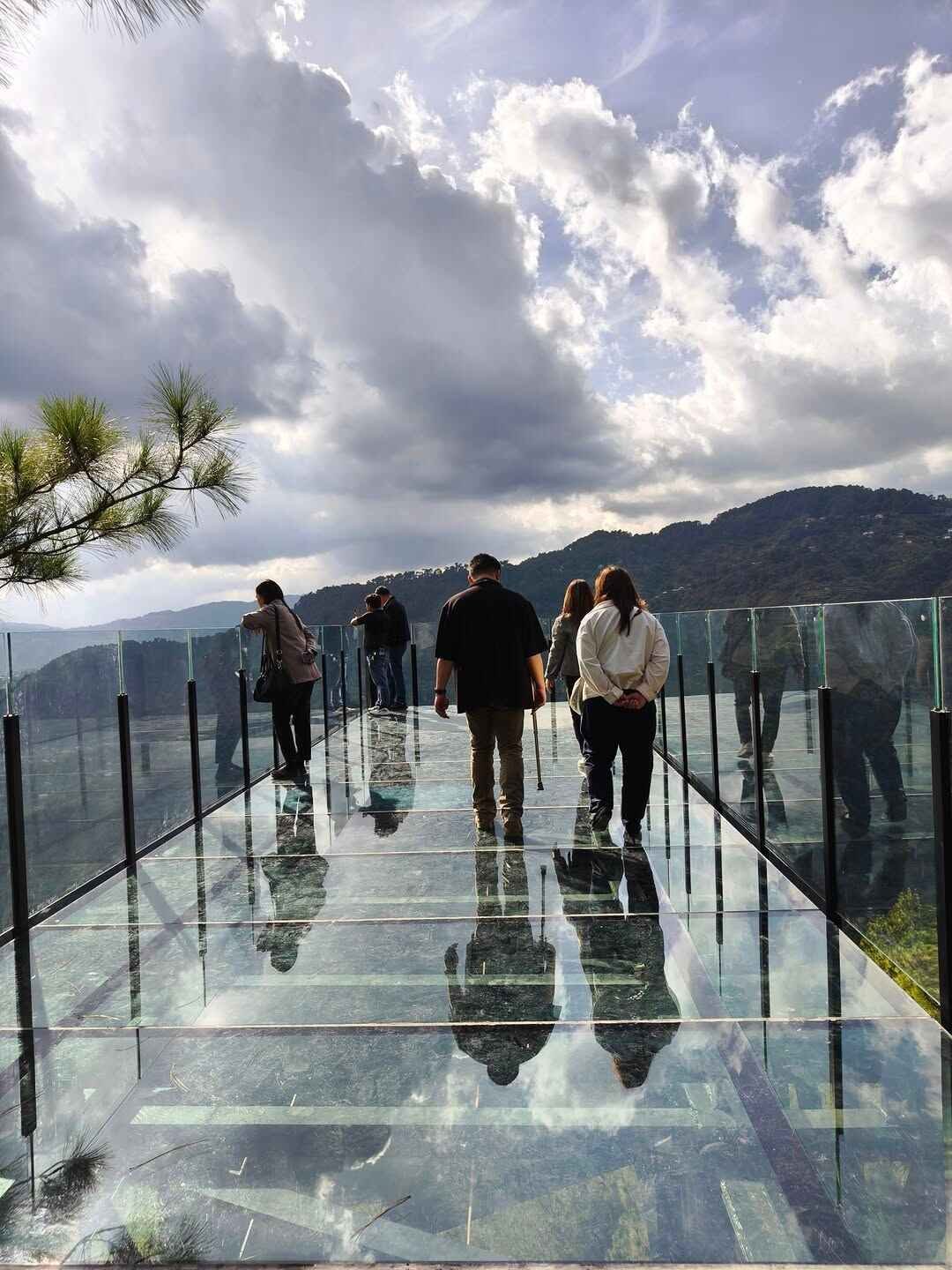
The Glass Walk (Alapaap): The cantilevered Alapaap Glass Walkway extends 19.81 meters over the edge of the ridge, elevated 65 feet above the pine canopy. The glass is bulletproof, constructed from three bonded layers, and rated for up to 50 people simultaneously, though management caps occupancy to prevent congestion. When I walked it, the psychological effect was immediate.
The pine canopy is directly below your feet and your brain argues with physics for the first few steps regardless of what you know about the engineering. The structure does not sway. The queue, however, does build fast. On a peak-season Saturday, the wait can rival the MRT by 10:00 AM. Hit the walkway at the 7:00 AM opening if you want a clear shot and no crowd.
The park’s built zones each carry a name drawn from Filipino and Cordilleran languages: Dagitab (spark) for the outdoor amphitheater, Silakbo (outburst of emotion) for the restroom facilities with A-line roofing and floating mountain-view mirrors, Binhi (seed) for the sustainability hall, Kalupi (pouch) for the gift shop, Dalisay (pure) for the all-wood children’s sensory play area, and Luntian and Kanlungan for the open-air and indoor event spaces. The Kanlungan Hall seats 40 to 60 people and was added to capture event bookings during the rainy season.
What You Will Actually Spend in Mt. Camisong
The ₱500 gate fee is the beginning, not the total. No outside food or drinks are permitted, and bags are inspected at the electronic entry gates. This is not a suggestion. The prohibition exists because the park runs a closed-loop biological composting system: all organic waste goes through vermicomposting beds managed by African Night Crawlers (nicknamed “Eugene” by the park team) for raw kitchen waste, and Black Soldier Fly larvae (“Hermie”) for post-consumer plate waste. Introducing external food contaminated with packaging or non-biodegradable residue breaks the chemical balance of the system. The rule is structural, not arbitrary.
That means you are eating inside the park. Here is what the tiers look like:
Muni-Muni Food Hall is the open-air lower deck with individual concessionaire stalls including Scrambled, Kettle Pop, Big Boy Birria, and Pica-Pica. Budget ₱250 to ₱500 per person.
Marahuyo Café is the mid-level al fresco restaurant integrated into the pine canopy. The menu centers on reimagined Filipino comfort food: Marahuyo Adobo (pork and chicken), Pigar Pigar Tapa, Chicken Inasal with sayote tops and a curried mango chutney. The Takipsilim is a purple iced tea made with blue ternate and lavender. Budget ₱400 to ₱800 per person.
Alapaap Dining sits directly beneath the glass walkway, enclosed in glass with panoramic sunset views. Chef Stan Suva runs a zero-waste kitchen. The Strawberry Cansi uses underripe tart strawberries from local farms as a souring agent alongside batwan for the beef broth. Reservations are mandatory during peak season. Budget ₱1,200 or more per person.
Samyo Private Picnic is a pre-booked experience in isolated forest clearings named Aduyyon (Abundance), Kamal (Unity), Siged (Good Values), and Shontog (Mountains). Baskets serve four to eight people: the Kanto street food basket is ₱1,400, Chicken and Waffles is ₱1,800, and Surf and Turf is ₱2,400.
A family of four eating a mid-range lunch at Marahuyo can easily cross ₱4,000 for the day when you add the base entry fees. Know this before you go, not after you sit down.
The Twilight Hack: If your priority is dinner ambiance and sunset views rather than the panoramic daylight landscape, enter after 5:00 PM. The 50% entrance discount cuts the adult fee to ₱250, and you still get Alapaap Dining under a fading sky. This is the most cost-effective way to experience the premium tier of the park.
Hydration note: Single-use plastic water bottles are confiscated at the gate. Bring a large empty insulated tumbler. The park’s free hydration stations dispense filtered spring water cold, and using them through a full 4.5-kilometer hike effectively offsets a portion of your entry cost.

Best Time to Visit Mt. Camisong
The best time to visit Mt. Camisong is November through April. The Cordillera’s dry season brings clear skies, cold air, and stable morning visibility. December through February sees ridge temperatures drop into single digits Celsius before sunrise. Bring a proper jacket, not a light hoodie.
The fog reality is non-negotiable regardless of season: the mountain ridge is typically engulfed by cloud cover by 11:00 AM. Visitors who arrive at noon on a clear forecast day often find themselves staring into opaque gray mist within the first hour. The viewing window is real and it is narrow. Arrive as close to the 7:00 AM opening as possible.
During typhoon season from July through September, the ridge road into Loacan becomes slick and the park may reduce hours or close during heavy weather. My September 2026 visit confirmed that the fog window is even shorter in the rainy season, the approach road is genuinely treacherous in heavy rain, and the crowds are lighter at roughly 1,500 daily visitors compared to dry-season peak days that have reached 3,500. If you have flexibility, visit between November and April. If September is what you have, go early, leave early, and check the park’s official social media the night before.
On weekends year-round: The glass walkway queue builds by 9:00 AM. The electric shuttle from Pacdal fills before its first departure. Weekdays are the correct choice if you have them.

Who Should Go and Who Should Skip Mt. Camisong
This park is the right choice for:
Multi-generational groups where someone in the party cannot manage roots, rocks, or sustained inclines. The 200-meter Easy Trail gets a grandparent and a toddler to the ridge view with no sweat equity required. The Dalisay children’s play area is built entirely from natural wood.
Eco-conscious visitors who are willing to pay a premium for verifiable environmental infrastructure. The solar grid, the sewage treatment plant, and the biological waste system are real and operational, not greenwashing on a signboard.
Content creators. The Silakbo restroom facilities alone, with their floating mirrors and A-line mountain-view roofing, are unlike anything else in the Cordilleras. The cantilevered glass, the wire art, and the pine-forest dining terraces produce photography that competing Benguet destinations cannot match.
Skip Mt. Camisong if:
You want a real mountain climb. There is nothing here that will test your legs or your nerve. Mt. Ulap in Ampucao, Itogon is the correct destination: an actual trail with roots, rocks, sustained elevation, and 4 to 6 hours of honest physical effort. Mt. Camisong is a curated leisure park that substitutes financial expenditure for physical exertion.
You are traveling on a tight budget. Between the ₱500 gate fee and the mandatory in-house dining (the only food option), a solo visitor should expect to spend at least ₱800 to ₱1,300 for the day, and a family of four can easily reach ₱4,000. Budget travelers are far better served by the Ambuklao Dam viewing decks in the same municipality, which cost little to nothing and allow outside food.
You are bringing a pet. The no-pets policy is absolute, and it extends to the parking area. Not on the trail, not at the dining deck, not in the lot. Arrange boarding in Baguio before you come.
Nearby Places to Visit After Mt. Camisong
Itogon and the surrounding Benguet area has enough to fill a full day trip from Baguio if you time your Mt. Camisong visit to the morning hours.
Mt. Ulap in Ampucao, Itogon is the nearest serious hiking alternative. The average person takes 4 to 6 hours to complete the loop. It requires roots, rocks, and real elevation. Do not do both in the same day unless you are prepared for a very long one.
Northern Blossom Flower Farm in Atok is about an hour deeper into Benguet and worth combining if you are already driving up from Baguio.
Strawberry Farm in La Trinidad is about 30 minutes from Itogon and directly on the road back to Baguio, making it the easiest add-on to the day.

Frequently Asked Questions About Mt. Camisong
What is the Mt. Camisong shuttle schedule from Baguio?
The free electric shuttle departs from the Mint Green waiting shed near the Pacdal Police Station in Baguio (across from Rizal Elementary School). Inbound trips to the park run from 6:10 AM to 6:00 PM. Return trips from the park to Baguio run until 8:00 PM. Each shuttle carries 21 to 26 passengers maximum and fills on a strict first-come, first-served basis. On peak weekends, the early-morning departures fill before 6:30 AM.
What is the last time you can enter the Mt. Camisong trails?
The last trail entry is 4:00 PM. The park closes at 8:00 PM, but the trails stop accepting new entrants at 4:00 PM. If you arrive in the early afternoon, you have a narrower window than the closing time suggests.
Is there parking at Mt. Camisong?
Parking is available on site. The main parking area doubles as the surface mount for the 363-panel solar array, which forms the canopy roof of the lot. Two 22kW EV charging stations are available for electric vehicles.
Are pets allowed at Mt. Camisong?
No. The prohibition on pets is non-negotiable and covers the trails, the dining areas, and the parking lot. Park management cites wildlife protection and sanitation requirements. There are no exceptions.
Can you bring outside food into Mt. Camisong?
No outside food or drinks of any kind are permitted. Bags are inspected at the electronic entry gates before you enter. The prohibition is tied directly to the park’s biological composting system, which requires controlled organic inputs. Budget for in-house dining before you go.
Are drones allowed at Mt. Camisong?
Drones are prohibited throughout the park.
How much does a day at Mt. Camisong cost in total?
The gate fee for adults is ₱500 (or ₱250 after 5:00 PM). Add food: the Muni-Muni Food Hall runs ₱250 to ₱500 per person, Marahuyo Café runs ₱400 to ₱800 per person, and Alapaap Dining runs ₱1,200 or more per person. A realistic solo budget for a full-day visit at the mid-range tier is ₱900 to ₱1,300. A family of four eating at Marahuyo should budget ₱3,500 to ₱4,500 for the day including entry.
Is Mt. Camisong open during the rainy season?
The park is open year-round, but the rainy season (May through October) brings consistent cloud cover that closes in by 11:00 AM, often earlier. The approach road through Itogon becomes slick in heavy rain. Always check the park’s official social media the night before a rainy-season visit, as extreme weather can prompt reduced hours or temporary closure.
How long does it take to visit Mt. Camisong?
The Easy Trail to the glass walkway and viewing deck takes 15 to 20 minutes one way. The Intermediate Trail takes 30 to 40 minutes at a steady pace. The full 4.5-kilometer Kahilom loop takes approximately 2 hours of walking, not counting time at the glass walk queue or meals. Most visitors who do the full trail and sit down for lunch spend 3 to 5 hours total inside the park.
Final Verdict
Mt. Camisong Forest Park and Events is a premium commercial eco-park, and it works exactly as designed for the visitors it was designed for. The infrastructure is real: 201 kW of solar power, a functioning sewage treatment plant, a biological composting system, and zero-emission shuttles from the city. The views from the glass walkway and the Alapaap ridge are the best accessible mountain panoramas in the immediate Baguio area.
The honest caveat is the financial contract. You pay ₱500 to enter a park that then prohibits you from bringing your own food. For a family, that is an expensive day before anyone has ordered anything. For a solo traveler who commits to the full 4.5-kilometer loop and uses the free hydration stations, the math is more defensible. For someone who walks 200 meters, takes a photo, and leaves, it is not.
My September 2026 visit confirmed that the park has matured meaningfully since the early 2025 complaints about construction grinders and fresh paint. Phases 1 and 2 are coherent and operational. But it also confirmed that the fog closes in fast, the last trail entry at 4:00 PM is enforced, and the Ambuklao Road home is not a road you want to be on in the dark without knowing it.
Go early, bring an empty tumbler, budget honestly for food, and leave by 6:00 PM. Do all four of those things and Mt. Camisong delivers exactly what it promises.