Mt. Amuyao is a 2,702 MASL major climb in Barlig, Mountain Province, rated 6/9 to 8/9 difficulty depending on the route and conditions. The standard Mt. Amuyao Barlig trail is an out-and-back from Sitio Macalana. It takes 5 to 8 hours to summit and is done as a 2-day, 1-night trip from Manila.
It reliably delivers a sea of clouds at sunrise from December to February, and regulars rate it more consistent than Mt. Pulag for that window. I was on this trail in October 2026, having covered 69 of the 82 provinces since 2015. Amuyao is still one of the hardest single climbs I have done for the elevation gained.
Key Takeaways
- 2,702 MASL elevation, with over 1,100 meters of elevation gain from the Macalana jump-off to the summit.
- Trail class: Major Climb, 6/9 to 8/9 difficulty. The Barlig out-and-back is rated 6/9 on a dry trail; recent climbers and the Barlig Tourism Office flag it closer to 8/9 in wet conditions or when factoring in cold-weather exposure.
- A guide is mandatory under LGU rules, at a ratio of 1 guide for every 5 climbers. Walk-ins are possible but a reservation in advance is strongly recommended.
- Best months: November to April. The sea of clouds is most reliable December to February. The trail is often suspended July to October.
- Bus fare from Manila to Bontoc runs ₱910 to ₱1,300 depending on bus class (as of October 13, 2026). Fares here follow diesel and gas prices.
- The Mt. Amuyao cross to Batad or Banaue is not recommended for independent hikers in 2026. Coordinate with both Barlig and Banaue tourism offices before attempting it.
Table of Contents

Where Is Mt. Amuyao?
Mt. Amuyao stands at 2,702 MASL (meters above sea level) in Barlig, Mountain Province, in the Cordillera Central range of northern Luzon. It is the highest peak in Mountain Province and the ancestral domain of the Igorot and Ifugao peoples. The official jump-off is at Sitio Macalana, Barangay Macalana, Barlig, Mountain Province.
How to Get to Mt. Amuyao from Manila
From Manila, the route to the Mt. Amuyao jump-off is a two-leg trip: an overnight bus to Bontoc, then a jeepney (a shared local minibus) to Barlig.
Manila to Bontoc by bus:
Coda Lines operates overnight buses from Cubao and Pasay to Bontoc. Travel time is about 9 to 10 hours.
Buses typically depart at 8:00 PM and 9:00 PM. Book at least one week ahead through Biyaheroes or the Coda Lines website.
Bus fares to Bontoc as of October 13, 2026 are listed below. Fares here follow diesel and gas prices.
| Bus Class | Fare Range |
|---|---|
| Express | Check current fares at the Coda Lines website |
| VIP | ₱910 to ₱1,300 |
The VIP class is worth the difference for overnight travel: lazyboy seats and an onboard restroom make the 10-hour ride manageable.
Bontoc to Barlig by jeepney:
From the Bontoc terminal, take the public jeepney to Barlig. Travel time is about 2 hours. The fare is ₱85 to ₱200.
The jeepney to Barlig departs once a day at around 1:00 PM to 2:00 PM. If you miss it or are travelling as a group, you will need to hire a private jeepney from Bontoc. The kuya (the guy at the terminal) can point you to drivers who do the Barlig run.
The jeepney drops you at Barlig Poblacion, not at the jump-off. From the Poblacion, you proceed to the Municipal Tourism Office to register, then continue to Sitio Macalana, Barangay Macalana, which is the official jump-off.
If you ride top-load on the jeepney for the views, bring a windbreaker and a face mask. The road to Barlig is dusty, and the wind chill cuts hard.

Permits, Fees, and Guide Rules
Registration at the Barlig Municipal Tourism Office is the first stop before you go anywhere near the trail. The MTO is near the Barlig Municipal Hall in the Poblacion. Walk-ins are allowed, but large groups must coordinate in advance through the Barlig Tourism Facebook page to secure guides and slots.
A Medical Certificate stating fitness for strenuous activity is required. A generic “fit to work” certificate is not accepted. The tourism officer checks specifically for clearance for mountaineering or strenuous physical activity. Hikers with heart conditions or severe asthma may be denied a permit. If you are coming from Manila, get this from any licensed physician or sports medicine clinic before you leave — do not assume you can get one in Bontoc on short notice.
You also need a DENR permit before you arrive at the MTO. A daily quota applies, and walk-ins without a confirmed DENR slot are turned away. For 2026 climbs, most commercial organizers include the DENR slot in their package and handle the reservation for you. If you are going independent, coordinate directly with the Barlig Tourism Office before booking any transport, and confirm your DENR permit is secured. CHECK: name or link for the DENR office or online portal where independent hikers can apply for a Mt. Amuyao DENR slot
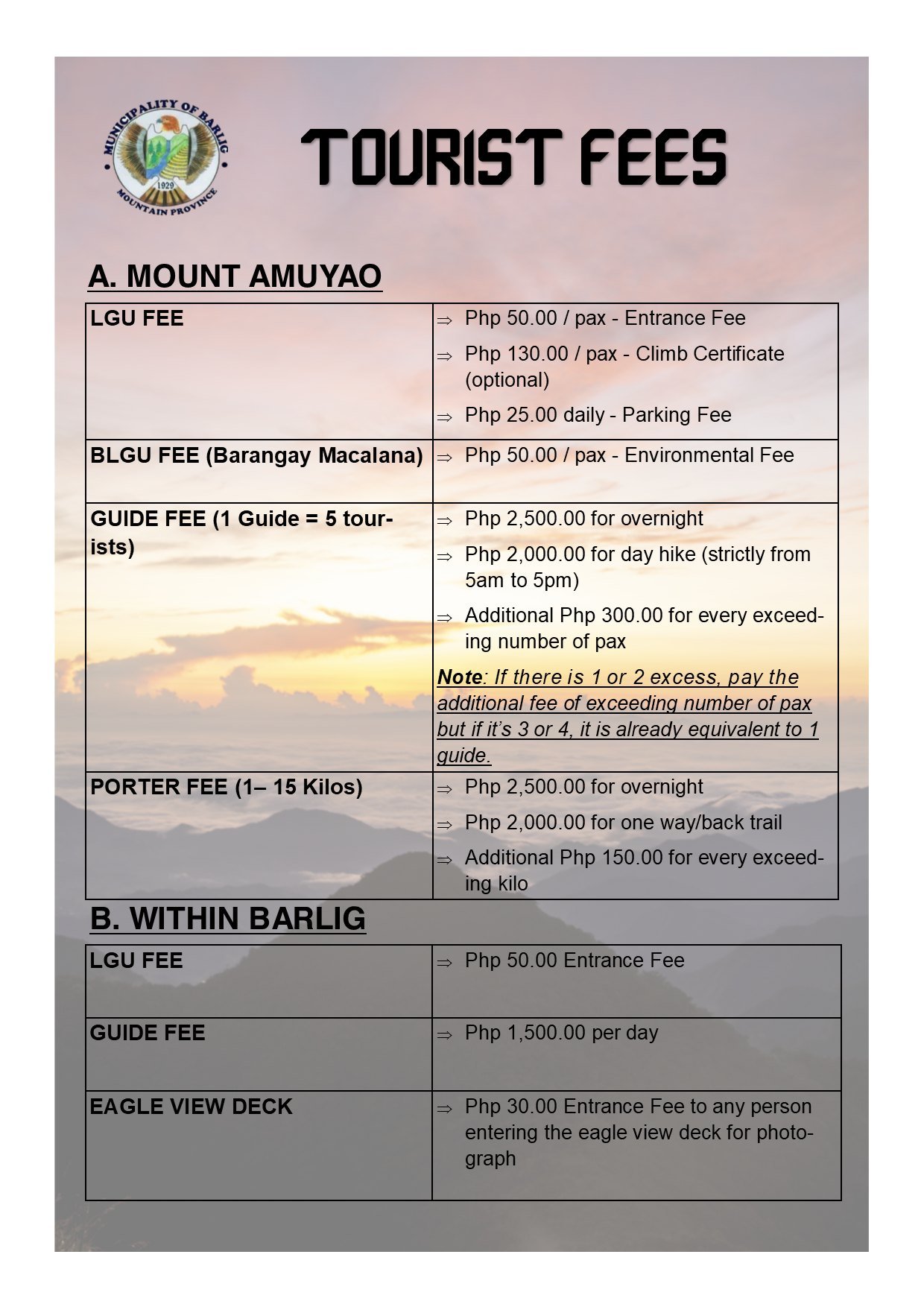
Here is every fee you will pay on this climb:
| Fee | Amount | Where Paid |
|---|---|---|
| Tourism fee | ₱20 to ₱25 per person | Municipal Tourism Office, Barlig Poblacion |
| Environmental fee | ₱50 per person | Barangay Macalana |
| Guide fee (day hike) | ₱1,500 to ₱2,000 | Arranged at MTO |
| Guide fee (overnight) | ₱2,000 to ₱2,500 | Arranged at MTO |
| Excess person surcharge | ₱100 per person beyond 5-climber ratio | Arranged at MTO |
| Porter (up to 15 kg) | ₱2,500 | Arranged at MTO |
| Bunkhouse at summit | ~₱100 per head | Paid to summit caretaker |
A guide is mandatory at a ratio of 1 guide for every 5 climbers. If your group has 6 people, you have two options: hire a second guide, or pay the ₱100 excess person surcharge for each climber beyond the ratio. The MTO will advise which applies on the day based on guide availability.
The guide fee range reflects what the MTO desk has posted for straightforward groups. The lower end applies to simple day-hike groups; overnight climbs and larger parties land closer to the higher end.
For joiner-climb packages that include round-trip van from Manila, registration, guide, and a climb certificate, total package prices run around ₱4,000 per person. The Medical Certificate and DENR permit requirements still apply even on a joiner climb — your organizer handles the slot, but the certificate is on you.

How Difficult Is the Mt. Amuyao Barlig Trail?
The Barlig backtrail is rated 6/9 on a dry trail. With cold-weather exposure or wet mossy forest conditions, the Barlig Tourism Office and most hikers place it closer to 8/9. Mt. Amuyao difficulty level comes primarily from one thing: relentless vertical gain of over 1,100 meters across a compressed horizontal distance, meaning the elevation hits you fast with almost no flat ground to recover on, and no switchbacks on the steepest sections.
The trail passes through four vegetation zones:
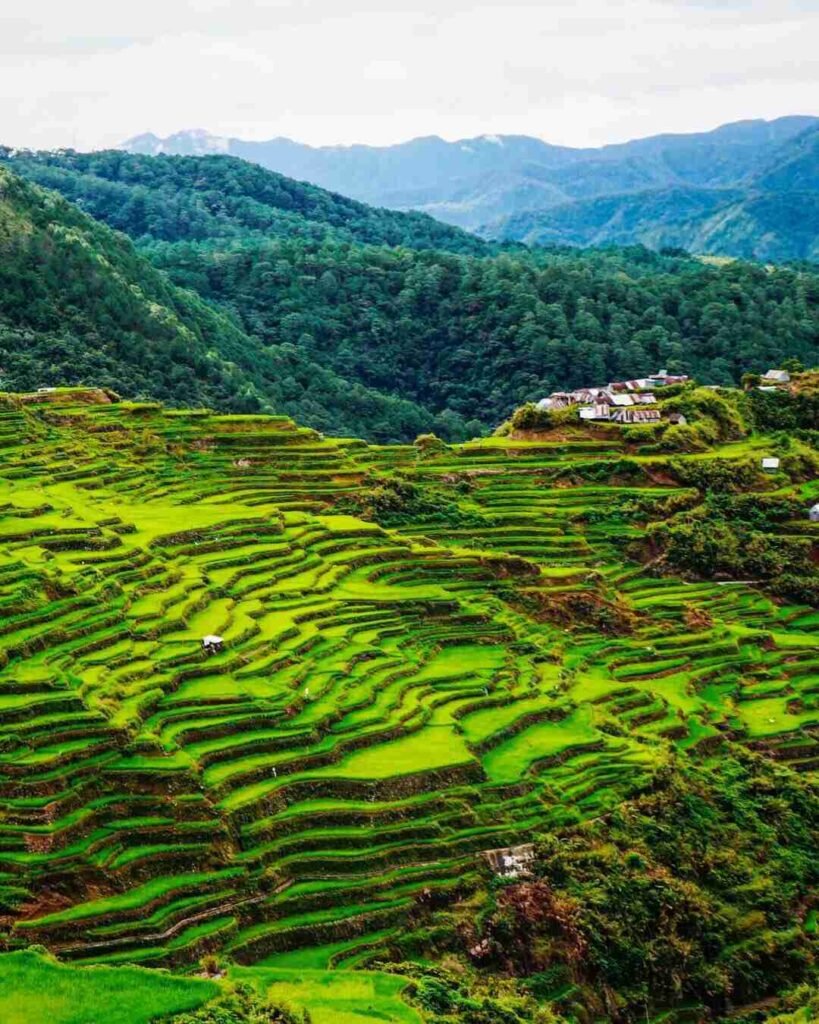
Tropical moist forest and rice terraces (1,600 to 1,800 MASL): The only section where the gradient eases. Walking beside the stone-walled Barlig rice terraces at the start is the calmest moment of the entire climb.
Pine forest transition (1,800 to 2,000 MASL): The incline steepens. Steps begin here and do not stop.
Mossy forest (2,000 to 2,400 MASL): Dense, atmospheric, and the slipperiest section on the trail. The humus underfoot can be 10 cm deep. Limatik (blood leeches) appear here in wet weather, and they are aggressive enough that most hikers check their legs every 30 minutes through this zone.
Summit grassland and bonsai ridge (2,400 to 2,702 MASL): This is where the Demonyo Trail begins. The Demonyo Trail is the exposed knife-edge ridge section that finishes the climb, and the name fits: it is steep, open to wind, and cold. I climbed in October, outside the recommended window — conditions were harder than they needed to be, with fog thick enough to cut visibility to a few metres on the ridge.
The feature that defines the Mt. Amuyao Barlig trail difficulty is the “Infinite Stairway,” an unrelenting series of concrete steps and carved earth risers built into the mountainside that runs through the middle and upper trail. It is man-made in origin, reinforced with concrete on the steeper sections, though the earth risers between steps are rough and uneven. Roughly 80 to 90 percent of the ascent is steps. The repetitive motion destroys your quadriceps going up and your knees coming down.
Ascent time from Macalana to the summit is 5 to 8 hours. Descent time is 3 to 5 hours.
Mt. Amuyao difficulty makes this unsuitable for first-time hikers. The minimum realistic benchmark before attempting it is two or three completed overnight major climbs. If you are still building up your Cordillera legs, check what to expect from a Major Climb rating in the Philippines before committing to a slot here.
Mt. Amuyao Traverse
The traverse routes — most commonly Barlig to Batad or Batad to Mayoyao — are not open to independent hikers as of 2026. The local government units on both sides restrict these to LGU-coordinated events run through commercial organizers. If you want to do the traverse, you need to book through an organizer who has already coordinated with both the Barlig and Banaue or Mayoyao tourism offices. Walk-in traverse attempts will not be approved at the trailhead. Check with the Barlig Municipal Tourism Office for the current list of accredited organizers before you plan your dates.
Campsites and Water Sources on the Trail
Mt. Amuyao has two places to stop overnight: Camp 1 at the Barlig Viewpoint (about 2,400 MASL) and the summit at 2,702 MASL. Most hikers push through Camp 1 and sleep at the summit.
Camp 1 / Barlig Viewpoint (~2,400 MASL): This is a mid-mountain clearing in the open, with a spring water source nearby. It is the most reliable water point on the trail, so fill your bottles here before the final push to the summit. The water source just below the summit can run dry in the dry season, and your guide will tell you on the day whether to haul extra water for the last section. CHECK: Is Camp 1 sheltered from wind, or fully exposed? Is there flat tent space for a full group?
Summit (2,702 MASL): The summit has a concrete bunkhouse maintained by caretakers. The fee is about ₱100 per head, paid directly to the caretakers on the spot — this is separate from the fees you already paid at the MTO and Barangay Macalana. Bring small bills; the caretakers may not have change.
The bunkhouse is first-come, first-serve, and space is limited. Tent pitching is permitted on the open ground outside near the relay towers. CHECK: Is tent pitching a guaranteed right for any group, or is it subject to caretaker permission? This matters for safety planning in cold weather. Either way, carry a full cold-weather sleeping system. Summit temperatures in December to February drop near or below freezing, and you cannot count on getting a bunkhouse spot.
There are no toilet facilities at the summit. Follow Leave No Trace practices: carry a trowel, pack out waste, and dispose of all food scraps properly. Food waste that is left behind attracts non-native rats, which are a direct threat to endemic species like the Amuyao tree-mouse (Musseromys inopinatus).

The Mt. Amuyao Sea of Clouds and Sunrise
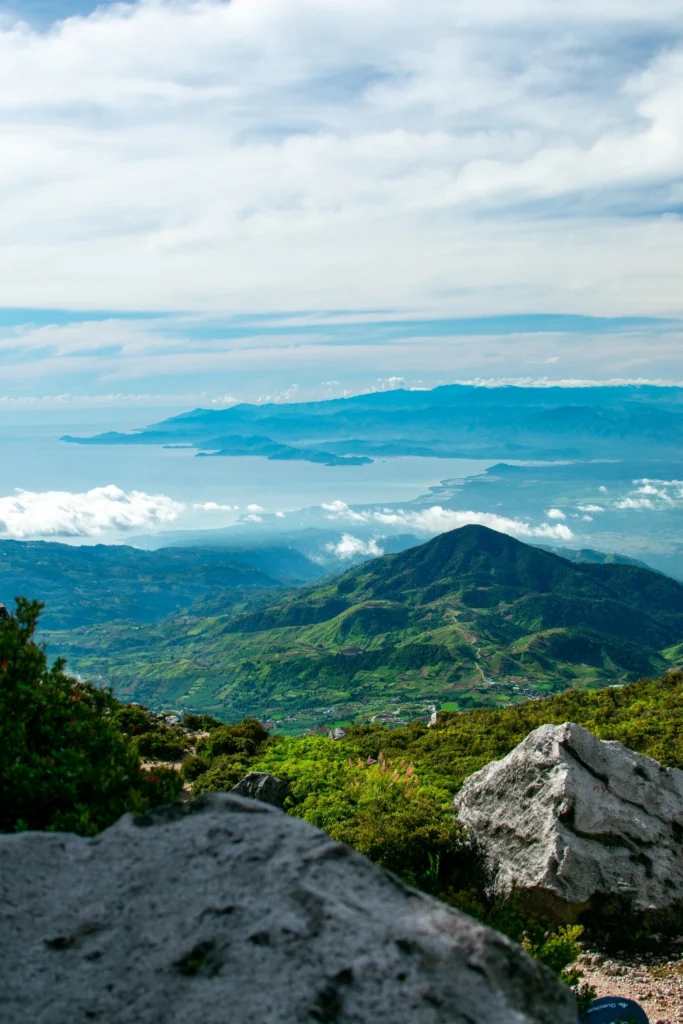
The Mt. Amuyao sea of clouds at sunrise is the main reason most people climb here, and it delivers more consistently than almost anywhere else in the Cordilleras. The sea of clouds is most reliable from December to February.
During this period, cold, dry air sits over the valleys of Ifugao and Cagayan at night. Low clouds then pool below the summit ridge at dawn.
Some hikers rate the Mt. Amuyao sea of clouds as more reliable than Mt. Pulag. The reason is geography: Amuyao rises sharply from the rice terraces and river valleys on all sides.
When clouds form overnight, they settle below the summit without being disrupted by adjacent ridges. The summit offers a 360-degree view covering Benguet to the west, Abra to the northwest, Kalinga to the north, Cagayan and Isabela to the northeast, and Ifugao to the south.
The comparison between Mt. Amuyao vs. Mt. Pulag comes down to this: Pulag is more organized, with a well-marked trail and higher visitor volume. Amuyao is rawer and quieter, and the reward at the top feels proportional to what you put in.
For everything you need to know about planning the other side of that comparison, the Mt. Pulag Ambangeg trail guide covers the route, fees, and cloud conditions in full.
December to February also brings blooming wildflowers in the mossy forest zone and the bonsai ridge, which adds a second reason to time the climb for that window.
Best Time to Climb Mt. Amuyao
The best months to climb Mt. Amuyao are November to April, the dry season.
The peak window is December to February, when:
- Cold air settles over the valleys overnight
- The sea of clouds forms most reliably at dawn
- Wildflowers bloom across the mossy forest and bonsai ridge
Avoid the trail from July to October. Typhoon season brings heavy rain that makes the mossy forest floor dangerously slippery, and limatiks (blood leeches) infest the entire mossy zone during wet months. The LGU often suspends the trail formally during this period, and guides may refuse to take groups out regardless.
The traverse routes — Barlig to Batad, Batad to Mayoyao — follow the same seasonal logic but come with an extra layer of restriction. As of 2026, these crossings are not open to independent hikers. Only LGU-coordinated climbs run through commercial event organizers are actively operating on the traverse. “Restricted” here means that if you show up without a coordinated permit from both ends, guides will refuse to take you, and you risk being turned back at a mid-trail checkpoint or stranded between two jurisdictions. There is no solo workaround.
The fee dispute between Barlig and Banaue or Mayoyao LGUs is an ongoing issue.
If the cross is your goal, contact the Barlig Tourism Facebook page and the Banaue tourism office separately, well before your travel date. Do this at least a month out, because 2026 traverse slots are being managed by organizers who need lead time to clear permits from both LGUs.
Day Hike vs. Overnight: Sample Itineraries
The recommended route for 2026 is the Barlig backtrail (out-and-back) from Sitio Macalana. The Mt. Amuyao cross to Batad or Banaue is restricted for independent hikers and is only actively operating through LGU-coordinated commercial events.
Overnight itinerary (recommended for most hikers):
- Day 1, early morning: Arrive Bontoc after overnight bus from Manila.
- Day 1, around 1:00 PM: Board jeepney from Bontoc to Barlig. Arrive about 3:00 PM.
- Day 1, upon arrival: Register at the Municipal Tourism Office, pay fees, confirm guide.
- Day 1, late afternoon: Rest in Barlig Poblacion. Eat a full meal before the climb. The MTO can refer you to community homestays in the Poblacion; ask when you register.
- Day 2, early morning (around 5:00 to 6:00 AM): Begin ascent from Sitio Macalana.
- Day 2, about 10:00 AM to 1:00 PM: Reach the summit after 5 to 8 hours.
- Day 2, afternoon: Rest at the summit bunkhouse or tent area.
- Day 3, pre-dawn: Wake for sunrise and sea of clouds.
- Day 3, after sunrise: Begin descent. Allow 3 to 5 hours back to the jump-off.
- Day 3, early afternoon: Return to Barlig, then jeepney back to Bontoc for the Manila bus.
Day hike is possible for very fit hikers with an early start. The ascent alone is 5 to 8 hours, meaning a round trip of 8 to 13 hours from the jump-off.
You miss the sea of clouds at sunrise and put extreme pressure on your knees on the descent. The overnight version is strongly recommended.
For hikers who want a similar Cordillera ridge experience with a shorter approach, Mt. Kupapey and Mt. Fato in Mountain Province offer a comparable ridgeline setting at a lower difficulty rating.
What to Pack for Mt. Amuyao
The mossy forest zone and the exposed summit ridge drive most of the gear decisions here.
Clothing and warmth:
- Thermal base layer and a mid-layer fleece. Summit temperatures in December to February drop near or below freezing.
- Waterproof rain jacket. Even in the dry season, the mossy forest holds moisture and the summit is frequently in cloud.
- Buff or neck gaiter and gloves for the summit ridge.
Footwear and trail gear:
- Waterproof trekking boots with ankle support. The mossy forest humus is slippery and unstable underfoot.
- Trekking poles. Non-negotiable on the descent of the Infinite Stairway.
- Gaiters to block limatiks (blood leeches) in the mossy forest section.
Water and food:
- Carry at least 2 to 3 liters from the Camp 1 spring before the final push to the summit. The water source below the summit can run dry.
- High-calorie food for the ascent. There are no stalls on the trail.
Leave No Trace essentials:
- Trash bags for all food waste. Food scraps that are left on the trail attract non-native rats, which directly threaten the Amuyao tree-mouse (Musseromys inopinatus), an endemic species found only on this mountain. The LNT rule here has a concrete conservation reason behind it.
Rules, Ancestral Domain, and Conservation
Mt. Amuyao is the ancestral domain of the Igorot and Ifugao peoples, and the rules on the mountain reflect that. Expedition leaders are responsible for the behavior of every member of their group, and the Barlig Tourism Office holds the leader accountable if a member causes damage or disturbance.
The trail passes through Barangay Lunas, and the sacred burial caves there must not be entered, touched, or photographed without explicit permission from community elders. These are active ancestral sites, not tourist attractions.
Leave No Trace compliance is mandatory. The specific reason matters here: food waste left on the trail attracts non-native rats into the mossy forest and bonsai zone. This directly threatens the Amuyao tree-mouse (Musseromys inopinatus), a rodent species found nowhere else in the world. The Amuyao tree-mouse (Musseromys inopinatus) has no natural defense against introduced rat competition, so every wrapper and food scrap you carry back down is a direct act of conservation.
The mountain sits within a broader Cordillera cultural corridor. If you are extending your trip north into Kalinga, the Buscalan village visit for Apo Whang-Od’s traditional Kalinga tattoo follows the same principles of community respect and advance coordination.
Side Trips Near Barlig and Mountain Province
Barlig sits on the Bontoc-to-Banaue road, which makes two extensions easy to add without backtracking.
Banaue Rice Terraces: From Bontoc, the road to Banaue passes through the same mountain corridor. The Banaue Rice Terraces and the wider Ifugao UNESCO landscape are a natural follow-up if you have a day after descending from Amuyao.
Bakun Trio, Benguet: Before I did Amuyao, the Bakun Trio cross in Benguet was the climb that got my legs ready for the Infinite Stairway.
Frequently Asked Questions About Mt. Amuyao
Is a guide mandatory on the Mt. Amuyao trail?
Yes. A guide is required by LGU rule for every group. The ratio is 1 guide for every 5 climbers.
You cannot proceed past the registration point without a confirmed guide. The Barlig Municipal Tourism Office assigns guides on the day, but large groups must coordinate in advance to guarantee availability.
What is the daily quota and how do you book a slot?
A daily quota applies to Mt. Amuyao. The Barlig Tourism Office manages slot availability. For full details on how the quota works and how to secure a slot, see the Permits section above.
Can a beginner hike Mt. Amuyao?
No. Mt. Amuyao difficulty level is rated Major Climb, 6/9 to 8/9. The minimum realistic preparation is two or three completed overnight major climbs on mountains of comparable elevation gain.
The Infinite Stairway places exceptional stress on the knees and cardiovascular system. First-time hikers risk injury on the descent.
Is the Mt. Amuyao traverse open to independent hikers?
The Mt. Amuyao cross to Batad or Mayoyao is not recommended for independent hikers in 2026. LGU fee disputes between Barlig and Banaue have made uncoordinated cross attempts unreliable.
Hikers attempting it without pre-arranged guides from both ends have been stranded or charged unexpected fees mid-trail. Only coordinate the cross through a commercial organizer or by contacting both the Barlig and Banaue tourism offices well in advance.
Where exactly do you register for Mt. Amuyao?
Register at the Barlig Municipal Tourism Office near the Barlig Municipal Hall in the Poblacion. You pay the tourism fee here and receive your guide assignment. After registration, proceed to Barangay Macalana to pay the environmental fee before reaching the jump-off at Sitio Macalana.
When does the Mt. Amuyao trail close?
The trail is strongly discouraged and often officially suspended from July to October due to typhoon and monsoon conditions. The mossy forest floor becomes dangerous, and limatik infestations make the zone miserable. Confirm with the MTO before booking if you are near the edges of the season.
What is the cell signal like at the summit?
Cell signal at the 2,702 MASL summit is stronger than most people expect from a Cordillera climb. The PT&T, ABS-CBN, and GMA relay transmitters installed at the top mean you can usually send messages and make calls. Signal on the lower trail sections, particularly inside the dense mossy forest, is unreliable.
Is Mt. Amuyao Worth the Climb?
Mt. Amuyao is worth it for conditioned hikers who are honest about what they are signing up for. The Infinite Stairway is as punishing as its name. The cold at the summit in October was sharper than I expected.
The descent will test your knees regardless of how fit you are. That said, the sea of clouds from the summit ridge on a clear December or January morning is the kind of view that makes every concrete step feel like a fair trade.
Who should go: hikers with two or three major climbs behind them, good knees, and a full cold-weather sleeping system. The rawness of the trail, the rice terraces at the start, and the quiet at the top are things Pulag, for all its organization, cannot match.
Who should skip it:
- Anyone who dislikes long bus rides (the Manila-to-Bontoc leg alone is 9 to 10 hours before the climb even starts)
- Anyone with a history of heart or knee problems
- Anyone expecting a well-paved, well-signposted experience
The trail does not ease up until it ends.” or cut entirely If you want to build toward Amuyao from a shorter Cordillera challenge first, Mt. Kabunian in Bakun, Benguet is the most direct stepping stone for the elevation and terrain type.